Finding Forces and Masses in a Hanging Weight System

  • Thread starter Thread starter BearMan
  • Start date Start date
  • Tags Tags
    String Weight
Click For Summary

Homework Help Overview

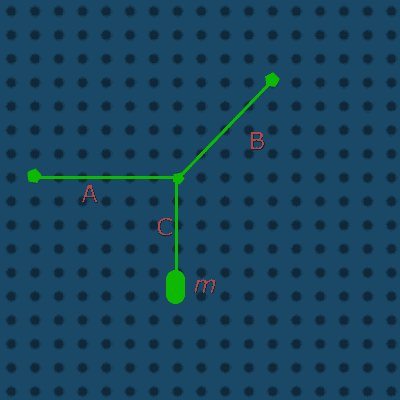
The discussion revolves around a physics problem involving a weight suspended by three threads, where one thread is horizontal and another forms a 45° angle with the horizontal. The original poster seeks to determine the force in the angled thread and the mass of the weight, given a known force in the horizontal thread.

Discussion Character

  • Exploratory, Assumption checking, Conceptual clarification

Approaches and Questions Raised

  • The original poster attempts to use the Pythagorean theorem to find the force in the angled thread but expresses uncertainty about their approach. Other participants question the equilibrium of forces at the junction of the threads and emphasize the importance of angles and forces in tension.

Discussion Status

Participants have provided hints and guidance regarding the relationship between the forces in the threads and the concept of equilibrium. There is an ongoing exploration of the forces involved, with some participants suggesting that the force in the angled thread must counterbalance the known force in the horizontal thread.

Contextual Notes

The original poster notes that the assignment was not part of the current curriculum, indicating a potential lack of familiarity with the concepts involved. There is also a mention of the need for relevant equations, suggesting that participants are encouraged to share applicable formulas.

BearMan
Messages
3
Reaction score
0
Just started with physics, I am not very good.

Homework Statement


A weight with the mass m is hanging in one thread (C) that is connected to two other threads (A and B). Thread A is completely horizontal, while thread B is forming a angle of 45° with the horizontal plane. All threads are connected in the way shown in the image. The force in thread A is 15N.
My task is to figure out the force in thread B and the mass of the weight.
g77OjOs.png


Homework Equations


The Attempt at a Solution


I thought that a simple use of the Pythagorean theorem would give me the power in thread B; the triangle is 4 in height, 4 in weight. The A "contains" 15N of energy and is 6 units long, therefore i divided 15 by 6 and got 2.5.
15/6=2.5
(4*2.5)^2+(4*2.5)^2=200
√(200)≈14.14N=B
That is wrong, I am sure.

I am not really sure how to solve this and I do not want the numerical answers to the questions, but rather tips and methods to solving the task.
We were not really supposed to do this perticular assignment (our teacher told us it was "stuff we had not gone through yet") but I am curious to know how one should go about solving it.
 
Physics news on Phys.org
You are given the force in thread A. What do you know about the force(s?) on the point where A, B and C are joined togethrer, if this point isn't moving ?
 
Oh, and: Hello ursus and welcome to PF!

The grid is distracting you. A force on a string at one end is carried along to the other end, irrespective of the length of the string. You can check that with a spring (or a rubber band), a piece of (lightweight) string and a suitable weight.

The nice thing about strings is that they can only exercise a force along the (taut) string. (if not "strung" then no force at all :smile:).

Bottom line: the length of the various strings doesn't matter. The angles do. So if string A is pulling to the left and they tell you the force is 15 N, something else has to pull back with the same force -- otherwise there is no equilibrium and movement would result.

In your case, wirde C can't do that, because all it does is pull in the vertical direction. Leaves only B. B is pulling up and to the right with equal forces, hence the 45 degree angle.

Enough "hints" for now, go to work with this and either come with new questions, or with the solution ! Good luck.

In the mean time, if you think something qualifies as "relevant equation", be sure to post it !
 
BvU said:
Oh, and: Hello ursus and welcome to PF!

The grid is distracting you. A force on a string at one end is carried along to the other end, irrespective of the length of the string. You can check that with a spring (or a rubber band), a piece of (lightweight) string and a suitable weight.

The nice thing about strings is that they can only exercise a force along the (taut) string. (if not "strung" then no force at all :smile:).

Bottom line: the length of the various strings doesn't matter. The angles do. So if string A is pulling to the left and they tell you the force is 15 N, something else has to pull back with the same force -- otherwise there is no equilibrium and movement would result.

In your case, wirde C can't do that, because all it does is pull in the vertical direction. Leaves only B. B is pulling up and to the right with equal forces, hence the 45 degree angle.

Enough "hints" for now, go to work with this and either come with new questions, or with the solution ! Good luck.

In the mean time, if you think something qualifies as "relevant equation", be sure to post it !

Thanks a lot. Did not expect that it would require almost no calculations. B is the only thing holding C from going to the left and since there is no motion, B must pull to the right with a force of 15 N. And also, since it is tilted at 45° then the force up must be equally as strong.
The weight:
15*9.82=1.47kg

And the B thread:
√(15^2+15^2)≈21.2 N
 
Looks good, except the weight. Could you check that ?
 

Similar threads

  • · Replies 38 ·
2
Replies
38
Views
6K
  • · Replies 17 ·
Replies
17
Views
4K
  • · Replies 12 ·
Replies
12
Views
1K
  • · Replies 21 ·
Replies
21
Views
2K
  • · Replies 62 ·
3
Replies
62
Views
5K
  • · Replies 5 ·
Replies
5
Views
2K
  • · Replies 2 ·
Replies
2
Views
2K
  • · Replies 42 ·
2
Replies
42
Views
4K
  • · Replies 38 ·
2
Replies
38
Views
8K
Replies
2
Views
2K