Finding Limit As X Approaches Infinite Of Square Root Function
Click For Summary
The discussion focuses on finding the limit of a square root function as x approaches infinity. A user initially attempted to solve the limit by multiplying by the conjugate and simplifying, but made an algebraic error. Suggestions included using L'Hôpital's Rule after rewriting the expression in fractional form. Participants emphasized the importance of correctly applying algebraic techniques and provided guidance on how to set up the limit for L'Hôpital's Rule effectively. The conversation highlights the need for careful manipulation of expressions to avoid mistakes in limit calculations.
CallMeShady
Messages
45
Reaction score
1
Finding Limit As "X" Approaches Infinite Of Square Root Function

Homework Statement


2bb6kg.jpg


Homework Equations


None that I am aware of.


The Attempt at a Solution


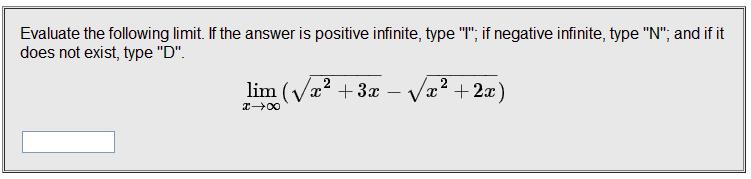
What I tried to do to solve this problem was first, multiplying the function by its conjugate, and then simplifying the numerator which yielded "5x" divided by the original conjugate. Then I factored out "x-squared" from the denominator and after taking the square root of that, I got the absolute value of "x". Since the limit approaches positive infinity, the absolute value of "x" becomes just "x" by itself. This divided out the "x's" from the numerator and the denominators. Then I simply substituted positive infinity for "x's" that remained in the square roots in the denominators and got the answer of 5/2... which is apparently wrong. Can anyone help please?
 
Physics news on Phys.org


Hint 1: Factor out x2 without multiplying and dividing the conjugate.


CallMeShady said:

Homework Statement


2bb6kg.jpg


Homework Equations


None that I am aware of.


The Attempt at a Solution


What I tried to do to solve this problem was first, multiplying the function by its conjugate, and then simplifying the numerator which yielded "5x" divided by the original conjugate. Then I factored out "x-squared" from the denominator and after taking the square root of that, I got the absolute value of "x". Since the limit approaches positive infinity, the absolute value of "x" becomes just "x" by itself. This divided out the "x's" from the numerator and the denominators. Then I simply substituted positive infinity for "x's" that remained in the square roots in the denominators and got the answer of 5/2... which is apparently wrong. Can anyone help please?
Check your algebra!

What is (x2+3x)-(x2+2x) ?

It's not 5x !


Thank you Sammy, that was a silly mistake on my part.
 
Have you tried using ln and getting into a l'hopital's rule situation? I haven't tried it but it seems it could yield a result.


zapz said:
Have you tried using ln and getting into a l'hopital's rule situation? I haven't tried it but it seems it could yield a result.
zapz,

Try it & tell us.

(Of course it can work.) First change the expression to an appropriate form.


zapz said:
Have you tried using ln and getting into a l'hopital's rule situation? I haven't tried it but it seems it could yield a result.

It's much like the other user just said.

SammyS said:
zapz,

(Of course it can work.) First change the expression to an appropriate form.

If you want to apply L'Hôpital Rule for this problem, then you will need to have the expression in fractional form? How? Simply multiply the top and the bottom by the conjugate of √(x² + 3x) - √(x² + 2x), which is √(x² + 3x) + √(x² + 2x). That gives us:

lim x→∞ (√(x² + 3x) - √(x² + 2x)) * (√(x² + 3x) + √(x² + 2x))/(√(x² + 3x) + √(x² + 2x))
= lim x→∞ (x² + 3x - (x² + 2x))/(√(x² + 3x) + √(x² + 2x))
= lim x→∞ (x² - x² + 3x - 2x)/(√(x² + 3x) + √(x² + 2x))
= lim x→∞ x/(√(x² + 3x) + √(x² + 2x))

If we let x = ∞, we obtain the indeterminate form, ∞/∞. For this case, we need to apply L'Hôpital Rule.

lim x→∞ d/dx [x]/(d/dx [(x² + 3x)^(½) + (x² + 2x)^(½)])
= lim x→∞ 1/(½ * (x² + 3x)^(½ - 1) * d/dx (x² + 3x) + ½ * (x² + 2x)^(½ - 1) * d/dx (x² + 2x))
= lim x→∞ 1/(½ * (x² + 3x)^(-½) * (2x + 3) + ½ * (x² + 2x)^(-½) * (2x + 2))
= lim x→∞ 1/((2x + 3)/(2√(x² + 3x)) + 2(x + 1)/(2√(x² + 2x))) [I factored out 2 out of 2x + 2]
= lim x→∞ 1/((2x + 3)/(2√(x² + 3x)) + (x + 1)/(√(x² + 2x)))

I believe you can take in from here. Find the limit of that function. Hint: This can be related to lim x→∞ Ax/(B√(x² + C)) = A/B.


NasuSama said:
It's much like the other user just said.

If you want to apply L'Hôpital Rule for this problem, then you will need to have the expression in fractional form? How? Simply multiply the top and the bottom by the conjugate of √(x² + 3x) - √(x² + 2x), which is √(x² + 3x) + √(x² + 2x). That gives us:
If you multiply by the conjugate over the conjugate , then simplify, and factor x (x2 under the radicals) from the radicals, you don't need L'Hôpital's rule .However:
To use L'Hôpital's rule, start with [BSourabh N][/B]'s suggestion in post#2.

\displaystyle \sqrt{x^2+3x}-\sqrt{x^3+2x}

\displaystyle =x\sqrt{1+\frac{3}{x}}-x\sqrt{1+\frac{2}{x}}

\displaystyle =\frac{\sqrt{1+3/x}-\sqrt{1+2/x}}{1/x}
This is of the form 0/0 as x → ∞ .

Apply L'Hôpital's rule to the limit of this expression.
 

Similar threads

  • · Replies 13 ·
Replies
13
Views
2K
  • · Replies 7 ·
Replies
7
Views
2K
  • · Replies 14 ·
Replies
14
Views
3K
  • · Replies 4 ·
Replies
4
Views
1K
  • · Replies 9 ·
Replies
9
Views
4K
  • · Replies 2 ·
Replies
2
Views
1K
  • · Replies 3 ·
Replies
3
Views
1K
  • · Replies 5 ·
Replies
5
Views
1K
  • · Replies 7 ·
Replies
7
Views
3K
  • · Replies 15 ·
Replies
15
Views
2K