MHB Finding Marginal PDFs: Need Help With Integrating Complex Expressions?

  • Thread starter Thread starter nacho-man
  • Start date Start date
  • Tags Tags
    Marginal
Click For Summary
To compute marginal PDFs from a joint PDF, integrate the joint PDF with respect to the other variable, specifically integrating f_{X,Y}(x,y) with respect to y to find f_X(x). This process can result in complex integrals, but techniques such as completing the square and variable substitution can simplify the calculations. For example, substituting w = y + (1/2)x√2 can help in evaluating the integral. Utilizing the standard integral of a normal distribution is also beneficial in this context. Proper application of these methods can lead to a clearer solution for the marginal PDFs.
nacho-man
Messages
166
Reaction score
0
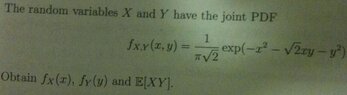
Please see the attached image for my question. I don't understand how to compute the integral, is there some trick?
I do believe that
to find fx(x) I integrate the joint pdf, with respect to x with the bounds set as the range of Y. But this leaves me with a very complex integration
Similarly for fy(y). Is there some trick?

Any help is greatly appreciated.
 

Attachments
  • pdf q.jpg
    pdf q.jpg
    23.7 KB · Views: 103
Last edited by a moderator:
Physics news on Phys.org
nacho said:
Please see the attached image for my question. I don't understand how to compute the integral, is there some trick?
I do believe that
to find fx(x) I integrate the joint pdf, with respect to x with the bounds set as the range of Y. But this leaves me with a very complex integration
Similarly for fy(y). Is there some trick?

Any help is greatly appreciated.
Hi nacho!

To find $f_X(x)$ you need to integrate $f_{X,Y}(x,y)$ with respect to y.

That is:
$$f_X(x) = \int_{-\infty}^{+\infty} f_{X,Y}(x,y) dy$$

The problem is of course that exponent, but you can complete the square, do a substitution, and use the standard integral of a normal distribution.

That is:
$$f_X(x) = \int_{-\infty}^{+\infty} f_{X,Y}(x,y) dy
= \int_{-\infty}^{+\infty} \frac{1}{\pi\sqrt 2} \exp\left(-(y + \frac 1 2 x \sqrt 2)^2 - \frac 1 2 x^2\right) dy$$

Can you substitute $w = y + \frac 1 2 x \sqrt 2$?

And use that $$\int_{-\infty}^{+\infty} \exp\left(-\frac 1 2 u^2\right) du = \sqrt{2\pi}$$?
 
The standard _A " operator" maps a Null Hypothesis Ho into a decision set { Do not reject:=1 and reject :=0}. In this sense ( HA)_A , makes no sense. Since H0, HA aren't exhaustive, can we find an alternative operator, _A' , so that ( H_A)_A' makes sense? Isn't Pearson Neyman related to this? Hope I'm making sense. Edit: I was motivated by a superficial similarity of the idea with double transposition of matrices M, with ## (M^{T})^{T}=M##, and just wanted to see if it made sense to talk...

Similar threads

  • · Replies 1 ·
Replies
1
Views
2K
  • · Replies 6 ·
Replies
6
Views
4K
  • · Replies 1 ·
Replies
1
Views
5K
  • · Replies 1 ·
Replies
1
Views
3K
  • · Replies 9 ·
Replies
9
Views
5K
  • · Replies 1 ·
Replies
1
Views
3K
  • · Replies 4 ·
Replies
4
Views
2K
  • · Replies 3 ·
Replies
3
Views
3K
Replies
5
Views
4K
  • · Replies 3 ·
Replies
3
Views
3K