Finding $\overset{\frown}{BN}$ with Given Parameters

  • Context:
  • Thread starter Thread starter Albert1
  • Start date Start date
  • Tags Tags
    Parameters
Join the discussion
Ask a follow-up here, or get your own question answered by working scientists, mathematicians and engineers — people, not an autocomplete.
Real named experts · corrections over time · the nuance an AI answer skips
6 replies · 2K views
Albert1
Messages
1,221
Reaction score
0
Points A,B are on circle C ,segment MN is a diameter of circle C, and point P is on

segment MN , if :

$\angle CAP=\angle CBP =10^o ,\,\, \overset{\frown} {MA}=40^o,\,\, find :\,\, \overset{\frown} {BN}=?$
 
Last edited:
Mathematics news on Phys.org
HallsofIvy said:
You refer to "circle C" but then treat "C" as if it were a point. Are we to assume that "C" is the center point of the circle?

yes ,you got it !
"C" is the center point of the circle.
 
Albert said:
Points A,B are on circle C ,segment MN is a diameter of circle C, and point P is on

segment MN , if :

$\angle CAP=\angle CBP =10^o ,\,\, \overset{\frown} {MA}=40^o,\,\, find :\,\, \overset{\frown} {BN}=?$
[sp]

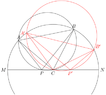
One solution is for $B$ to be opposite $A$ on the other side of $MN$, at the point labelled $B'$ in the picture. Then $\overset{\frown} {BN} = 140^\circ$. But that is too obvious to be interesting, and I assume that what was wanted is the case where $A$ and $B$ are on the same side of $MN$.

The points $A, B, C, P$ are concyclic, because $\angle CAP=\angle CBP =10^\circ$. Therefore $\angle ABP=\angle ACP =40^\circ$, and so $\angle ABC= 10^\circ + 40^\circ = 50^\circ.$ The triangle $ABC$ is isosceles, so $\angle BAC = 50^\circ$, and $\angle ACB =80^\circ$. Finally, $\angle BCP =40^\circ + 80^\circ = 120^\circ$, from which $\overset{\frown} {BN}= \angle BCN = 60^\circ.$[/sp]
 

Attachments

  • angles.png
    angles.png
    6.9 KB · Views: 111
what will be the value of arc BN , if point P locates between points C and N
 
Albert said:
what will be the value of arc BN , if point P locates between points C and N
Good question! I hadn't thought of that possibility. The method will be similar to the previous one, but this time the angle ABC ($\angle A'B'C$ in the diagram below) will be $40^\circ - 10^\circ = 30^\circ$ instead of $40^\circ + 10^\circ = 50^\circ$. Then $\angle A'CB' = 120^\circ$ and $\overset{\frown} {BN} = 20^\circ.$
 

Attachments

  • angles2.png
    angles2.png
    9.6 KB · Views: 114
very good solution :cool:
this is an open -style problem ,if the position of point B or point P changes ,then the answer will also differ (it depends upon how the diagram is sketched)
sometime we may give students a mathematic problem with more then one possible answer