Finding sum of infinite series

Ryaners
Messages
50
Reaction score
2
[Please excuse the screengrabs of the fomulae - I'll get around to learning TeX someday!]

1. Homework Statement

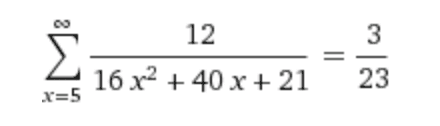
Find the sum of this series (answer included - not the one I'm getting)
3lz8gX9.png


The Attempt at a Solution


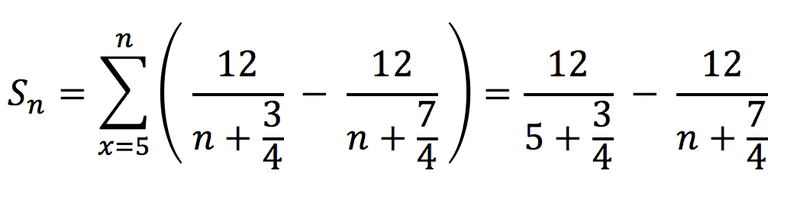
So I'm trying to sum this series as a telescoping sum. I decomposed the fraction and the partial sum collapses down to this:
PkZ9pxR.png

Then when I take the limit, the second term vanishes, leaving just the first term as the final value, i.e.:

t3SRR8e.png

Needless to say 48/23 ≠ 3/23 :redface:
I can't see what I'm doing wrong - I've triple-checked everything & must be misunderstanding something fundamentally speaking. The partial fraction decomposition is (to the best of my / Wolfram A's knowledge) correct. Can anyone point out my mistake(s)?
 
Physics news on Phys.org
It's hidden in the part you didn't show us. Can you explain your decomposition of ##16x^2+40x+21## into two fractions?
 
fresh_42 said:
It's hidden in the part you didn't show us. Can you explain your decomposition of ##16x^2+40x+21## into two fractions?

Sure thing. I used the quadratic formula to find the roots of the polynomial in the denominator, & then decomposed the fraction - here's the process in detail:
tQhfcLj.png
 
Yes, ##16x^2+40x+21=(4x+7)(4x+3)## and this gives the new denominators. But from the first to the second line is an unseen error, because the first equality in the second line is wrong by a factor ##16##.
 
  • Like
Likes Ryaners
You have a mistake right off the bat.
$$\frac{12}{16x^2 + 40x + 21} \ne \frac{12}{(x + 3/4)(x + 7/4)}$$
You have lost two factors of 4 from the denominators on the right.
 
Last edited:
  • Like
Likes Ryaners
Ok, I can see that now - so was my mistake to use the quadratic formula the same way I'd use it if the polynomial = 0, where I was kind of unconsciously dividing through by the 4 without realising? In other words, I should have:

QWCYjjH.png


Does that even make sense? :bugeye:
 
Ryaners said:
Ok, I can see that now - so was my mistake to use the quadratic formula the same way I'd use it if the polynomial = 0, where I was kind of unconsciously dividing through by the 4 without realising? In other words, I should have:

QWCYjjH.png


Does that even make sense? :bugeye:
No, this part of your calculation has been correct. You can work either with ##x+\frac{3}{4}\, , \,x+\frac{7}{4}## or with ##4x+3\, , \,4x+7##.
However, this has an effect to your nominators. Look again at the inequality @Mark44 pointed to in post #5 - make it an equality (with either denominators).
 
Ryaners said:
I'll get around to learning TeX someday!
We have a tutorial here: https://www.physicsforums.com/help/latexhelp/
You can be up an running in a short time. To see what I or fresh_42 did, right-click on any of the expressions we wrote, and choose "Show Math As.. " and "TeX Commands". This will show the LaTeX script we wrote.

In post #5 I wrote this:
##\frac{12}{16x^2 + 40x + 21} \ne \frac{12}{(x + 3/4)(x + 7/4)}##

The TeX script looks like this:
\frac{12}{16x^2 + 40x + 21} \ne \frac{12}{(x + 3/4)(x + 7/4)}
 
fresh_42 said:
No, this part of your calculation has been correct. You can work either with ##x+\frac{3}{4}\, , \,x+\frac{7}{4}## or with ##4x+3\, , \,4x+7##.
However, this has an effect to your nominators. Look again at the inequality @Mark44 pointed to in post #5 - make it an equality (with either denominators).
Right - so I should recognise once I find the roots that I might need to scale them by a third (constant) factor so I'm not changing the value of the expression? Just trying to get to the bottom of what mental shortcut I'm taking that I shouldn't be.

I had assumed that because the quadratic formula incorporated all the coefficients 'as they are' (i.e. a=16, b=40, c=21 in this case), the roots it 'spits out' would have included all that info. 'Course when I look at it I can see that the two expressions aren't equal (as pointed out by Mark44). I'm unclear on why that's the case, though. How can I make sure when I'm performing this kind of operation in future that I haven't magically eliminated a constant factor, like I did here?

Thanks for your help so far by the way :)
 
  • #10
Mark44 said:
We have a tutorial here: https://www.physicsforums.com/help/latexhelp/
You can be up an running in a short time. To see what I or fresh_42 did, right-click on any of the expressions we wrote, and choose "Show Math As.. " and "TeX Commands". This will show the LaTeX script we wrote.

In post #5 I wrote this:
##\frac{12}{16x^2 + 40x + 21} \ne \frac{12}{(x + 3/4)(x + 7/4)}##

The TeX script looks like this:
\frac{12}{16x^2 + 40x + 21} \ne \frac{12}{(x + 3/4)(x + 7/4)}

Fantastic, thank you! That looks much less difficult than I expected. :)
 
  • #11
Fractions aren't too complicated. Here are a couple of others that I frequently use:

Summations:
\sum_{n = 1}^{\infty} \frac 1 {n^2}
In rendered form: ##\sum_{n = 1}^{\infty} \frac 1 {n^2}##

Integrals:
\int_{t = 0}^{10} t^2 + 3t~dt = \left.\frac{t^3}{3} + \frac{3t^2}{2}\right|_0^{10}
In rendered form: ##\int_{t = 0}^{10} t^2 + 3t~dt = \left.\frac{t^3}{3} + \frac{3t^2}{2}\right|_0^{10}##
 
  • Like
Likes Ryaners
  • #12
Ryaners said:
Right - so I should recognise once I find the roots that I might need to scale them by a third (constant) factor so I'm not changing the value of the expression? Just trying to get to the bottom of what mental shortcut I'm taking that I shouldn't be.
This is a matter of taste. Personally I like to work with equations ##1\cdot x^2 + px +q = 0## because I don't have to bother the scaling then.
I also use ##x_{1,2} = -\frac{p}{2} \pm \sqrt{(-\frac{p}{2})^2-q}## because I learned it this way, although mostly ##x_{1,2} = -\frac{1}{2}(p \pm \sqrt{p^2-4q})## is used. Once you have the decomposition, say ##(x+\frac{3}{4})\cdot (x+\frac{7}{4})##, simply make sure that you decomposed ##16x^2+40x+21=16(x^2+\frac{5}{2}+\frac{21}{16})= 16 \cdot (x+\frac{3}{4})\cdot (x+\frac{7}{4})## and not ##16x^2+40x+21=(4x+3)\cdot (4x+7)##. Until then and after this everything has been o.k. with your calculation. Maybe it's easiest to take the factor ##\frac{12}{16}## completely in front of all the rest and multiply the result at last again with it. This way the algorithmic procedure doesn't have to consider the scaling factor. But as I said above: it's a matter of taste. Find a way that minimizes potential mistakes for you.
 
  • #13
What do you get if you reduce ##\frac{3}{4x+3}-\frac{3}{4x+7}## to a common denominator?
 
  • #14
fresh_42 said:
This is a matter of taste. Personally I like to work with equations ##1\cdot x^2 + px +q = 0## because I don't have to bother the scaling then.
I also use ##x_{1,2} = -\frac{p}{2} \pm \sqrt{(-\frac{p}{2})^2-q}## because I learned it this way, although mostly ##x_{1,2} = -\frac{1}{2}(p \pm \sqrt{p^2-4q})## is used. Once you have the decomposition, say ##(x+\frac{3}{4})\cdot (x+\frac{7}{4})##, simply make sure that you decomposed ##16x^2+40x+21=16(x^2+\frac{5}{2}+\frac{21}{16})= 16 \cdot (x+\frac{3}{4})\cdot (x+\frac{7}{4})## and not ##16x^2+40x+21=(4x+3)\cdot (4x+7)##. Until then and after this everything has been o.k. with your calculation. Maybe it's easiest to take the factor ##\frac{12}{16}## completely in front of all the rest and multiply the result at last again with it. This way the algorithmic procedure doesn't have to consider the scaling factor. But as I said above: it's a matter of taste. Find a way that minimizes potential mistakes for you.

Yes! Ok! This is making sense now. So the safest thing to do is to put the quadratic in a form where the coefficient of the x2 term is 1 before applying the quadratic formula, so you don't lose track of any constant factors while finding the roots. That's exactly the insight I was looking for, thanks for your help :)
 
  • #15
Chestermiller said:
What do you get if you reduce ##\frac{3}{4x+3}-\frac{3}{4x+7}## to a common denominator?
I get it now, thanks for your input :)
 

Similar threads

  • · Replies 10 ·
Replies
10
Views
3K
  • · Replies 7 ·
Replies
7
Views
2K
  • · Replies 11 ·
Replies
11
Views
3K
  • · Replies 3 ·
Replies
3
Views
2K
  • · Replies 9 ·
Replies
9
Views
2K
  • · Replies 3 ·
Replies
3
Views
1K
  • · Replies 9 ·
Replies
9
Views
2K
  • · Replies 2 ·
Replies
2
Views
2K
Replies
3
Views
3K
  • · Replies 3 ·
Replies
3
Views
2K