Finding the coodinates of two lines.

  • Context: MHB 
  • Thread starter Thread starter animaguy
  • Start date Start date
  • Tags Tags
    Lines
Click For Summary

Discussion Overview

The discussion revolves around finding the coordinates of the intersection point of two lines defined by four points on a plane. Participants explore various methods and formulas to determine the intersection point, including geometric approaches and algebraic formulas.

Discussion Character

  • Exploratory
  • Technical explanation
  • Debate/contested
  • Mathematical reasoning

Main Points Raised

  • One participant describes the lines formed by points a, b, c, and d and seeks a formula for the intersection point e.
  • Another participant suggests using midpoints for specific shapes like squares or parallelograms but acknowledges uncertainty about the correctness of this approach.
  • A participant expresses the need for a formula that can determine point e, even if the coordinates are not whole numbers.
  • One participant provides a formula from Wikipedia for finding the closest intersection point of multiple lines in higher dimensions, adapting it for the two lines in question.
  • Another participant thanks the community for assistance but reports difficulties in applying the formula correctly.
  • A later post indicates that the formula used did not yield the expected intersection coordinates, raising doubts about its applicability.
  • One participant requests specific examples of lines with coordinates to demonstrate the formula's application for finding intersection points.
  • Another participant shares an Excel sheet demonstrating the use of a two-dimensional formula, claiming it matches the intersection point.
  • Confusion arises regarding the definitions of certain values in the formula, prompting further clarification from other participants.
  • A final post indicates that the problem has been resolved, though details of the resolution are not provided.

Areas of Agreement / Disagreement

Participants express varying levels of confidence in the formulas discussed, with some agreeing on the need for clarification and others reporting difficulties in application. The discussion remains unresolved regarding the most effective method to find the intersection point, with multiple approaches and formulas being considered.

Contextual Notes

Some participants note that the formulas discussed may not apply to all scenarios, particularly regarding dimensionality and the specific geometric configuration of the lines.

Who May Find This Useful

This discussion may be useful for individuals interested in geometry, algebraic methods for finding intersections, or those seeking assistance with mathematical problem-solving in two dimensions.

animaguy
Messages
7
Reaction score
0
I have four points on the same plane (a, b, c, d).

Points a and b form a line ab.

Points c and d form a line cd.

Line ab and cd intersect at point e.

Does anyone have a formula that can find the coordinates of point e?
 
Mathematics news on Phys.org
You would take the midpoint of opposite vertexes. Take the coordinates of A and C, the midpoint of that, then the midpoint of D to B. That is if the plane is say a square with ABCD, listed in order all around. This is if only it is a square. If a parallelogram, I think you take the midpoint A to D, and B to C. I don't really know if my answer is correct, I have geometry teacher that seems sketchy lol.
 
The problem with this scenario is polygon adcd is not a square or a parrallelogram.

I would be happy if I could find a formula that can determine point e, even if the coordinates were not whole and rounded of.
 
Hi animaguy! :)

From wikipedia (slightly revised to fit the purpose):
The point where multiple lines meet closest in any number of dimensions is:
x= \left(\sum_i I-v_i v_i^T\right)^{-1} \left(\sum_i (I-v_i v_i^T) p_i\right)​
where
$v_i$ is a unit vector along the ith line,
$p_i$ is a point vector on the ith line,
$v_i^T$ is the transpose of $v_i$.​
In your case you have 2 lines and the point where those lines meet closest is the intersection point.
That means:

$v_1 = {b - a \over ||b-a||}$

$p_1 = a$

$v_2 = {d - c \over ||d-c||}$

$p_2 = c$

$x = e$​
 
Very quickly, I want to thank the help I have received. I am still working out the calculations regarding how I am applying it and so far I am having some problems but it may just be a simple error.

Regardless, thanks for the help and as soon as I have something more concrete to post I will definitely follow up as a courtesy for your help.

(Happy)
 
acd2938d1c482f5247654e6822ec06ad.png


``````````````````````````````````````````````````````````````````````````
1)
I used the formula on the wikipedia link provided by ILikeSerena.

Assuming this is the formula that I am genuinely looking for, the two coordinates that I produce by using this formula is not the intersection of the two lines.

2)
And I am still unsure of how to test the revised formula ILikeSerena provided.

3)
I am unsure if the formula provided by the Dr. Math link applies because the formula is based on a three dimensional line.

The two lines are on the same plane (x,y) so a z-coordinate at this point is unnecessary.

```````````````````````````````````````````

Question:

Can anyone provide:

a)
a line with the xy-coordinates of two points on that line

b)
a second line with the xy-coordinates of two points on that line and on the same plane as the first line

c)
and demonstrate the use of a formula using those two lines to produce the intersection of the xy-coordinates of the point at which the two lines intersect?

``````````````````````````````````````````````

I would humbly appreciate it.

``````````````````````````````````````````````

In the meantime, I will keep trying.

Thank you,
Animaguy
 
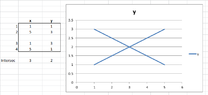
I have just created an excel sheet with 2 lines, using the 2-dimensional formula (from wiki):

http://www.mathhelpboards.com/attachment.php?attachmentid=554&d=1359287603

As you can see, the result matches the intersection point.

The formula I gave is the most generic, which is for m dimensions and for 2 or more lines.
Based on your opening post, I thought you were asking for that.
After your current comment it appears that you don't need it.
 

Attachments

  • intersection_lines.png
    intersection_lines.png
    3.8 KB · Views: 124
I LIKE SERENA,

thanks for the help. i am still having problems solving the formula but I know what the problem is...

acd2938d1c482f5247654e6822ec06ad.png


(x1 - x2)
(x3 - x4)
(y1 - y2)
(y3 - y4)

are self explanatory for me...

however the values...

x1y2
y1x2
y3y4
y3x4

confuse me...

how are these values defined?
 
  • #10
animaguy said:
however the values...

x1y2
y1x2
y3y4
y3x4

confuse me...

how are these values defined?

The expression $x_1 y_2$ means $x_1 \times y_2$.
 
  • #11
Problem solved!
 

Similar threads

Replies
1
Views
2K
  • · Replies 10 ·
Replies
10
Views
2K
  • · Replies 1 ·
Replies
1
Views
1K
  • · Replies 2 ·
Replies
2
Views
2K
  • · Replies 13 ·
Replies
13
Views
3K
  • · Replies 2 ·
Replies
2
Views
2K
  • · Replies 4 ·
Replies
4
Views
1K
  • · Replies 2 ·
Replies
2
Views
5K
  • · Replies 3 ·
Replies
3
Views
3K
  • · Replies 1 ·
Replies
1
Views
1K