Finding the magnitude of the hydrostatic force per unit of circumference

Click For Summary

Homework Help Overview

The discussion revolves around calculating the hydrostatic force acting on a cylindrical tank filled with water. Participants are exploring the concept of hydrostatic pressure and how it varies with depth, specifically focusing on finding the force per unit of circumference of the tank.

Discussion Character

  • Exploratory, Assumption checking, Conceptual clarification

Approaches and Questions Raised

  • The original poster attempts to apply a formula for force but is uncertain about how to calculate the force per unit circumference. Some participants suggest considering the variation of pressure with depth and the correct interpretation of the area involved.

Discussion Status

Participants are actively discussing the correct approach to finding the hydrostatic force per unit circumference. Some guidance has been offered regarding the need to account for the varying pressure along the height of the tank and the correct area to use in calculations. There is an ongoing exploration of the assumptions regarding the centroid and depth measurements.

Contextual Notes

There is some confusion regarding the dimensions used in calculations, particularly the depth and the area of the tank. Participants are also clarifying the distinction between the centroid of the entire tank versus the vertical side of the tank.

tomtomtom1
Messages
160
Reaction score
8
Homework Statement
Finding magnitude of hydrostatic force per unit of circumference
Relevant Equations
Force = Density * Gravity * Distance from Surface to centriod of tank * Area
Density = 1000
Gravity = 9.8
Distance from surface to centriod of tank = 4.25
Area = 28.274
Hello all

I am trying to find the hydrostatic force of a cylindrical tank of water. I was hoping someone could help point me in the right direction.

I have a cylindrical water tank. The dimensions are as follows:-
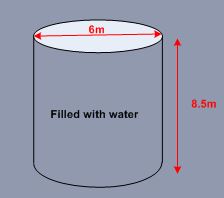
fffff.JPG


I need to find the magnitude of the hydro static force per unit of circumference.

I know the answer which is 354000 i just don't know how to get to it.

I currently do the following:-

Force = Density * Gravity * Distance from Surface to centriod of tank * Area
Density = 1000
Gravity = 9.8
Distance from surface to centriod of tank = 4.25
Area = 28.274

Force = 1000 * 9.8 * 4.25 * 28.274 = 1177612 Newtons

Circumference = 2 * Pie * Radius = 18.8496

I don't really know where to from here?

I thought i could just divide the Force by the Circumference but i have been told that this is incorrect.

Its the "per unit of circumference" that's really throwing me.

Can anyone help?

Thank you.
 
Physics news on Phys.org
The pressure (force per unit area) is increasing with the distance z beneath the surface according to the equation $$p=\rho g z$$ So the pressure force per unit area on the wall is lower near the surface than near the bottom of the tank. So there isn't just one value of p that you have to work with; you need to take into account how p is varying with depth. The differential area on the circumference of the tank wall is given by ##dA=Rd\theta dz##. What is the pressure force acting on this differential element of area?
 
tomtomtom1 said:
Homework Equations:: Force = Density * Gravity * Distance from Surface to centriod of tank * Area
Density = 1000
Gravity = 9.8
Distance from surface to centriod of tank = 4.25
Area = 28.274
.
Force = 1000 * 9.8 * 4.25 * 28.274 = 1177612 Newtons
Your work looks OK, except for the value of the lateral area of the cylinder. (Looks like you calculated the area of the bottom.) Recall that the lateral area is given by the circumference times the height. (You don't need to evaluate the circumference since you are going to divide F by the circumference to get the force per unit circumference.)
 
TSny said:
Your work looks OK, except for the value of the lateral area of the cylinder. (Looks like you calculated the area of the bottom.) Recall that the lateral area is given by the circumference times the height. (You don't need to evaluate the circumference since you are going to divide F by the circumference to get the force per unit circumference.)
It shouldn't be the distance from the centroid. It should be half the depth, 1.75 m.
 
The only way I could get the stated answer was to assume that the question is asking for the hydrostatic pressure on just the vertical side of the tank per unit circumference. Half the depth (4.25 m) would then be the same as the depth of the centroid of the vertical side of the tank. This is the value that @tomtomtom1 used. He referred to it as the depth of the "centroid of the tank" rather than the depth of the "centroid of the vertical side of the tank".
 
TSny said:
The only way I could get the stated answer was to assume that the question is asking for the hydrostatic pressure on just the vertical side of the tank per unit circumference. Half the depth (4.25 m) would then be the same as the depth of the centroid of the vertical side of the tank. This is the value that @tomtomtom1 used. He referred to it as the depth of the "centroid of the tank" rather than the depth of the "centroid of the vertical side of the tank".
I misread the depth as 3.5 rather than 8.5. My eyes are not what they used to be.
 

Similar threads

Replies
60
Views
7K
  • · Replies 21 ·
Replies
21
Views
4K
  • · Replies 14 ·
Replies
14
Views
2K
  • · Replies 5 ·
Replies
5
Views
10K
  • · Replies 24 ·
Replies
24
Views
3K
  • · Replies 1 ·
Replies
1
Views
3K
  • · Replies 17 ·
Replies
17
Views
6K
  • · Replies 14 ·
Replies
14
Views
3K
Replies
1
Views
1K
  • · Replies 1 ·
Replies
1
Views
3K