Why Is My Calculation of Vertical Hydrostatic Force Incorrect?

  • Thread starter Thread starter The Real Nick
  • Start date Start date
  • Tags Tags
    Fluids Hydrostatic
Click For Summary

Homework Help Overview

The discussion revolves around calculating the vertical hydrostatic force acting on a quarter-circle surface submerged in water. The original poster expresses confusion after obtaining an incorrect value for this force, despite successfully calculating the horizontal component. The problem involves concepts from fluid mechanics, particularly hydrostatic pressure and the application of Pascal's Law.

Discussion Character

  • Exploratory, Assumption checking, Conceptual clarification

Approaches and Questions Raised

  • Participants discuss the use of the equation for hydrostatic force, questioning the correct application of the center of gravity (Zcg) and its relation to the center of pressure. There is mention of an alternative method involving the weight of the "missing water" above the quarter-circle, which some participants find unclear. Others explore the implications of pressure variation with depth and its effect on calculations.

Discussion Status

The conversation is ongoing, with participants sharing their calculations and reasoning. Some have arrived at similar values for the vertical force, leading to speculation about the accuracy of the textbook answer. There is a mix of interpretations regarding the role of the missing water and how it affects the overall hydrostatic force.

Contextual Notes

Participants note discrepancies between their calculations and the textbook answer, leading to discussions about the assumptions made in their approaches. The original poster expresses uncertainty about methods not covered in class, indicating a potential gap in understanding the topic.

The Real Nick
Messages
25
Reaction score
0
MODERATOR'S NOTE: THIS THREAD HAS BEEN MOVED FROM ANOTHER FORUM, SO THERE IS NO TEMPLATE.
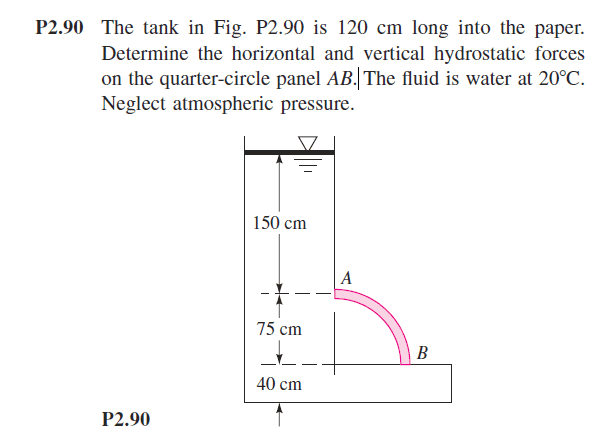
BlXNu3u.png

This is the problem here. I am having trouble making progress on this problem after getting the wrong answer for the vertical hydrostatic force.

The equations I am using are: fx= (density)(gravity)(Zcg)(Projected area)

For this I used
p= 1000 kg/m^3
g = 9.81 m/s^2
Zcg = 1.5m + (0.75/2)m
A = (0.75(1.2) m^2

this gave me 16,554.4 N, which is correct (for the horizontal component).

Now, trying to solve for the vertical hydrostatic force I used the same equation, but with Zcg being 1.5+0.75 meters as it is at the bottom of the quarter-circle. I am not sure what else to do, but this doesn't give me the right answer, it is short by about 3,000 N.

I have seen other solutions that solve for the vertical force by finding the "weight of the missing water" above the quarter-circle. I don't understand this method, and it was never explained in class or in my book, so I am weary to use it.

If anyone could help that would be great!

Thank you.
 
Last edited by a moderator:
Physics news on Phys.org
Argh, I just realized I posted this in the wrong section. My apologies!
 
The Real Nick said:
MODERATOR'S NOTE: THIS THREAD HAS BEEN MOVED FROM ANOTHER FORUM, SO THERE IS NO TEMPLATE.
BlXNu3u.png

This is the problem here. I am having trouble making progress on this problem after getting the wrong answer for the vertical hydrostatic force.

The equations I am using are: fx= (density)(gravity)(Zcg)(Projected area)

For this I used
p= 1000 kg/m^3
g = 9.81 m/s^2
Zcg = 1.5m + (0.75/2)m
A = (0.75(1.2) m^2

this gave me 16,554.4 N, which is correct (for the horizontal component).

Now, trying to solve for the vertical hydrostatic force I used the same equation, but with Zcg being 1.5+0.75 meters as it is at the bottom of the quarter-circle. I am not sure what else to do, but this doesn't give me the right answer, it is short by about 3,000 N.

I have seen other solutions that solve for the vertical force by finding the "weight of the missing water" above the quarter-circle. I don't understand this method, and it was never explained in class or in my book, so I am weary to use it.

If anyone could help that would be great!

Thank you.
For the hydrostatic force in the vertical direction, have you accounted for the variation in pressure due to depth, otherwise known as Pascals's Law:

https://en.wikipedia.org/wiki/Pascal's_law

Because pressure changes with depth, the c.g. and the center of pressure don't coincide in the vertical direction.
 
SteamKing said:
For the hydrostatic force in the vertical direction, have you accounted for the variation in pressure due to depth, otherwise known as Pascals's Law:

https://en.wikipedia.org/wiki/Pascal's_law

Because pressure changes with depth, the c.g. and the center of pressure don't coincide in the vertical direction.
Well, I changed the Zcg to be the entire radius of the quarter-circle, as this would put it at the depth of the bottom of the circle, whereas for the horizontal component was the radius/2.
 
The Real Nick said:
Well, I changed the Zcg to be the entire radius of the quarter-circle, as this would put it at the depth of the bottom of the circle, whereas for the horizontal component was the radius/2.
Yes, but as you found with your calculations, that didn't provide the correct answer.
 
SteamKing said:
Yes, but as you found with your calculations, that didn't provide the correct answer.
This is true, but I'm not sure what else to do with your suggestion, as I feel I already tried that. The vertical component of the force would act on the horizontal plane of the bottom of the quarter-circle, so wouldn't the cp and cg coincide for that case?
 
"The vertical component of pressure force on a curved surface equals in magnitude
and direction the weight of the entire column of fluid, both liquid and atmosphere,
above the curved surface."

This is from my textbook, and is adding to my confusion, because in this problem the surface technically has no water above it, but I know the pressure at the surface from the inside is affected by the column of water above it, which I thought my equation would handle, but it's not :/
 
With regard to the vertical force, if the "missing water" region were actually filled with water, it's weight would just balance the upward force exerted on the arc from below. In other words, in this filled situation, if the arc weren't there, all the water would still be in equilibrium. It wouldn't know that the arc is there.

Chet
 
Chestermiller said:
With regard to the vertical force, if the "missing water" region were actually filled with water, it's weight would just balance the upward force exerted on the arc from below. In other words, in this filled situation, if the arc weren't there, all the water would still be in equilibrium. It wouldn't know that the arc is there.

Chet
I thought about that too, Chet. I tried to calculate the force by finding the volume of the water above the arc (as if there was water there), finding it's weight, and the force. This also gives me the wrong answer. I am starting to wonder if the answer in the back of the book is wrong. They get 22,600 N.
 
  • #10
The Real Nick said:
I thought about that too, Chet. I tried to calculate the force by finding the volume of the water above the arc (as if there was water there), finding it's weight, and the force. This also gives me the wrong answer. I am starting to wonder if the answer in the back of the book is wrong. They get 22,600 N.
You can get the volume much more easily by just subtracting the area of the quarter circle.
 
  • #11
Chestermiller said:
You can get the volume much more easily by just subtracting the area of the quarter circle.
That's what I did. Acted as if it were a rectangular cube, and then subtracted the area of the cylinder. This gives me 14,664.5N when converted to a force.
 
  • #12
The Real Nick said:
That's what I did. Acted as if it were a rectangular cube, and then subtracted the area of the cylinder. This gives me 14,664.5N when converted to a force.
I am at my wits end with this problem. I will probably just go with this answer and hope the back of the book is wrong. If anyone has some suggestions otherwise, that would be great. Thanks again.
 
  • #13
My answer matches yours, plus I derived the equation by integrating the pressure from below over the surface, and got the same answer. So the book must be wrong.

Chet
 
  • #14
Chestermiller said:
My answer matches yours, plus I derived the equation by integrating the pressure from below over the surface, and got the same answer. So the book must be wrong.

Chet
Thank you for being so thorough! I think I can finally move on to the next problem. FEWF! 1/5 complete, and only 3 hours later :D
 
  • #15
The Real Nick said:
Thank you for being so thorough! I think I can finally move on to the next problem. FEWF! 1/5 complete, and only 3 hours later :D
Actually, I integrated it first because I couldn't figure out a simpler method of doing the problem. Then I realized that this was the same as the weight of the missing water.
 

Similar threads

  • · Replies 1 ·
Replies
1
Views
2K
  • · Replies 24 ·
Replies
24
Views
3K
  • · Replies 5 ·
Replies
5
Views
10K
Replies
6
Views
3K
Replies
1
Views
1K
  • · Replies 6 ·
Replies
6
Views
2K
  • · Replies 4 ·
Replies
4
Views
2K
  • · Replies 17 ·
Replies
17
Views
3K
  • · Replies 2 ·
Replies
2
Views
5K