Finding the work done by a Stirling Cycle

Click For Summary
SUMMARY

The discussion focuses on calculating the theoretical work done in a Stirling Cycle, specifically W12, Q12, W34, and Q34, using the ideal gas law and thermodynamic principles. The four processes of the Stirling Cycle are identified as isothermal compression, heat addition at constant volume, isothermal expansion, and heat removal at constant volume. Key formulas provided include W = nRTln[Vf/Vi] for isothermal processes and Q = nCvΔT for heat transfer. The total theoretical p-V work for the full cycle is derived from these calculations.

PREREQUISITES
  • Understanding of the Stirling Cycle and its processes
  • Familiarity with the ideal gas law
  • Knowledge of thermodynamic principles, including work and heat transfer
  • Basic calculus for integrating pressure and volume
NEXT STEPS
  • Study the derivation of the ideal gas law and its applications in thermodynamics
  • Learn about the efficiency calculations for Stirling Engines
  • Explore advanced thermodynamic cycles beyond the Stirling Cycle
  • Investigate numerical methods for solving thermodynamic problems
USEFUL FOR

Students and professionals in mechanical engineering, thermodynamics enthusiasts, and anyone involved in the design or analysis of Stirling Engines.

TheBigDig
Messages
65
Reaction score
2
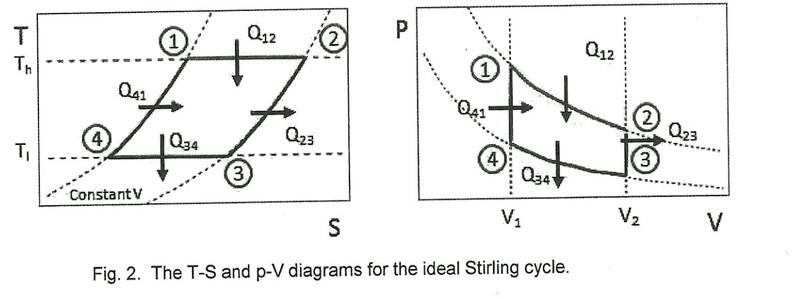
1. Given the following p-V diagram of an ideal Stirling Cycle, determine the theoretical values of W12, Q12, W34 and Q34 in terms of T1, T2, V1, V2, n (the number of moles) and R (the universal gas constant). Determine the total theoretical p-V work W12341 for the full cycle.2. dU = dQ-Pdv3. I've only just started thermodynamics recently, so my grasp on it is still very weak. I've tried finding W12 using W = -∫pdV but I'm not really sure how that gives me theoretical work. I think I'm supposed to end up with some sort of numerical answer for the final part to compare it with an actual p-V work value and find the efficiency of the Stirling Engine.
de424315a5395941d2365d8e794de16e.png
 
Physics news on Phys.org
TheBigDig said:
I've tried finding W12 using W = -∫pdV but I'm not really sure how that gives me theoretical work.
When you write W12 = - ∫p dV, both p and V are changing from 1 to 2. How about replacing p with something else using the ideal gas law?
 
  • Like
Likes   Reactions: Bystander
The working fluid in an ideal Stirling cycle engine goes through four processes :

Compression at constant temperature .
Heat addition at constant volume .
Expansion at constant temperature .
Heat removal at constant volume .

Can you identify the four processes on your diagrams ?

What formulas apply to each process ?

Reading material :

Stirling Cycle
Constant temperature process
Constant volume process
 
Last edited:
Nidum said:
The working fluid in an ideal Stirling cycle engine goes through four processes :

Compression at constant temperature .
Heat addition at constant volume .
Expansion at constant temperature .
Heat removal at constant volume .

Can you identify the four processes on your diagrams ?

What formulas apply to each process ?

Reading material :

Stirling Cycle
Constant temperature process
Constant volume process
Oh thank you! Your response was very illuminating. I hope you don't mind but I'd just like to check I've got this right:
For Isothermal Expansion : W = nRTln[Vf/Vi]
For Isothermal Compression: W = - nRTln[Vf/Vi]
For Heat Addition: Q = nCvΔT
For Heat Removal: Q = - nCvΔT
 

Similar threads

Replies
14
Views
2K
  • · Replies 1 ·
Replies
1
Views
2K
  • · Replies 2 ·
Replies
2
Views
1K
Replies
10
Views
2K
  • · Replies 3 ·
Replies
3
Views
3K
  • · Replies 3 ·
Replies
3
Views
2K
Replies
3
Views
3K
Replies
8
Views
3K
  • · Replies 7 ·
Replies
7
Views
5K
  • · Replies 3 ·
Replies
3
Views
1K