Finding the work done by a Stirling Cycle

Join the discussion
Ask a follow-up here, or get your own question answered by working scientists, mathematicians and engineers — people, not an autocomplete.
Real named experts · corrections over time · the nuance an AI answer skips
3 replies · 5K views
TheBigDig
Messages
65
Reaction score
2
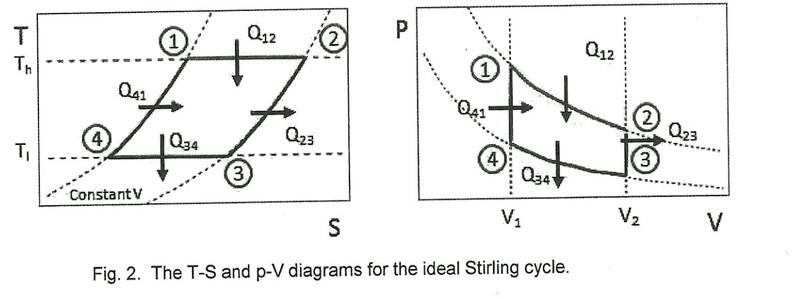
1. Given the following p-V diagram of an ideal Stirling Cycle, determine the theoretical values of W12, Q12, W34 and Q34 in terms of T1, T2, V1, V2, n (the number of moles) and R (the universal gas constant). Determine the total theoretical p-V work W12341 for the full cycle.2. dU = dQ-Pdv3. I've only just started thermodynamics recently, so my grasp on it is still very weak. I've tried finding W12 using W = -∫pdV but I'm not really sure how that gives me theoretical work. I think I'm supposed to end up with some sort of numerical answer for the final part to compare it with an actual p-V work value and find the efficiency of the Stirling Engine.
de424315a5395941d2365d8e794de16e.png
 
Physics news on Phys.org
The working fluid in an ideal Stirling cycle engine goes through four processes :

Compression at constant temperature .
Heat addition at constant volume .
Expansion at constant temperature .
Heat removal at constant volume .

Can you identify the four processes on your diagrams ?

What formulas apply to each process ?

Reading material :

Stirling Cycle
Constant temperature process
Constant volume process
 
Last edited:
Nidum said:
The working fluid in an ideal Stirling cycle engine goes through four processes :

Compression at constant temperature .
Heat addition at constant volume .
Expansion at constant temperature .
Heat removal at constant volume .

Can you identify the four processes on your diagrams ?

What formulas apply to each process ?

Reading material :

Stirling Cycle
Constant temperature process
Constant volume process
Oh thank you! Your response was very illuminating. I hope you don't mind but I'd just like to check I've got this right:
For Isothermal Expansion : W = nRTln[Vf/Vi]
For Isothermal Compression: W = - nRTln[Vf/Vi]
For Heat Addition: Q = nCvΔT
For Heat Removal: Q = - nCvΔT