Fluid dynamics of sailing boat when steering

  • Context: Undergrad 
  • Thread starter Thread starter user079622
  • Start date Start date
  • Tags Tags
    Boat Sailing Steering
Click For Summary
SUMMARY

The discussion focuses on the fluid dynamics of a sailing boat when maneuvering in reverse, particularly the effects of rudder angle on turning radius. It is established that a rudder can stall at low angles of attack (AoA), resulting in reduced lift and increased drag, which can be beneficial for tight turns. The conversation highlights the importance of understanding water flow dynamics and the effective AoA during turns, emphasizing that a stalled rudder can create significant drag, aiding in maneuverability. Practical insights include the use of small rudder angles for effective steering and the distinction between sailing and engine propulsion in maneuvering strategies.

PREREQUISITES
  • Understanding of fluid dynamics principles
  • Knowledge of rudder mechanics and angles of attack (AoA)
  • Familiarity with sailing terminology and maneuvering techniques
  • Experience with boat handling in confined spaces
NEXT STEPS
  • Study the effects of rudder angle on lift and drag in sailing dynamics
  • Learn about the principles of flow separation and stall in hydrodynamics
  • Research techniques for maneuvering boats in confined spaces
  • Explore the differences between sailing propulsion and auxiliary engine use in maneuvering
USEFUL FOR

Sailors, sailing instructors, marine engineers, and anyone interested in the dynamics of boat maneuvering and fluid mechanics in sailing contexts.

user079622
Messages
449
Reaction score
29
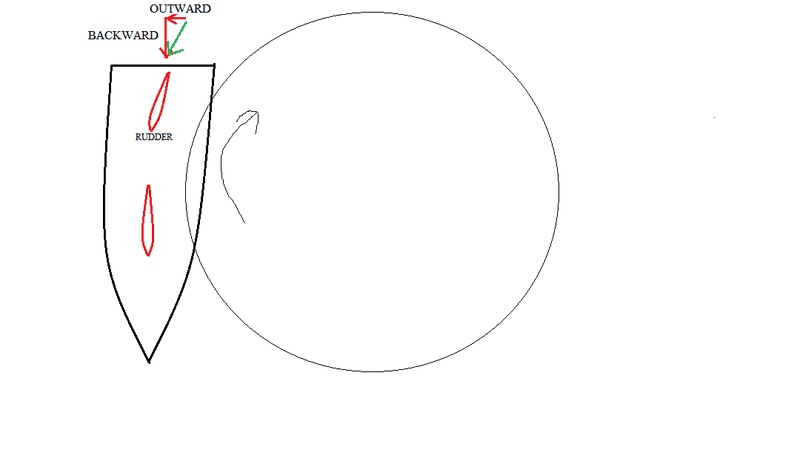
1. Is it possible that sailing boat(going backward) turns less when rudder is full right, then rudder is at some smaller angle?
Due to too high AoA and flow separation/stall, trailing edge of rudder is sharp that also lower stall AoA...

2. Analysis waterflow when object move at curved path.
Can I show flow at rudder with backward component because boat moves backward plus outward flow due to boat rotation around itself?

Untitled.png
 
Physics news on Phys.org
user079622 said:
1. Is it possible that sailing boat(going backward) turns less when rudder is full right, then rudder is at some smaller angle?
Due to too high AoA and flow separation/stall, trailing edge of rudder is sharp that also lower stall AoA...
Yes, as you said, the rudder can stall and produce less "lift" than when it has attached flow.

user079622 said:
2. Analysis waterflow when object move at curved path.
Can I show flow at rudder with backward component because boat moves backward plus outward flow due to boat rotation around itself?
Any vector (water flow field in your case) can be expressed as a sum of independent vectors that span the space. Usually we like to make them orthogonal, as you have.
 
user079622 said:
sailing boat(going backward)
I'm just curious: why would you want to sail a sailboat backwards?
 
berkeman said:
I'm just curious: why would you want to sail a sailboat backwards?
Sometimes you have to; docking and such.
Sometimes you mess up and do it by accident; in irons and the subsequent recovery.
Sometimes you're just showing off.

But it never works very well, LOL.

PS. Then there's the whole reference frame thing. I recall a beautiful spring day sailing backwards along the Marina district in SF bay. The knot meter said 2 knots or so, but the buildings were going backwards.
 
  • Like
  • Informative
Likes   Reactions: russ_watters and berkeman
DaveE said:
Yes, as you said, the rudder can stall and produce less "lift" than when it has attached flow.
foil produce approx same lift at 45° AoA as at max AoA, but has drop between two..
Trailing edge of rudder is sharp so rudder will stall at low AoAs, I think even lower than 8°, so from this theory you must use only small rudder angles if you want to steer "hard" this is opposite from human practice in cars..

Lift must point perpendicular to boat centerline for max steering, that also mean small rudder angle, so what is best angles to steer for smaller radius of path? In practice people often steer full to one side, which will stall rudder for sure..

7Abww.png


DaveE said:
Any vector (water flow field in your case) can be expressed as a sum of independent vectors that span the space. Usually we like to make them orthogonal, as you have.
How can I determine direction of resultant water flow vector at rudder?


berkeman said:
I'm just curious: why would you want to sail a sailboat backwards?
Because boat are docked with stern.
Beginners +wind docking almost always results in crash, you can see these crashes on youtube...
 
A sailing boat will travel downwind backwards. The rudder is pointed in the direction you wish to travel. Steering will work over a maximum of approx +/- 75 degrees relative to the wind direction, but no more. The sails and/or hull and rig -are just providing drag and no aerofoil action. An additional steering moment can be obtained by holding the boom out against the wind on one side or the other.
Regarding the max rudder angle, there are two modes possible. The first is the aerofoil condition, where we keep a small angle of attack, and the other is the "barn door" method when we put the rudder well over. In this case there is no smooth water flow but the rudder is used as a drag. I find this is sometimes useful when starting to go astern under power.
 
  • Like
Likes   Reactions: pbuk
The UC Berkeley yacht club required backward sailing to pass the test to be able to take out boats.
This was important, because sometimes you had to back in to the dock because of the funny Berkeley winds.
To sail straight back, just keep the tiller pointing toward a fixed point on the shore.
What was more efficient in turning didn't matter because, if you turned just a little bit too much, you started to spin. That was quickly followed by a capsize.
 
Please also note that the moment your boat starts turning the flow into the rudder is not from straight ahead (or aft..) anymore. So this allows you to have a much greater rudder angle than what theory would suggest is possible compared to neutral.

In the sailing school where I worked a long time ago it was common to start steering slowly and increase angle as the rotation rate of the boat increases. [edit] if the goal was to make a sharp as possible turn[/edit]
 
  • Like
Likes   Reactions: tech99
tech99 said:
the other is the "barn door" method when we put the rudder well over. In this case there is no smooth water flow but the rudder is used as a drag
This.

@user079622 you seem to be focusing on maximising the rate of turn with respect to time; when manoeuvring a boat in a confined space time is usually less important than the rate of turn with respect to distance - it doesn't matter if it takes you 10 seconds to turn your boat round or 20, but if your turning circle is 1 metre larger than the space available you have a problem.

In this case a stalled rudder creating a large amount of drag is exactly what you want.
 
Last edited:
  • Like
Likes   Reactions: russ_watters
  • #10
Arjan82 said:
Please also note that the moment your boat starts turning the flow into the rudder is not from straight ahead (or aft..) anymore. So this allows you to have a much greater rudder angle than what theory would suggest is possible compared to neutral.
Yes this correct because flow in turn is curved, so effective AoA at rudder is reduced, that help to delay flow separation..

The-steady-state-cornering-flow-conditions.png


pbuk said:
This.

@user079622 you seem to be focusing on maximising the rate of turn with respect to time; when manoeuvring a boat in a confined space time is usually less important than the rate of turn with respect to distance - it doesn't matter if it takes you 10 seconds to turn your boat round or 20, but if your turning circle is 1 metre larger than the space available you have a problem.

In this case a stalled rudder creating a large amount of drag is exactly what you want.
I am interested at minimum radius of turn..
So you want to say that sailing boat has smallest radius of turn always with rudder full at one side(deep stall), position where rudder almost act as brake not foil?
 
  • #11
user079622 said:
So you want to say that sailing boat has smallest radius of turn always with rudder full at one side(deep stall), position where rudder almost act as brake not foil?
No, I want to say exactly what I did say:
pbuk said:
... a stalled rudder creating a large amount of drag is exactly what you want.
which does not include the words "always" or "full at one side".

In the real world we turn a boat using our experience of the handling characteristics of that boat (including centre of rotation, rudder overbalance, prop walk and other factors you have not taken into consideration) and observation of conditions including speed and direction of the wind and of tidal or other stream.

Finally can I suggest that you think about the difference between "a sailing boat" i.e. a boat that is being propelled by the forces of the wind on its sails and the water on its foils (in which case you need to consider the turning moment due to the distance between the centre of effort of the sails and the centre of effort of the keel), or if you actually mean "a boat that is normally propelled by sails but is currently being propelled by an auxiliary engine".
 
  • Like
Likes   Reactions: DaveE

Similar threads

Replies
0
Views
2K
  • · Replies 6 ·
Replies
6
Views
3K
  • · Replies 3 ·
Replies
3
Views
10K
  • · Replies 31 ·
2
Replies
31
Views
4K
  • · Replies 27 ·
Replies
27
Views
10K
  • · Replies 45 ·
2
Replies
45
Views
6K
  • · Replies 24 ·
Replies
24
Views
4K
Replies
5
Views
3K
  • · Replies 5 ·
Replies
5
Views
2K