Fluid Dynamics - Using the Manometer Equation

Click For Summary
SUMMARY

The discussion centers around the application of the manometer equation in fluid dynamics, specifically addressing the calculation of height differences in a U-shaped tube containing mercury and water. The participants clarify that the pressure at both ends of the reservoir is atmospheric, leading to a misunderstanding regarding the change in pressure. The correct interpretation reveals that the hydrostatic pressure difference can be calculated using the formula (delta)P = pg(delta)h, resulting in a height difference of 3.15 meters for the water column induced by the mercury column of 25 cm.

PREREQUISITES
  • Understanding of hydrostatic pressure principles
  • Familiarity with the manometer equation and its applications
  • Knowledge of fluid density, specifically for mercury (13.60 Mg/m³) and water (1.00 Mg/m³)
  • Basic grasp of Bernoulli's principle in fluid mechanics
NEXT STEPS
  • Study the derivation and applications of the manometer equation in various fluid scenarios
  • Learn how to calculate pressure differences in fluid columns using hydrostatic principles
  • Explore Bernoulli's equation and its limitations in static fluid scenarios
  • Investigate real-world applications of manometers in engineering and fluid measurement
USEFUL FOR

Students and professionals in engineering, particularly those specializing in fluid dynamics, as well as anyone involved in practical applications of pressure measurement using manometers.

dylanwalt
Messages
6
Reaction score
4
Homework Statement
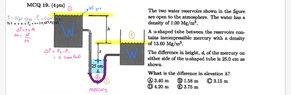
The two water reservoirs shown in the figure are open to the atmosphere. The water has a density of 1.00 Mg/m°.
A u-shaped tube between the reservoirs contains incompressible mercury with a density of 13.60 Mg/m'.
The difference in height, d, of the mercury on either side of the u-shaped tube is 25.0 cm as shown.
What is the difference in elevation h?
Relevant Equations
(delta)P=pg(delta)h
I tried to use this equation, so I isolated the delta h because that is what im solving for and then I thought because the pressure on both ends of the reservoir is both atmospheric pressure the change in pressure is 0. This makes my entire equation 0 and thus height is 0 which is definitely not the case.
 

Attachments
  • IMG_0771.jpg
    IMG_0771.jpg
    29.8 KB · Views: 148
Physics news on Phys.org
Think of the two reservoirs as the right hand side and left hand side of an equation. In this instance the equation for pressure. You would put mercury's pressure on the right hand side.

P_h + Px + P25 = Pmerc + Px
 
Last edited:
dylanwalt said:
Homework Statement: The two water reservoirs shown in the figure are open to the atmosphere. The water has a density of 1.00 Mg/m°.
A u-shaped tube between the reservoirs contains incompressible mercury with a density of 13.60 Mg/m'.
The difference in height, d, of the mercury on either side of the u-shaped tube is 25.0 cm as shown.
What is the difference in elevation h?
Relevant Equations: (delta)P=pg(delta)h

I tried to use this equation, so I isolated the delta h because that is what im solving for and then I thought because the pressure on both ends of the reservoir is both atmospheric pressure the change in pressure is 0. This makes my entire equation 0 and thus height is 0 which is definitely not the case.
You appear to be using Bernoulli's between 1 and 3? While not wrong...it's not going to get you anywhere. You have to think about the pressures at the various points in the manometer. You can relate these from surface ##\enclose{circle}{\text{1}}## to surface ##\enclose{circle}{\text{3}}##.
 
Is it clear to you that, at the bottom of the blue section in either leg of the manometer, the pressures are equal (since there is only mercury of equal heights in the two legs below this level)?
 
  • Like
Likes   Reactions: scottdave and erobz
Yes it is clear to me, I worked it out. I used the idea that the pressure on the left is equal to the pressure on the right because the system is in equilibrium and then placed all the values in and got an answer of 3.15 meters.
 
  • Like
Likes   Reactions: Chestermiller, osilmag, Steve4Physics and 1 other person
dylanwalt said:
Yes it is clear to me, I worked it out. I used the idea that the pressure on the left is equal to the pressure on the right because the system is in equilibrium and then placed all the values in and got an answer of 3.15 meters.
Welcome, @dylanwalt !

For homework questions, we require you to show your attempt to resolve the problem.

Another way to see it:
A hydrostatic pressure able to create a 0.25-meter column of mercury, will be able to induce a [(13.60 / 1.00) x 0.25]-meter column of water (which is not equal to answer C).
 
Lnewqban said:
A hydrostatic pressure able to create a 0.25-meter column of mercury, will be able to induce a [(13.60 / 1.00) x 0.25]-meter column of water (which is not equal to answer C).
To avoid possible confusion, it's worth noting that the question asks for the value of ##h##. But ##h## is not the length of a "[(13.60 / 1.00) x 0.25]-meter column of water".

So, unless I'm misunderstanding something, the OP has the correct answer (C, 3.15m in Post #5).

Minor edit made.
 
Last edited:
  • Like
Likes   Reactions: haruspex and erobz

Similar threads

Replies
2
Views
1K
Replies
2
Views
1K
  • · Replies 13 ·
Replies
13
Views
1K
Replies
9
Views
2K
  • · Replies 6 ·
Replies
6
Views
3K
  • · Replies 56 ·
2
Replies
56
Views
4K
Replies
1
Views
2K
Replies
12
Views
2K
  • · Replies 5 ·
Replies
5
Views
2K
  • · Replies 11 ·
Replies
11
Views
6K