Fluid flow acceleration in a channel

Click For Summary

Discussion Overview

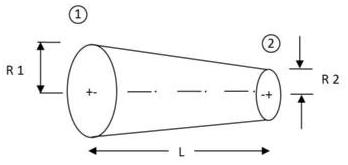
The discussion revolves around a fluid mechanics problem involving the acceleration of fluid flow in a two-dimensional converging channel with a linearly varying cross-sectional area. Participants explore how to determine the flow acceleration along the x-axis given known values for area and discharge.

Discussion Character

  • Homework-related
  • Technical explanation
  • Conceptual clarification
  • Debate/contested

Main Points Raised

  • One participant presents the equation for area as A(x)=(A2-A1/L).x+A1 and questions how to relate discharge Q to velocity.
  • Another participant notes the ambiguity of the term "discharge" and seeks clarification on its intended meaning.
  • It is suggested that at steady state, acceleration can be expressed as vdv/dx, referencing momentum balance equations.
  • There is a discussion about whether the velocity v should be considered as mean velocity or as a velocity field, with implications for calculating acceleration using the material derivative.
  • One participant proposes that the problem likely assumes a flat velocity profile due to the gradual convergence of the channel.

Areas of Agreement / Disagreement

Participants express uncertainty regarding the definition of discharge and whether to treat velocity as mean or as a field variable. There is no consensus on how to proceed with the calculations, indicating multiple competing views on the approach to the problem.

Contextual Notes

Participants note limitations in the problem statement, including missing assumptions about the velocity profile and the nature of the discharge term.

Proletario
Messages
5
Reaction score
0
MODERATOR NOTE: THIS HOMEWORK WAS SUBMITTED TO A NON-HOMEWORK FORUM SO THERE IS NO TEMPLATE

Hi everyone,

I'm stuck on a fluid mechanics problem and maybe you could help me.

As shown in figure, there is a two-dimensional converging channel, in which cross-section area varies linearly with x. If Q is the discharge, determine the flow acceleration along the x-axis (A1, A2 and L are known).
6119a243-1265-4e02-b2cd-6078d0bd7c5a.jpe


I got for area: A(x)=(A2-A1/L).x+A1

I'm not sure what to do about Q, should Q=A.v be used? Any hint about how to get the velocity field?

Thanks in advance!
 
Last edited by a moderator:
Physics news on Phys.org
You don't have any other indication about what they want you to use for discharge? That's an ambiguous term.
 
At steady state, the acceleration is vdv/dx. Are you familiar with this term in the momentum balance equations?

Chet
 
Chestermiller said:
At steady state, the acceleration is vdv/dx. Are you familiar with this term in the momentum balance equations?

Chet

Do you mean Navier-Stokes eq.? I still don't know how to get the velocity field... :frown:
 
boneh3ad said:
You don't have any other indication about what they want you to use for discharge? That's an ambiguous term.

No, that's all the information. I think discharge here means volume per time. That's why I tried to use Q=A.v
 
Proletario said:
Do you mean Navier-Stokes eq.? I still don't know how to get the velocity field... :frown:
What about getting v(x) from the two equations in your original post:
A(x)=(A2-A1/L).x+A1
and
Q=A.v

Chet
 
Chestermiller said:
What about getting v(x) from the two equations in your original post:
A(x)=(A2-A1/L).x+A1
and
Q=A.v

Chet

I thought the same, but isn't v the mean velocity? If I can use v as the v-field, then the acceleration is quite simple via material derivative.
 
Proletario said:
I thought the same, but isn't v the mean velocity? If I can use v as the v-field, then the acceleration is quite simple via material derivative.
It's pretty safe to say that this is what they expected you to do. They just forgot to mention that the channel is converging very gradually and that locally you can assume a flat velocity profile.

Chet
 
Chestermiller said:
It's pretty safe to say that this is what they expected you to do. They just forgot to mention that the channel is converging very gradually and that locally you can assume a flat velocity profile.

Chet

Wow, so obvious. Thanks Chet. :bow:
 

Similar threads

  • · Replies 9 ·
Replies
9
Views
3K
Replies
31
Views
4K
Replies
2
Views
3K
  • · Replies 2 ·
Replies
2
Views
6K
  • · Replies 3 ·
Replies
3
Views
2K
  • · Replies 5 ·
Replies
5
Views
2K
  • · Replies 5 ·
Replies
5
Views
3K
  • · Replies 9 ·
Replies
9
Views
4K
Replies
1
Views
3K
  • · Replies 25 ·
Replies
25
Views
5K