Flux Density, B, of a Cylindrical Magent

Click For Summary

Discussion Overview

The discussion centers on calculating the flux density (B) of a cylindrical magnet, specifically focusing on determining the distance (z) from the pole face along the symmetrical axis. Participants explore the implications of this distance on the calculation and the nature of the magnetic field.

Discussion Character

  • Exploratory
  • Technical explanation
  • Homework-related

Main Points Raised

  • One participant seeks assistance in finding the value of z, the distance from the pole face on the symmetrical axis, necessary for calculating flux density.
  • Another participant suggests that z is merely a variable and implies that an equation exists for calculating flux density at varying distances along the z-axis.
  • A participant expresses uncertainty about the nature of z, proposing that it might be a set value related to the height of the flux field, but admits to lacking knowledge about the height of the flux field.
  • It is asserted by one participant that the flux density does change with respect to z, contradicting the earlier assumption that it remains constant.
  • A question is raised regarding the calculation of B when the distance is horizontal from the magnet rather than vertical, suggesting the need for a different formula.

Areas of Agreement / Disagreement

Participants do not reach consensus on the nature of z or whether the flux density remains constant with respect to z. Multiple viewpoints regarding the calculation methods and implications of distance remain present.

Contextual Notes

There are unresolved assumptions regarding the relationship between z and the flux density, as well as the specifics of the equations applicable for different orientations of measurement.
Bri1
Messages
4
Reaction score
1
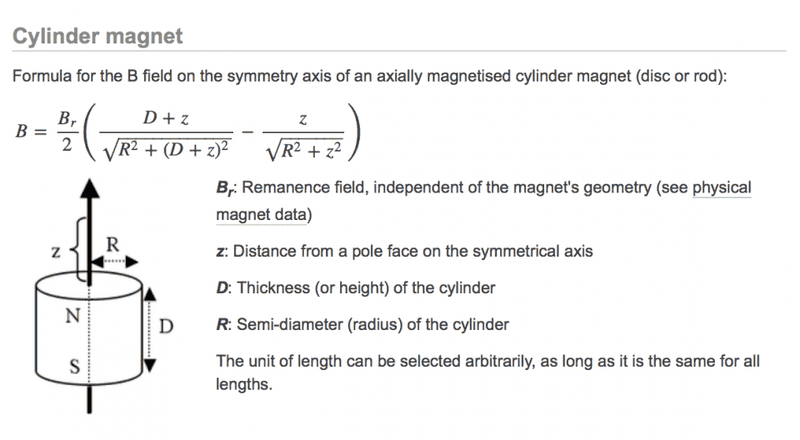
Hi, I'm trying to calculate the flux density of a magnet, I can get all but one of the values needed to calculate it. Does anyone know how/where to get the z(distance from a pole face on the symmetrical axis) value?
Screen Shot 2017-02-21 at 12.33.07 PM.png
 
Engineering news on Phys.org
Bri1 said:
Hi, I'm trying to calculate the flux density of a magnet, I can get all but one of the values needed to calculate it. Does anyone know how/where to get the z(distance from a pole face on the symmetrical axis) value?View attachment 113520
Welcome to the PF.

z is just a variable. It looks like you have an equation there which would work along the z axis for varying distances, no?

BTW, is this for schoolwork or a hobby project?
 
berkeman said:
Welcome to the PF.

z is just a variable. It looks like you have an equation there which would work along the z axis for varying distances, no?

BTW, is this for schoolwork or a hobby project?

Thanks for responding, It's for school but it feels more like a hobby, I was thinking of just assuming a value for z. I'm studying mechanical engineering so electrical isn't my strong point. But I believe it might be a set value, maybe a distance from the pole face to the height of the flux field? but then I don't know the height of the flux field anyway

My reason for thinking its a set value is because the flux density of the magnet shouldn't change with respect to z not so?
 
Bri1 said:
Thanks for responding, It's for school but it feels more like a hobby, I was thinking of just assuming a value for z. I'm studying mechanical engineering so electrical isn't my strong point. But I believe it might be a set value, maybe a distance from the pole face to the height of the flux field? but then I don't know the height of the flux field anyway

My reason for thinking its a set value is because the flux density of the magnet shouldn't change with respect to z not so?
No, it definitely changes with distance z. It looks like this:

http://www.4physics.com/phy_demo/NewtonsNightmare/ShortBarMagnetBField.gif
ShortBarMagnetBField.gif

So yes, just use the equation to calculate the flux density at some distance z away from the pole face.
 
Oh okay thanks!

but what if the distance I wanted to calculate B for is horizontally across from the magnet instead of vertically away from it? A different formula?
 

Similar threads

Replies
5
Views
4K
Replies
8
Views
2K
  • · Replies 24 ·
Replies
24
Views
2K
  • · Replies 4 ·
Replies
4
Views
3K
  • · Replies 4 ·
Replies
4
Views
7K
  • · Replies 28 ·
Replies
28
Views
6K
  • · Replies 9 ·
Replies
9
Views
1K
Replies
2
Views
3K
  • · Replies 6 ·
Replies
6
Views
2K
  • · Replies 1 ·
Replies
1
Views
2K