Force acting on superparamagnetic particle

  • Context: Graduate 
  • Thread starter Thread starter Oleg
  • Start date Start date
  • Tags Tags
    Force Particle
Click For Summary

Discussion Overview

The discussion revolves around estimating the force acting on a micron-sized superparamagnetic particle in the field of a permanent magnet. Participants explore the relevant equations, the behavior of magnetic moments in varying magnetic fields, and the implications of cylindrical symmetry in calculations.

Discussion Character

  • Technical explanation
  • Mathematical reasoning
  • Conceptual clarification
  • Debate/contested

Main Points Raised

  • Oleg introduces the equation F = ∇(m⋅B) and questions whether m can be treated as a constant for a given B.
  • Some participants clarify that the expression for force is F = -∇(m⋅B) and discuss the implications of using vector identities in this context.
  • There is a discussion about the conditions under which the magnetic moment can be considered constant, with some suggesting it has a fixed direction and magnitude under certain magnetic field strengths.
  • Oleg seeks clarification on whether the magnetic moment remains parallel to the field when the field strength is below a certain threshold, and participants confirm that it does, with only the magnitude changing.
  • The transition from Cartesian to cylindrical coordinates is discussed, with questions about the physical meaning of certain partial derivatives in cylindrical coordinates.

Areas of Agreement / Disagreement

Participants generally agree on the mathematical framework and the behavior of the magnetic moment in relation to the magnetic field, but there are nuances in understanding the implications of constants and derivatives that remain contested.

Contextual Notes

Participants express uncertainty regarding the treatment of the magnetic moment as a constant and the implications of cylindrical symmetry on the calculations. The discussion includes various interpretations of vector calculus identities and their application in different coordinate systems.

Oleg
Messages
9
Reaction score
0
Hello,

I'm currently doing the project and need to estimate the force that will act on the micron size superparamagnetic particle in the field of permanent magnet.

I found several article there similar problem is solved, but I a bit confused. I hope someone could hep me.
So, the main equation to start with is:
F = ∇(m⋅B),
where B the magnetic field and m - is the magnetic moment, which is also function of B (m = ƒ(B)).
If I have data how magnetic moment (or magnetization) depends on field, like this one:
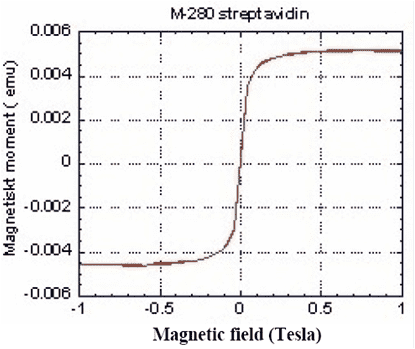
image46.png


could I just use m as a constant for the given B? I so the equation terns to be:
F = m(∇⋅B).
Is it correct?

So next I need to to find ∇⋅B, which is as I understood is gradient of B (i.e. dBx/dx+dBy/dy+dBz/dz). Is it right? I have some doubts because in one article they use ∂Bx/dy term. I just thought that this difference may be due to difference in used magnets (permanent vs electromagnet).

And the last question is that would be direction of force vector? Anti-parallel to field?

I would appreciate your help.

Oleg
 

Attachments

  • image46.png
    image46.png
    29.3 KB · Views: 725
Physics news on Phys.org
Hi Oleg and welcome to PF.

The expression is ##\vec F=-\vec{\nabla}(\vec{m}\cdot \vec{B}).## I would use the vector identity ##\vec{\nabla}(\vec{A}\cdot \vec {B})=\vec{A}\times(\vec{\nabla}\times \vec{B})+\vec{B}\times(\vec{\nabla}\times \vec{A})+(\vec{A} \cdot \vec{\nabla} ) \vec{B}+(\vec{B} \cdot \vec{\nabla} ) \vec{A}.##
Note that the third term can be expanded as $$(\vec{A} \cdot \vec{\nabla} ) \vec{B}=\left( A_x\frac{\partial}{\partial x} +A_y\frac{\partial}{\partial y} +A_z\frac{\partial}{\partial z} \right)(B_x \hat x+B_y \hat y +B_z \hat z) $$ and similarly for the fourth term. It looks scary, but a lot of terms vanish. Yes, you can use m as a constant because although it depends on the external magnetic field, its spatial derivatives vanish. Eventually, you will get terms like the one described in the article. Which field derivatives you should use depend on the shape of the pole faces. Usually, there is a dominant derivative while the others may approximately be set to zero. The shape of the pole faces determines the gradient components which in turn determine the direction of the force.
 
  • Like
Likes   Reactions: berkeman and Oleg
Hi kuruman,

thank you for your explanation. Now I understand where ∂Bx/dy term comes from.
Talking about my particular case - I'll use disc magnet so I have some symmetry and Bz term turns to 0. But after this vector identity I scary that I'm don't know that "magnetic moment is going to be a constant" is actually means:
1) Is it become a scalar or
2) constant vector (same length and direction in any spatial point)?

In first case - could we than simplify the original equation to:
$$m⋅(\vec ∇\vec B) = m⋅\begin{vmatrix} i & j & k \\ \frac {d} {dx} & \frac {d} {dy} & \frac {d} {dz} \\ B_x & B_y & B_z \end{vmatrix}$$

In second case - how to find x, y, z components of ##\vec m ## (i.e. that is direction of magnetic moment in compare to the field)?
 
Oleg said:
In first case - could we than simplify the original equation to:
No, we cannot. It's not the same equation and that's why I wrote out the correct expansion. Force is a vector but what you show is the scalar quantity ##\vec{m} \cdot (\vec{\nabla} \times \vec{B})##.
Oleg said:
...I'm don't know that "magnetic moment is going to be a constant" is actually means ...
It means that it has fixed direction and magnitude. Look at the graph you posted. If you define as ##z## the direction of the magnetic field at the location where your sample is, then your graph says that as long as the magnitude of the magnetic field is greater than about 0.3 T, the magnetic moment points in the same direction as the field and has magnitude about 0.005 emu.

If you use a strong enough disc magnet of cylindrical symmetry and you place your sample on the z-axis, then you can approximate ##\vec{m}\approx m \hat z## and the field ##\vec{B}\approx B(z) \hat z##. So the force becomes ##\vec{F} \approx m \frac{\partial B_z}{\partial z} \hat z##. Needless to say, if you plan to take your own measurements, you must calibrate your method by measuring the force on a standard sample.
 
  • Like
Likes   Reactions: Oleg
Thank you. Now, I think, I understood.
 
Hi kuruman,

it's me again... :)

kuruman said:
If you define as ##z## the direction of the magnetic field at the location where your sample is, then your graph says that as long as the magnitude of the magnetic field is greater than about 0.3 T, the magnetic moment points in the same direction as the field and has magnitude about 0.005 emu.

Please clarify, if magnetic field is less then 0.3 T the magnetic moment still point at the same direction (parallel to field) and only magnitude is changing?

Thanks in advance!
 
Oleg said:
Please clarify, if magnetic field is less then 0.3 T the magnetic moment still point at the same direction (parallel to field) and only magnitude is changing?
Yes, that's what the graph that you posted is saying.
 
  • Like
Likes   Reactions: Oleg
Great! But how did you understand that?
 
Oleg said:
Great! But how did you understand that?
I looked at the graph that you posted. It shows that when the magnetic field (horizontal axis) is negative, the magnetic moment (vertical axis) is also negative. When the magnetic field is positive, the magnetic moment is also positive. When the field is zero, the magnetic moment is zero. All this says to me that the magnetic moment follows the magnetic field like a compass needle more or less. Actually the moment that is plotted in the graph is the sum of many moments some of which may be at an angle with respect to magnetic field. The reason that they are not all lined at values lower than about 0.3 T is because of thermal fluctuations. However, at fields greater than about 0.5 T the magnetic energy overwhelms the thermal energy and the "magnetic needles" are all pulled in the direction of the field and the total magnetic moment of the sample saturates.
 
  • Like
Likes   Reactions: Oleg
  • #10
And one more question about this:
kuruman said:
The expression is ##\vec F=-\vec{\nabla}(\vec{m}\cdot \vec{B}).## I would use the vector identity ##\vec{\nabla}(\vec{A}\cdot \vec {B})=\vec{A}\times(\vec{\nabla}\times \vec{B})+\vec{B}\times(\vec{\nabla}\times \vec{A})+(\vec{A} \cdot \vec{\nabla} ) \vec{B}+(\vec{B} \cdot \vec{\nabla} ) \vec{A}.##
Note that the third term can be expanded as $$(\vec{A} \cdot \vec{\nabla} ) \vec{B}=\left( A_x\frac{\partial}{\partial x} +A_y\frac{\partial}{\partial y} +A_z\frac{\partial}{\partial z} \right)(B_x \hat x+B_y \hat y +B_z \hat z) $$ and similarly for the fourth term.

In my case the task has cylindrical symmetry and I want to shift from Cartesian to cylindrical coordinates. In Wikipedia I found the nabla formulas in cylindrical coordinates (https://en.wikipedia.org/wiki/Del_in_cylindrical_and_spherical_coordinates). Is quite understandable but I'm not sure in physical meaning of such partial derivatives as ##\frac{\partial (\rho A_\rho)}{\partial \rho} ##. Simple ##\frac{\partial (A_\rho)}{\partial \rho} ## means the change in ##\rho## component of vector ##\vec{A}## while we moves along radius vector. What does additional ##\rho## change?
 
  • #11
Oleg said:
What does additional ##\rho## change?
It doesn't change anything. It's what's needed to transform from Cartesian to cylindrical coordinates. The term ##\frac{\partial (\rho A_{\rho})}{\partial \rho}## means the "change of ##(\rho A_{\rho})## with respect to ##\rho## keeping ##\theta## and ##z## constant. If you are wondering why it's there, you need to start from the Cartesian expression of whatever operator you are working on and transform to cylindrical using the chain rule. I call your attention to the material derivative ##(\vec{A} \cdot \vec{\nabla} ) \vec{B}## already derived for you in cylindrical coordinates near the bottom of the link you provided.
 
  • Like
Likes   Reactions: Oleg

Similar threads

  • · Replies 0 ·
Replies
0
Views
409
  • · Replies 11 ·
Replies
11
Views
3K
  • · Replies 1 ·
Replies
1
Views
2K
  • · Replies 4 ·
Replies
4
Views
2K
  • · Replies 1 ·
Replies
1
Views
1K
  • · Replies 14 ·
Replies
14
Views
2K
  • · Replies 5 ·
Replies
5
Views
2K
  • · Replies 5 ·
Replies
5
Views
1K
  • · Replies 3 ·
Replies
3
Views
1K
  • · Replies 12 ·
Replies
12
Views
2K