su3liminal1
- 1
- 0
- Homework Statement
- Find the percentage of these states that have electrons in them, assuming the number of electrons above Ec+2kT is negligible.
- Relevant Equations
- -
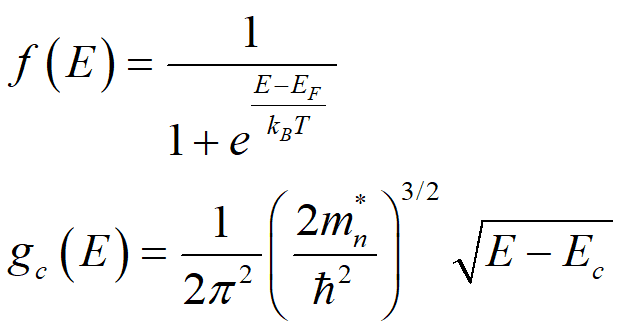
I just want to clear some confusion I am having with the Fermi-Dirac distribution & density of states (DOS) of a semiconductor, which are given by
Say we have a piece of Silicon in equilibrium and its Fermi level lies 0.25 eV below the conduction band edge, i.e. Ec - EF = 0.25 eV. Let us say we want to compute two things:
(1) Total number of states in the range Ec ≤ E ≤ E+ 2kBT.
(2) The percentage of these states that have electrons in them, assuming the number of electrons above Ec+2kBT is negligible.
For (1), it is straight forward: we just integrate the density of states function in the conduction band, gc(E) over the indicated range:

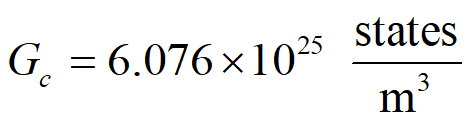
At room temperature and using an effective mass of silicon is, say, mn*=1.09m0. This yields
For (2), I know that the Fermi-Dirac distribution in this context represents the the probability of an electron occupying a state at energy E, which can also be interpreted as the ratio of filled state to total states at the energy. But I am really not sure what do here. Do I compute the difference of Fermi-Dirac distributions in that range, or do I integrate, or both are wrong?
Say we have a piece of Silicon in equilibrium and its Fermi level lies 0.25 eV below the conduction band edge, i.e. Ec - EF = 0.25 eV. Let us say we want to compute two things:
(1) Total number of states in the range Ec ≤ E ≤ E+ 2kBT.
(2) The percentage of these states that have electrons in them, assuming the number of electrons above Ec+2kBT is negligible.
For (1), it is straight forward: we just integrate the density of states function in the conduction band, gc(E) over the indicated range:
At room temperature and using an effective mass of silicon is, say, mn*=1.09m0. This yields
For (2), I know that the Fermi-Dirac distribution in this context represents the the probability of an electron occupying a state at energy E, which can also be interpreted as the ratio of filled state to total states at the energy. But I am really not sure what do here. Do I compute the difference of Fermi-Dirac distributions in that range, or do I integrate, or both are wrong?

