Gauss' law and an object with nonuniform charge distribution

Click For Summary

Discussion Overview

The discussion revolves around the application of Gauss' law to a non-uniformly charged spherical shell and the implications for the electric field in various scenarios. Participants explore the relationship between charge distribution, electric field, and the mathematical formulations of Gauss' law, including both integral and differential forms.

Discussion Character

  • Exploratory
  • Technical explanation
  • Debate/contested
  • Mathematical reasoning

Main Points Raised

  • One participant questions whether the electric field is zero on a Gaussian surface surrounding a non-conducting spherical shell with no charge inside, reflecting on the application of Gauss' law.
  • Another participant clarifies that Gauss' law indicates the integral of the electric field over the surface is zero, not necessarily the field itself.
  • A comparison is made to a parallel plate capacitor, suggesting that the electric field is not zero even if the total flux through a Gaussian surface is zero.
  • Participants discuss the concept of electric field lines and their behavior in relation to surfaces enclosing net charge versus those that do not.
  • There is a discussion about the divergence of the electric field, with one participant proposing that it is zero when there is no charge inside, while another refines this by explaining the distinction between pointwise divergence and integral forms of Gauss' law.
  • One participant asserts that Gauss' law applies regardless of charge distribution, emphasizing that the total charge inside a closed surface can be zero while still containing both positive and negative charges.
  • Another participant notes the relationship between the integral and differential forms of Gauss' law, referencing Gauss's Integral Theorem.

Areas of Agreement / Disagreement

Participants express differing views on the implications of Gauss' law in the context of non-uniform charge distributions. While some agree on the mathematical principles, there is no consensus on the interpretation of the electric field behavior in specific scenarios.

Contextual Notes

Participants highlight limitations in understanding the divergence of the electric field and its relationship to charge distribution, indicating that the discussion is nuanced and dependent on specific conditions and definitions.
Leo Liu
Messages
353
Reaction score
156
Gauss' law: $$\iint_{\partial A}\vec E\cdot d\vec A=\frac{Q}{\epsilon_0}$$
1641987043291.png

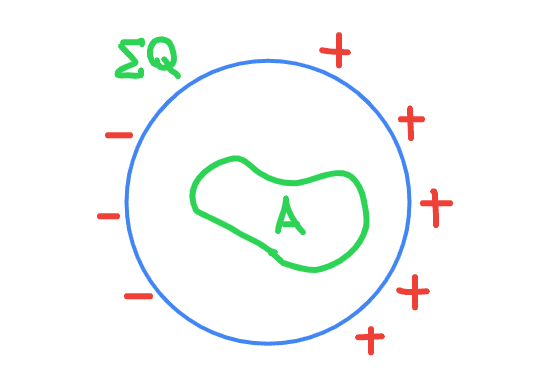
Suppose we have a unevenly charged non-conducting spherical shell, in which a Gaussian surface is placed. In this case, is the electrical field on A 0, given that there is no charge inside A? I came up with this example to ascertain whether the G's law applied to a body with nonuniform charge distribution.
Thanks.

EDIT: In hindsight, I realized I asked a very dumb question. Sorry for wasting the time of all of us. Haha.
 
Last edited:
Physics news on Phys.org
Gauss' law does not say that the field is zero - it says (roughly) that the component of the field perpendicular to the Gaussian surface, summed over the whole surface is zero. Your charge distribution looks like a parallel plate capacitor, just with the plates a bit bent. Is the electric field inside a capacitor zero?

An actual parallel plate capacitor is easier to understand. Draw a parallel plate capacitor with very large plates. What does the electric field look like? Draw a Gaussian surface that is a long thin rectangle, with the long side parallel to the plates. Which way does ##d\vec A## point on each of the four sides? So what is ##\vec E.d\vec A## on each of the four sides? So what is the integral over the whole surface?
 
  • Like
Likes   Reactions: Leo Liu
Right. Let's put this imaginary gigantic capacitor, whose left plate carries positive charge on a plane so that its gap is parallel to the y axis. Then the electric flux flowing through the left side of the rectangle is ##\mathbf{\Phi}_l=QA/\epsilon_0\;\hat i##, and the flux passing through the right side of the rectangle is ##\mathbf{\Phi}_r=-QA/\epsilon_0\;\hat i##. It follows that the total flux summed over the closed surface is 0, suggesting that there is no charge inside the rectangle.
 
  • Like
Likes   Reactions: Ibix and Dale
That's right. The field isn't zero (nor is it in your original diagram), but the integral of the field dotted with the vector area is zero. It means that if you draw field lines you'll find that any field line that crosses the surface crosses it again somewhere in the opposite direction. That isn't the case with a surface that encloses net charge, because field lines will start on the charge and at least some will go out to infinity, crossing the surface only once (or some other odd number of times if your surface is complicated).
 
  • Like
Likes   Reactions: Leo Liu
Ibix said:
That's right. The field isn't zero (nor is it in your original diagram), but the integral of the field dotted with the vector area is zero. It means that if you draw field lines you'll find that any field line that crosses the surface crosses it again somewhere in the opposite direction. That isn't the case with a surface that encloses net charge, because field lines will start on the charge and at least some will go out to infinity, crossing the surface only once (or some other odd number of times if your surface is complicated).
Is it correct to say that, mathematically, the divergence of the electric field is 0 when there is no charge inside, and is nonzero when there is a charge inside which acts as a faucet or a sink?
 
It's always simpler to think in terms of the differential form of Maxwell equations. One is Gauss's Law for the electric charge,
$$\vec{\nabla} \cdot \vec{E}=\frac{1}{\epsilon_0} \rho,$$
which means that the source of the electric field are electric charges.
 
  • Like
Likes   Reactions: Leo Liu and Ibix
Leo Liu said:
Is it correct to say that, mathematically, the divergence of the electric field is 0 when there is no charge inside, and is nonzero when there is a charge inside which acts as a faucet or a sink?
Not quite. The divergence of a field is defined at a point, whereas the integral form of Gauss' law is defined over a volume. So if you have a volume that includes a negative charge (gives a positive divergence at that point) and an equal positive charge (negative divergence at that point), the integral of divergence over the volume can be zero even if the divergence isn't zero everywhere.

So it is correct to say that if the integral ##\iint_S\vec E\cdot d\vec A## over a closed surface ##S## is zero then the total divergence over the enclosed region is zero, but not necessarily that the divergence is everywhere zero.
 
  • Like
  • Informative
Likes   Reactions: vanhees71 and Leo Liu
I think Gauss's law states that the flux of the electric field out of an arbitrary closed surface is proportional to the total charge enclosed by that surface, no matter how the charges are distributed and how fast they are moving.

That is, even if the total electric flux through the closed surface is zero, in this case, the total charge inside must be zero, but there can still be positively charged objects, negatively charged objects and electric fields inside the closed surface.
 
Last edited:
  • Like
Likes   Reactions: vanhees71
Of course the integral form follows from the differential form (and vice versa) via Gauss's Integral Theorem,
$$\frac{Q_V}{\epsilon_0}=\int_{V} \mathrm{d}^3 x \vec{\nabla} \cdot \vec{E}=\int_{\partial V} \mathrm{d}^2 \vec{f} \cdot \vec{E}.$$
So the "flux" of the electric field through a closed surface is the charge within the enclosed volume (modulo a unit-conversion factor ##1/\epsilon_0##).
 
  • Like
Likes   Reactions: Ibix

Similar threads

  • · Replies 1 ·
Replies
1
Views
2K
  • · Replies 7 ·
Replies
7
Views
779
  • · Replies 29 ·
Replies
29
Views
2K
Replies
4
Views
2K
  • · Replies 1 ·
Replies
1
Views
3K
  • · Replies 1 ·
Replies
1
Views
1K
  • · Replies 4 ·
Replies
4
Views
3K
  • · Replies 5 ·
Replies
5
Views
3K
  • · Replies 1 ·
Replies
1
Views
1K
  • · Replies 5 ·
Replies
5
Views
3K