Generate a trackmap with speed and g forces

  • Context: Undergrad 
  • Thread starter Thread starter Gwen49
  • Start date Start date
  • Tags Tags
    G-forces Speed
Click For Summary

Discussion Overview

The discussion revolves around generating a trackmap using speed and G-forces data in Excel. Participants share their experiences and challenges related to data processing and visualization, with a focus on both personal projects and potential academic applications.

Discussion Character

  • Exploratory
  • Technical explanation
  • Debate/contested
  • Homework-related

Main Points Raised

  • One participant seeks help in generating a trackmap from speed and G-forces data, expressing a desire for explanations and learning.
  • Another participant advises against attaching files that may contain macros, suggesting a PDF screenshot instead.
  • Concerns are raised about the data structure, including missing time intervals and potential issues with the lateral acceleration units.
  • Specific mathematical corrections are proposed regarding the calculations for angles and positions in the Excel spreadsheet.
  • A participant expresses feeling stuck due to uncertainty about certain variables (Ao and A) necessary for solving equations related to the trackmap.
  • Clarifications are provided regarding the definitions of angles and their relationships in the context of the trackmap generation.
  • One participant expresses gratitude for assistance received and reports progress on their project.
  • Questions arise about the final version of the spreadsheet and the possibility of applying correction factors to the data for accuracy.
  • A participant shares their personal project of building a dash logger for a track bike, emphasizing the need for accurate data representation.

Areas of Agreement / Disagreement

Participants express varying levels of understanding and approaches to the problem, with some providing corrections and others seeking clarification. No consensus is reached on the best method to generate the trackmap or the specific data handling techniques.

Contextual Notes

Limitations include potential missing assumptions about data collection methods, the need for clarification on units of measurement, and unresolved mathematical steps in the calculations discussed.

Who May Find This Useful

This discussion may be of interest to individuals working on data visualization in motorsports, those involved in engineering projects related to vehicle dynamics, and hobbyists developing data logging tools for racing applications.

Gwen49
Messages
5
Reaction score
5
Hello everyone,

I hope you are all great. I am writing down to all of you concerning a problem of mine. I am struggling to generate a trackmap based on Speed (m/s) and G-Forces on excel.
I followed a topic created 12 years ago but unfortunately it is closed :
https://www.physicsforums.com/threads/draw-map-based-on-speed-and-g-forces.518628/

Attached you will find my row data, there is just the beginning of the lap to minimize the file's size, I would be so happy to get some explanations, we never learn enough :-)

Thank you very much!
 

Attachments
Physics news on Phys.org
Welcome to PF.

It's best not to attach files that can contain macros, since those can pose security issues. It's better to post a PDF screenshot of your file, to give others an idea of what you are doing.

Is this for schoolwork, BTW? Or is it for your own personal racing and tuning?
 
Thank you very much!

The file doesn’t contain macro, it’s a xlsx file.
In fact it’s just a file full a data no more, with car speed and g-lat forces.

From that, I would like to draw a track map.

This is for both! Thanks
 
Gwen49 said:
The file doesn’t contain macro, it’s a xlsx file.
Excel files routinely contain macros; I've used them myself to automate various tasks in spreadsheets. There is no way to know if there are macros (good or bad) in an Excel file prior to opening it, AFAIK.

Gwen49 said:
This is for both!
Which both?
 
In your Excel spreadsheet:
  • You are missing the time interval between each measurement;
  • Are you sure the lateral acceleration is in m/s²?
  • dA doesn't include the multiplication with the time interval;
  • Vx & Vy have the wrong angle (they all have 1 rad or 89 rad);
  • X & Y do not include the multiplication with the time interval either;
  • X & Y have the velocity Vx & Vy multiplied by sine and cosine and they shouldn't;
  • Might be better if X0 & Y0 both equal zero;
  • Your graphs are linked to external data.
Because of the large values for R, this looks like a vehicle going in a straight line.
 
jack action said:
In your Excel spreadsheet:
  • You are missing the time interval between each measurement;
  • Are you sure the lateral acceleration is in m/s²?
  • dA doesn't include the multiplication with the time interval;
  • Vx & Vy have the wrong angle (they all have 1 rad or 89 rad);
  • X & Y do not include the multiplication with the time interval either;
  • X & Y have the velocity Vx & Vy multiplied by sine and cosine and they shouldn't;
  • Might be better if X0 & Y0 both equal zero;
  • Your graphs are linked to external data.
Because of the large values for R, this looks like a vehicle going in a straight line.
Jack, massive thanks for this deep analysis, I go back to work!
 
  • Like
Likes   Reactions: palagi
After working today on it, I feel I am not too far away from the right result.
The thing is, I don't know how to figure Ao out. As I don't know Ao and A, I can't solve the equation. I feel like I am stuck.
Is there another way round to know my Ao ? As normally i should be able to draw a trackmap from G forces and Speed I guess there is something I don't get here
Thanks!
 

Attachments

  • Like
Likes   Reactions: palagi
A is the angle of the car with respect to your X-Y plot. It is not the steering angle.
A0 is the initial value.

A1 = A0 + dA0
A2 = A1 + dA1
A3 = A2 + dA2
...

The same concept goes for X and Y.
 
  • Like
Likes   Reactions: palagi
  • #10
Jack,

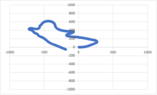
Big big thanks for your crucial help. I manage to finish the tool I wanted to do.
You are a genius!

See you soon!
 

Attachments

  • pau excel.png
    pau excel.png
    7.1 KB · Views: 140
  • Like
Likes   Reactions: palagi, Juanda and jack action
  • #11
Can you post the final version of your spreadsheet? Also, can there be a correction factor applied to lateral G to join the ends of the plot? I assume these are the same position on the track (start/finish)... I recall about 25 years ago, PI datalogging software would automatically do this to represent a track map.

I also notice that your plot is a mirror image of the actual Pau track. Again can this simply be corrected by multiplying Lateral G by -1?
 
  • #12
Welcome to PF. :smile:

palagi said:
Can you post the final version of your spreadsheet?

@Gwen49 has not been back since June of 2023, so about a year. Hopefully he gets an e-mail notification about your post (or my tagging him) and comes back to respond.
 
  • Like
Likes   Reactions: palagi
  • #13
Thanks, I'm no maths genius,, just a hack programmer that tries to solve such challenges by adapting other smarter peoples stuff. I am building a dash logger with my son for his track bike and would love to be able to plot track maps. GPS data is not fine enough and this method being tied to distance enables overlay comparisons of data from one lap with another with an indicator on a map for reference.
 
  • #14
palagi said:
Thanks, I'm no maths genius,, just a hack programmer that tries to solve such challenges by adapting other smarter peoples stuff. I am building a dash logger with my son for his track bike and would love to be able to plot track maps. GPS data is not fine enough and this method being tied to distance enables overlay comparisons of data from one lap with another with an indicator on a map for reference.
What is your data acq suite on that track bike? I'm sure you have speed, but how do you handle the combined g-forces and bike lean angle?
 

Similar threads

  • · Replies 6 ·
Replies
6
Views
2K
  • · Replies 9 ·
Replies
9
Views
2K
  • · Replies 11 ·
Replies
11
Views
3K
  • · Replies 13 ·
Replies
13
Views
17K
  • · Replies 6 ·
Replies
6
Views
3K
  • · Replies 24 ·
Replies
24
Views
4K
  • · Replies 2 ·
Replies
2
Views
2K
  • · Replies 16 ·
Replies
16
Views
9K
  • · Replies 9 ·
Replies
9
Views
3K
  • · Replies 19 ·
Replies
19
Views
2K