Discussion Overview
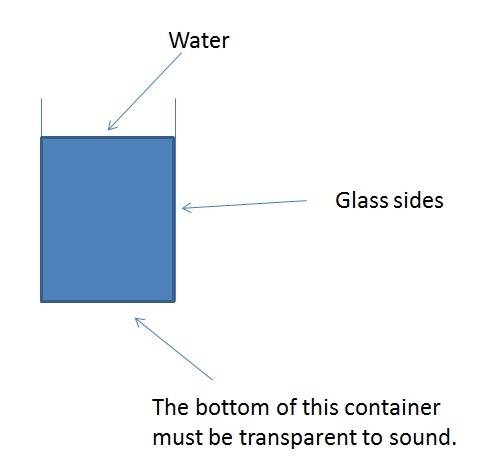
The discussion revolves around finding a material that can be combined with glass to create a flat surface that is transparent to sound, with minimal degradation of sound waves as they pass through. The context includes considerations of acoustic coupling and the structural requirements for a vessel containing water.
Discussion Character
- Exploratory
- Technical explanation
- Debate/contested
Main Points Raised
- One participant seeks a material that minimally affects sound wave degradation and can serve as a flat surface.
- Another participant discusses the importance of acoustic coupling and suggests that the boundary should have similar acoustic properties to the media through which sound is propagated, emphasizing the need for minimal mass and sufficient tensile strength.
- Questions are raised about the rigidity of the base and whether the vessel will be sitting in water, with suggestions of using a thin membrane.
- Concerns are expressed about transitions between materials with different sound speeds, which could complicate sound propagation.
- A participant mentions using a flexiglass type material but expresses a need for something more rigid yet acoustically transparent for manufacturing purposes.
- Polydimethylsiloxane is proposed as a potential material, with inquiries about its moldability to glass for creating the vessel's bottom.
Areas of Agreement / Disagreement
Participants express various viewpoints on the requirements for the material and the design of the vessel, indicating that multiple competing views remain without a consensus on the best solution.
Contextual Notes
Discussions include assumptions about the acoustic properties of materials and the structural integrity needed for the vessel, but these assumptions are not universally agreed upon.