Gravitational Collapse Calculations Problem Solved

Click For Summary
SUMMARY

The discussion centers on the gravitational collapse of a sphere of pressureless dust as described in T. Padmanabhan's "General Relativity," specifically in section 7.6. The calculations involve a line element defined by the equation ##ds^2=-d\tau^2+e^{\lambda(\tau,R)}dR^2+[r(\tau,R)]^2(d\theta ^2+\sin^2 \theta d\varphi^2##. The critical focus is on equations 7.188, 7.189, and 7.190, which necessitate considering three cases for the function f, representing different initial conditions of the collapse: ##f > 0##, ##f = 0##, and ##f < 0##. Each case corresponds to distinct physical scenarios regarding the inward velocity of the dust relative to the escape velocity at a given radius.

PREREQUISITES
  • Understanding of general relativity principles, particularly gravitational collapse.
  • Familiarity with the mathematical framework of line elements in spacetime.
  • Knowledge of escape velocity concepts in astrophysics.
  • Proficiency in interpreting tensor equations, specifically stress-energy tensors.
NEXT STEPS
  • Study the implications of different initial conditions in gravitational collapse scenarios.
  • Learn about the mathematical derivation of escape velocity in general relativity.
  • Explore the role of pressureless dust in cosmological models.
  • Investigate the significance of the stress-energy tensor in general relativity.
USEFUL FOR

Students and researchers in theoretical physics, particularly those focusing on general relativity, cosmology, and gravitational dynamics. This discussion is also beneficial for astrophysicists analyzing collapse phenomena in stellar evolution.

ShayanJ
Science Advisor
Insights Author
Messages
2,802
Reaction score
605
I'm reading T. Padmanabhans General Relativity. In section 7.6, he describes the gravitational collapse of a sphere of pressureless dust(So ## T_{\mu \nu}=\rho u_{\mu} u_{\nu} ##). I should say his argument is the same as Landau's, but reading Landau's didn't help too.
At first, he assumes a line element of the form:
## ds^2=-d\tau^2+e^{\lambda(\tau,R)}dR^2+[r(\tau,R)]^2(d\theta ^2+\sin^2 \theta d\varphi^2)##
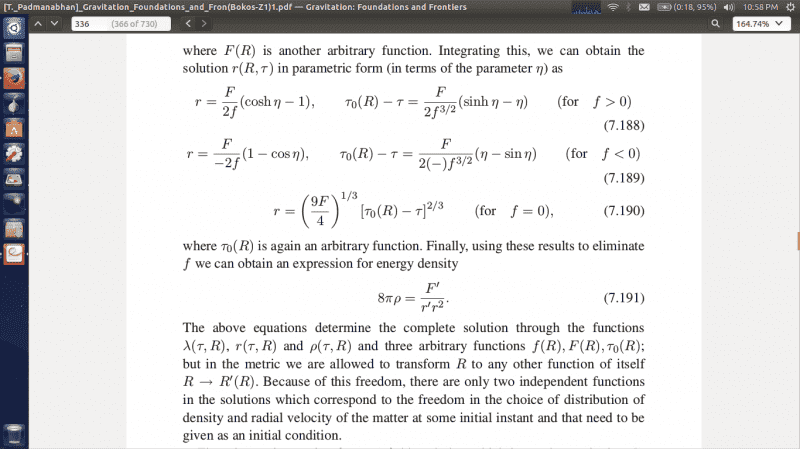
The rest of the calculations are shown in the following pictures.
Screenshot from 2015-04-22 22:57:18.png
Screenshot from 2015-04-22 22:58:13.png


My problem is with eq. 7.188,7.189 and 7.190. I can't understand why should we consider three cases for the function f. Because if this is only an arbitrary function we use in constructing the solution, then choosing one region would do the job and it makes no difference which region we choose. But then is it actually considering three regions for an arbitrary function? Or a physical interpretation is being attached to the function f and the three regions are somehow different parts of the collapse?
I'll appreciate any exlpanation.
Thanks
 
Physics news on Phys.org
Shyan said:
if this is only an arbitrary function we use in constructing the solution, then choosing one region would do the job

No, it wouldn't, because you might not be covering all possible initial conditions. The three different possibilities for ##f## correspond to three different kinds of initial conditions: if I'm remembering correctly, ##f > 0##, ##f = 0##, and ##f < 0## correspond to collapses where the inward velocity of the dust a a given radius is greater than, equal to, or less than the "escape velocity" at that radius, which is ##\sqrt{2M / r}## ( ##M## is the total mass of the dust as measured from far away, which will be constant during the collapse). All three possibilities must be considered since they are all physically possible initial conditions.
 
  • Like
Likes   Reactions: ShayanJ

Similar threads

  • · Replies 0 ·
Replies
0
Views
2K
  • · Replies 16 ·
Replies
16
Views
2K
  • · Replies 30 ·
2
Replies
30
Views
3K
  • · Replies 8 ·
Replies
8
Views
2K
  • · Replies 5 ·
Replies
5
Views
2K
  • · Replies 38 ·
2
Replies
38
Views
3K
  • · Replies 1 ·
Replies
1
Views
962
  • · Replies 4 ·
Replies
4
Views
2K
  • · Replies 28 ·
Replies
28
Views
4K
  • · Replies 5 ·
Replies
5
Views
2K