Science Advisor
- 2,802
- 605
I'm reading T. Padmanabhans General Relativity. In section 7.6, he describes the gravitational collapse of a sphere of pressureless dust(So ## T_{\mu \nu}=\rho u_{\mu} u_{\nu} ##). I should say his argument is the same as Landau's, but reading Landau's didn't help too.
At first, he assumes a line element of the form:
## ds^2=-d\tau^2+e^{\lambda(\tau,R)}dR^2+[r(\tau,R)]^2(d\theta ^2+\sin^2 \theta d\varphi^2)##
The rest of the calculations are shown in the following pictures.

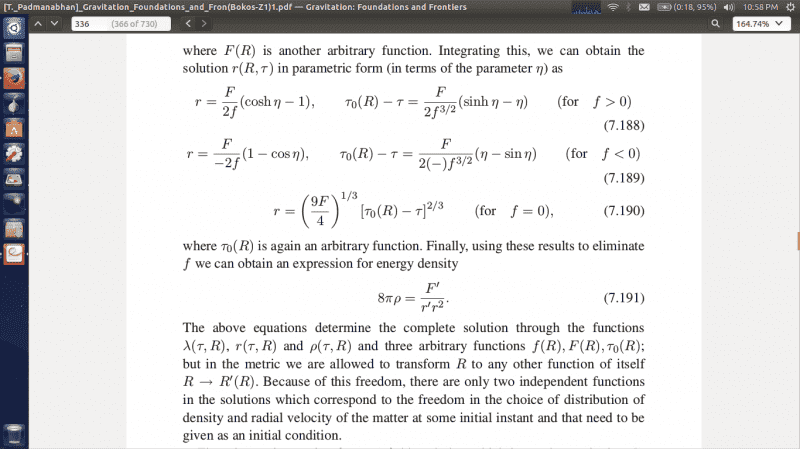
My problem is with eq. 7.188,7.189 and 7.190. I can't understand why should we consider three cases for the function f. Because if this is only an arbitrary function we use in constructing the solution, then choosing one region would do the job and it makes no difference which region we choose. But then is it actually considering three regions for an arbitrary function? Or a physical interpretation is being attached to the function f and the three regions are somehow different parts of the collapse?
I'll appreciate any exlpanation.
Thanks
At first, he assumes a line element of the form:
## ds^2=-d\tau^2+e^{\lambda(\tau,R)}dR^2+[r(\tau,R)]^2(d\theta ^2+\sin^2 \theta d\varphi^2)##
The rest of the calculations are shown in the following pictures.
My problem is with eq. 7.188,7.189 and 7.190. I can't understand why should we consider three cases for the function f. Because if this is only an arbitrary function we use in constructing the solution, then choosing one region would do the job and it makes no difference which region we choose. But then is it actually considering three regions for an arbitrary function? Or a physical interpretation is being attached to the function f and the three regions are somehow different parts of the collapse?
I'll appreciate any exlpanation.
Thanks