Group theory? This solution doesn't make sense....

Join the discussion
Ask a follow-up here, or get your own question answered by working scientists, mathematicians and engineers — people, not an autocomplete.
Real named experts · corrections over time · the nuance an AI answer skips
2 replies · 2K views
applestrudle
Messages
64
Reaction score
0
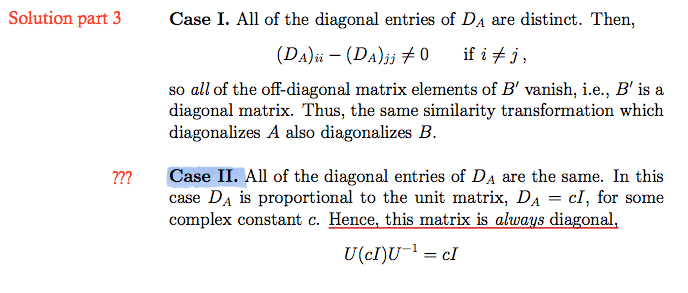
Case 2:
I get that D = c I means A must also be proportional to I but how does that mean B must be diagonal?

Question:
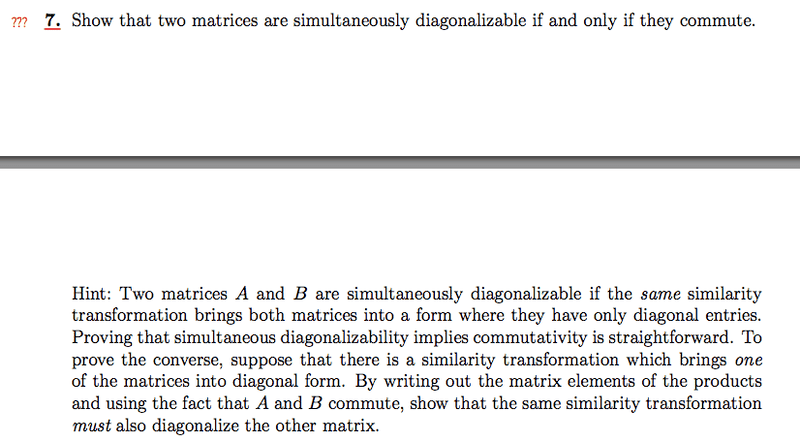
Screen Shot 2015-07-22 at 17.14.32.png

Answers:
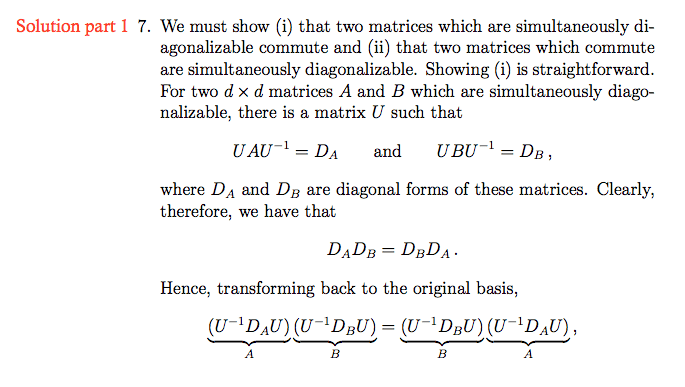
Screen Shot 2015-07-22 at 17.17.04.png


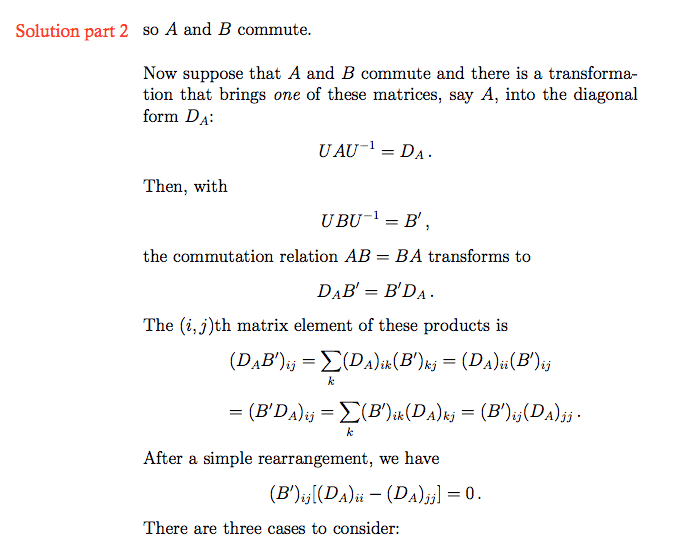
Screen Shot 2015-07-22 at 17.18.17.png


Screen Shot 2015-07-22 at 17.18.59.png

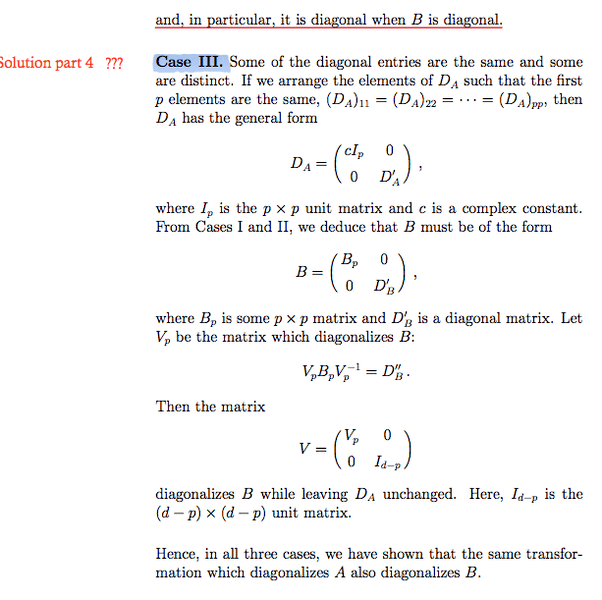
Screen Shot 2015-07-22 at 17.20.00.png
 
Physics news on Phys.org
It does not show that B is diagonalizable. B is presumed to be such. The point is that there is a transform that makes B diagonal and also makes A diagonal IFF A and B commute. The particular case of A proportional to the identity matrix means that A is always diagonal. Because every similarity transform on the identity matrix simply gives back the identity matrix. So, in this case, any similarity transform that makes B diagonal will leave A unchanged and still diagonal.
 
  • Like
Likes   Reactions: WWGD
DEvens said:
It does not show that B is diagonalizable. B is presumed to be such. The point is that there is a transform that makes B diagonal and also makes A diagonal IFF A and B commute. The particular case of A proportional to the identity matrix means that A is always diagonal. Because every similarity transform on the identity matrix simply gives back the identity matrix. So, in this case, any similarity transform that makes B diagonal will leave A unchanged and still diagonal.
THANKS! :D