Hamiltonian mechanics: phase diagram

Click For Summary
SUMMARY

The discussion focuses on constructing phase diagrams in Hamiltonian mechanics, emphasizing the importance of transforming Cartesian coordinates (x, y, z) into spherical and cylindrical coordinates for accurate representation. Participants agree that starting with Cartesian coordinates simplifies the problem-solving process, especially for those less experienced in physics. The conversation highlights the necessity of understanding coordinate transformations and the potential pitfalls associated with singularities in non-Cartesian systems.

PREREQUISITES
  • Understanding of Hamiltonian mechanics
  • Familiarity with coordinate systems: Cartesian, spherical, and cylindrical
  • Knowledge of phase space concepts
  • Basic skills in vector calculus
NEXT STEPS
  • Research Hamiltonian mechanics and its applications in phase space analysis
  • Study coordinate transformations between Cartesian and spherical/cylindrical coordinates
  • Learn about singularities in different coordinate systems
  • Explore Lagrangian mechanics as a complementary approach to Hamiltonian mechanics
USEFUL FOR

Physics students, educators, and researchers interested in advanced mechanics, particularly those focusing on phase diagrams and coordinate transformations in Hamiltonian systems.

LuccaP4
Messages
24
Reaction score
9
Homework Statement
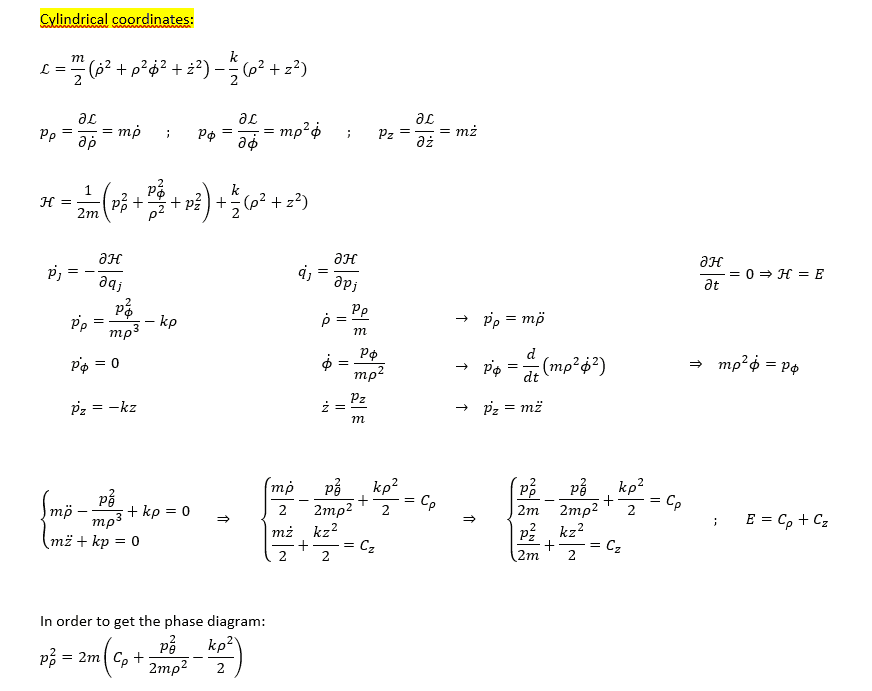
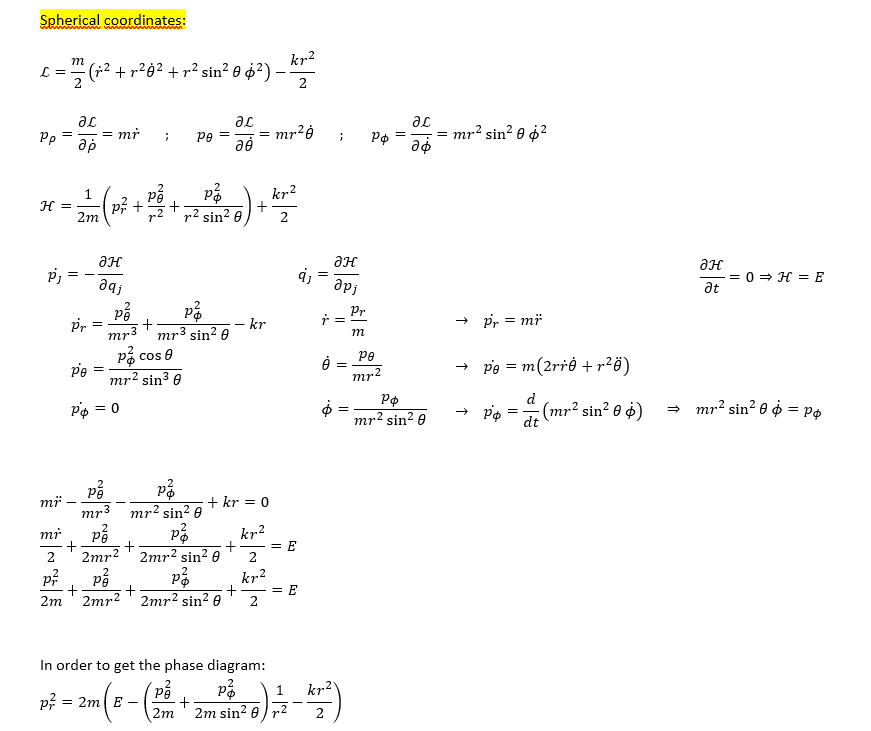
Write the Hamiltonian and Hamilton equations for an isotropic three-dimensional harmonic oscillator in spherical and cylindrical coordinates. Build the phase diagram.
Relevant Equations
..
The issue here is that I don't know how to operate the final equations in order to get the phase diagram. I suppose some things are held constant so I can get a known curve such as an ellipse.
I attach the solved part, I don't know how to go on.
82b7dc783b13b50dc3ca40487b662bda.png


15149cb5c8aaf6a5e8f17f9e9c406f07.png
 
Last edited:
Physics news on Phys.org
As a start how about writing down Hamiltonian in Descartes x,y,z coordinates ?
 
anuttarasammyak said:
As a start how about writing down Hamiltonian in Descartes x,y,z coordinates ?
But the statement says to write it in spherical and cylindrical coordinates. I have to build the phase space in that coordinates.
 
You can get it by transformation from Descartes coordinates.
 
anuttarasammyak said:
As a start how about writing down Hamiltonian in Descartes x,y,z coordinates ?
LuccaP4 said:
But the statement says to write it in spherical and cylindrical coordinates. I have to build the phase space in that coordinates.

This is a fundamental skill in physics that isn't taught very well anymore, think of it this way, you don't think in terms of spherical or cylindrical coordinates, you think in terms of x,y,z. The best way to start for nearly any problem is to write all your quantities in Cartesian coordinates and convert. I used to make my students in electromagnetics do this and if they didn't took major points off.
 
anuttarasammyak said:
You can get it by transformation from Descartes coordinates.
Dr Transport said:
This is a fundamental skill in physics that isn't taught very well anymore, think of it this way, you don't think in terms of spherical or cylindrical coordinates, you think in terms of x,y,z. The best way to start for nearly any problem is to write all your quantities in Cartesian coordinates and convert. I used to make my students in electromagnetics do this and if they didn't took major points off.
Okay, then I'll do that. Thanks.
 
Dr Transport said:
This is a fundamental skill in physics that isn't taught very well anymore, think of it this way, you don't think in terms of spherical or cylindrical coordinates, you think in terms of x,y,z. The best way to start for nearly any problem is to write all your quantities in Cartesian coordinates and convert. I used to make my students in electromagnetics do this and if they didn't took major points off.
Really? The use of the mos convenient coordinates for a given problem is a skill physicists cannot learn early enough.

What's however important to stress is where the used coordinates have singularities and to be careful with expressions like ##\Delta \vec{A}## for a vector field ##\vec{A}## when calculated not in Cartesian coordinates.
 
vanhees71 said:
Really? The use of the mos convenient coordinates for a given problem is a skill physicists cannot learn early enough.

I agree, on the other hand an undergraduate hasn't enough experience setting up problems. In highly symmetric cases, sure, but anything else, why take the chance of going off into left field.

I was taught to do it that way from some really fine physicists in my formative years and that is the way I taught it, it works. I'm a mere mortal, I do what works to at least set up the problem correctly. Take for example, the Lagrangians for this problem, I couldn't write them down from memory, but if I started with the Cartesian versions, I'd have them written in less than half a page. Same for electro-static/magneto-static problems.
 
  • Like
Likes   Reactions: vanhees71

Similar threads

  • · Replies 6 ·
Replies
6
Views
1K
  • · Replies 1 ·
Replies
1
Views
2K
  • · Replies 22 ·
Replies
22
Views
4K
  • · Replies 5 ·
Replies
5
Views
2K
  • · Replies 9 ·
Replies
9
Views
2K
  • · Replies 6 ·
Replies
6
Views
2K
  • · Replies 1 ·
Replies
1
Views
2K
  • · Replies 14 ·
Replies
14
Views
3K
Replies
5
Views
2K
  • · Replies 7 ·
Replies
7
Views
3K