Have you seen this in-plug fuse arrangement before?

  • Thread starter Thread starter berkeman
  • Start date Start date
  • Tags Tags
    Fuse
Click For Summary
SUMMARY

The discussion centers on the use of fused plugs in small appliances, particularly a floor fan, and the rationale behind this design choice. Participants highlight that fused plugs, commonly found in the UK, serve to protect against electrical faults, including overloads and short circuits. The conversation also touches on the cost implications of using fuses, with references to specific fuse types like the Bussmann GDC-5A. Ultimately, the consensus suggests that while fused plugs may increase safety, they also introduce complexity and potential fire risks.

PREREQUISITES
  • Understanding of electrical safety standards, particularly in the UK.
  • Familiarity with fuse types, specifically the Bussmann GDC-5A and its applications.
  • Knowledge of household wiring systems, including the Ring Main system.
  • Basic principles of electrical overload and short circuit protection.
NEXT STEPS
  • Research the UK Ring Main system and its advantages for household wiring.
  • Learn about the different types of fuses and their specific applications in appliances.
  • Investigate the standards and regulations governing appliance safety in the UK.
  • Explore the implications of using fused plugs in various electrical devices.
USEFUL FOR

Electrical engineers, appliance manufacturers, safety inspectors, and anyone involved in appliance design and electrical safety compliance will benefit from this discussion.
berkeman
Admin
Messages
69,345
Reaction score
24,669
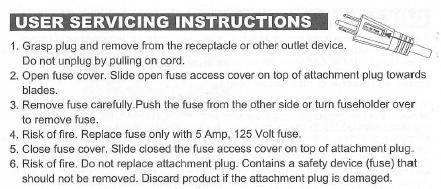
I bought a small floor fan yesterday, and in reading the instructions (yes, some of us do read the instructions), I was surprised to see this. Have any of you seen a fuse in the AC mains power plug like this before? If I hadn't read the instructions, it would have never occurred to me to look for a fuse there if the fan stopped working...

Fan Power Plug Fuse.jpg
 
Engineering news on Phys.org
No, I never saw that.

One could save on copper in the lead wires if they were designed for max 5 amps. But savings would be offset by the complexity of the fused plug. I find it hard to imagine that copper savings is the motivation.

Shock hazard also sounds dubious. The difference in hazard between 5A@120V and 15A@120V seems slight.

Yes someone thought that the expense of that extra fuse was justified. Good mystery.
 
I have seen electric fence chargers that have 2 fuses in the plug. One fuse for each wire, hot and neutral. I believe this is to help prevent lightning strikes from energizing the AC line. It really isn't to protect from overcurrent from a failure in the fence charger although obviously it would do that too.
-
So what say you @berkeman ? Any chances of a lightning strike on your fan? :DD
 
LOL, let's hope not! :smile:

I'm guessing it's to protect against fire in the case of a stuck rotor, but who knows. I wonder if my other fans have fuses that are not accessible, and customers complained too much when the fans stopped working and they could not easily replace the fuse.
 
Out of curiosity, do you know the cord length and AWG?
Fuse specifics (is it a 5x20mm slo-blow glass fuse similar to a Bussmann GDC fuse)?

I've seen fused plugs on Christmas tree lighting, but I'm puzzled for the same reasons as @anorlunda why one would be used for a fan motor and cordset. Mouser lists the 2000+ quantity cost of a GDC-5A fuse as $0.584 ($1.36 single unit), and I'm having a hard time understanding the manufacturer's cost justification if the idea was fusing allowed using thinner wire.

It seems to me that plug fusing may have actually increased fire risk.
  • Fuse heating isn't much (fuse resistance is 0.00985 ohms; about 1/4 watt at 5 amps), but it won't dissipate very well surrounded by insulation.
  • 3 additional connection points - two at the fuse clip to fuse interface, and an additional connection from wire to clip - that are heated bu the fuse.
 
upload_2017-6-18_22-28-38.png


This is the inside of the 3 pin plug used on most domestic and office equipment in the UK . Rated at 13 Amp but generally used on devices drawing up to about 10 Amp maximum . Various rated fuses can be fitted . Most common are 3 Amp and 13 Amp .
 
  • Like
Likes   Reactions: CWatters, sophiecentaur, Nik_2213 and 1 other person
Nidum said:
View attachment 205713

This is the inside of the 3 pin plug used on most domestic and office equipment in the UK . Rated at 13 Amp but generally used on devices drawing up to about 10 Amp maximum . Various rated fuses can be fitted . Most common are 3 Amp and 13 Amp .

So what risks do those fuses protect against?. Presumably, a short circuit will blow the fuse or breaker on the house's panel. Is it overload of the appliance, but not short circuit?

An appliance with a motor can overload with a blocked rotor. But something like an oven either works at rated power or is short circuited, it is hard to think of an overload fault for a oven.I bet @sophiecentaur can help us.
 
Most household fan motors will be what is called 'impedance protected'. Locked rotor current is limited by the nature of the design. It surprises me that a fan would have a fuse. Maybe it is simply standardization to be legal to use in various countries.
 
I didn't find any smoking gun however this document gives some good background info... https://www.cpsc.gov/s3fs-public/portfan.pdf

This write-up is a bit dated (2003) but what jumped out at me was the reference to other motor standards requiring a non-resettable overload device to protect the motor from overheating. Impedance protection is also discussed.

I'm guessing there have been some changes in this standard, purchase required... https://standardscatalog.ul.com/standards/en/standard_507_9

However there is also some allusion to the fused safety plug becoming standard equipment on a fan contained within the website of this manufacturer, who seems to fabricate appliance cords for the industry... http://www.yunhuanelectric.com/America-UL-fused-plug-power-cord-1-15P.html

Maybe someone having hands-on experience with the standard can give us more? But to answer the OP, I recall seeing these plugs out there for some time, and I have also noticed them on some forms of portable lighting such as christmas decorations. I think it sums up as cheap insurance; in a world of uncertain applications at least the appliance can somewhat look out for it's own wiring from the point of supply.
 
Last edited:
  • #10
anorlunda said:
So what risks do those fuses protect against?. Presumably, a short circuit will blow the fuse or breaker on the house's panel. Is it overload of the appliance, but not short circuit?
The standard 13A plug was designed in conjunction with the (240V) Ring Main system, which has a 32A fuse, feeding several outlets (at least five or six twin outlets). A fault in an appliance or even a partial short at the cable entry can produce a load which will not blow a 32A fuse but fry the lead and set fire to the carpet etc. There are many differing opinions about 120V vs 240V domestic systems but the higher voltage allows thinner conductors and more flexible leads for appliances. That's a real practical advantage. A plug fuse gives the appropriate protection for the appliance and its lead where the fuse at the panel has to be over-generous for low power appliances.
People who aren't used to the Ring Main tend to treat the whole idea with suspicion and fear. Nonetheless, it works very well and there are very few accidents which can be attributed to that system. It's even better nowadays when all appliances are fitted with moulded plugs and the correct fuse. People do very few home repairs these days and appliances mostly get thrown out with the original fuse still in the plug.
Also, Ring Main = Low Cost Installation.
 
  • Like
Likes   Reactions: Merlin3189, anorlunda and Nidum
  • #11
@ Anorlunda : So what risks do those fuses protect against ?

The primary purpose of a fuse is to protect the electricity supply system from any damage which could be caused by excess current flow due to a short .

Basic theory is that fuses are always arranged so that in event of a short in one section of the supply system they prevent any excess current from being drawn from the next section along in the direction of the power station .

In the standard UK electricity supply system there is a cascade of protection devices of increasing rating between your domestic appliance and the power station .

Actual blow wire fuses are only used in the lower power end of the system . Solenoid and electronic breakers are almost universally used at higher powers .

New build houses in UK now mostly have electronic combined RCD + overload protection systems .

Nice little link with history though - most power supply companies still demand the fitting of a 100 Amp cartridge fuse on the ingoing feeder . They never seem to blow . You still see ones in use that are over 60 years old and with the trade name markings of long gone makers .
 
Last edited:
  • Like
Likes   Reactions: Merlin3189 and anorlunda
  • #12
Nidum said:
The primary purpose of a fuse is to protect the electricity supply system from any damage which could be caused by excess current flow due to a short .
You need to consider both upstream and downstream of the fuse. The safety aspect of fuses is primarily to protect downstream (assuming the cabling is correctly specified for any more upstream fuses).
If that were the only function, you could have 32A fuses in each plug (which would make them superfluous, of course). The 'Primary' purpose of the Plug Fuse is to protect the appliance and its lead from all the. Frying the lead and burning the house down would involve a value of current that the Ring Main can easily supply. The 32A fuse is what 'protects the Ring. There are many faults, other than 'dead shorts' that need to be protected against.
 
  • Like
Likes   Reactions: jim hardy
  • #13
The fuses in domestic appliances and plug connectors do provide some safety protection for the appliance and for the user but this is somewhat incidental to the primary purpose of the fuses .

In practice this safety protection is often not very effective . They help by shutting off power to a shorting device and so help prevent possibility of fires but provide little protection against shocks . RCD's are much better at preventing shocks .
 
  • #14
Nidum said:
Solenoid and electronic breakers are almost universally used at higher powers .
There has always been a wire fuse in series with the company supply to all of my houses. Very few problems with a wire fuse failing to blow - although they can get tired and cut your supply when they shouldn't.
 
  • #15
Thanks @Nidum and @sophiecentaur . I always enjoy learning.
Nidum said:
View attachment 205713

This is the inside of the 3 pin plug used on most domestic and office equipment in the UK .

Most means some. How do they decide which are and are not?
 
  • #16
Nidum said:
but this is somewhat incidental to the primary purpose of the fuses .
Not in the case of a star or ring main. How would the ring need any protection from a faulty appliance that is drawing 25A, for instance? The house cabling is thick enough and there is a 32A fuse. The plug fuse is appropriate for the appliance and its lead.
In fact, thinking more about it, any supply distribution system will have plenty more capacity than the individual legs will ever need. There is a 100A fuse at the input of UK houses. The 3 phase supply can handle many houses on the same phase with each house taking near its maximum. A serious fault in the house, involving, say 15kW of power would hardly be noticed by the supply.
I have to agree, of course, that the company need to avoid an overload but that involves much more current than a single house wiring could handle. Bigger planned loads need to have a special supply, arranged with the company (3 phase, usually).
 
  • #17
anorlunda said:
Thanks @Nidum and @sophiecentaur . I always enjoy learning.

Most means some. How do they decide which are and are not?
For 'most' read 'all'. Fuseless square pin plugs do not exist in the UK (except, possibly as illegal imports but there would be no point). I think I can say that with certainty. (is that an oxymoron?). The last time that fuseless plugs were used for major appliances, it was 15A round pins, which were phased out in the '50s.
Edit: All my remarks above, relate to Ring Mains. Any appliances taking more than 13A (and immersion heaters) are fed individually from the fuse box.
 
Last edited:
  • #18
anorlunda said:
Most means some. How do they decide which are and are not?

upload_2017-6-19_11-43-16.png


This type of wall socket is the one used almost universally with the ring mains that @sophiecentaur described above . The plug goes with the socket . There are other types of plug and socket but they are rarely used now .
 
  • #19
sophiecentaur said:
For 'most' read 'all'. Fuseless square pin plugs do not exist in the UK (except, possibly as illegal imports but there would be no point). I think I can say that with certainty. (is that an oxymoron?). The last time that fuseless plugs were used for major appliances, it was 15A round pins, which were phased out in the '50s.

What about minor appliances like a cell phone charger, or a LED night light?
image.jpeg
image.jpeg
 
  • #20
anorlunda said:
What about minor appliances like a cell phone charger, or a LED night light?
View attachment 205746View attachment 205745
They are autonomous and, if they are type approved, then they will have their own internal protection. ("No user serviceable parts inside" - but I have tried on occasions) I think the lower picture is of a US socket?. The very low power devices catch fire relatively often, I believe. eBay -type imports could have absolutely anything inside them - even just a high value resistor and a diode and the authorities can't really do anything about that.
There are no Outlets on a ring main that do not include a fuse - ' a fused spur' has the fuse integral and a fixed cable, feeding a permanent appliance or possible an alternative non-fused plug. The standard 13A plug is a big beast and it takes up a lot of wall space. That's the only downside of it I can think of. It is possible to feed a compact distribution panel from a fused spur on the ring. Nerdy hifi and computer types will use such a system in a 'home studio' environment where there are dozens of bits of low power equipment. But the easier alternative is to use a multiway extension.
 
Last edited:
  • #21
Nidum said:
The primary purpose of a fuse is to protect the electricity supply system from any damage which could be caused by excess current flow due to a short .

sophiecentaur said:
The safety aspect of fuses is primarily to protect downstream

There are two objectives.

1. Protect the wires downstream of the protective device (fuse or breaker) from overheating , which is essentially fire protection.
Observe that National Electric Code is published not by us engineers' IEEE organization, but by NFPA (National Fire Protection Association)
https://en.wikipedia.org/wiki/National_Electrical_Code

2. Co-ordinate with upstream protective devices so that the one nearest the fault will open first.
"Stuck Breaker" protection is backup and is always slower, to give time for the primary protection downstream to do its job.
That's for convenience EDIT and is called 'Co-ordination'.
Local faults should be cleared gracefully, not cascade into a whole house(or a whole state) blackout .
 
Last edited:
  • Like
Likes   Reactions: Nidum
  • #22
I like @sophiecentaur 's posts #10 and #13. They illustrate the kind of logic that engineers do every day to find a balance. In this case, fire safety versus affordability. Engineers especially are fond of the phrase "everything is a trade-off.."

They also illustrate a non-obvious secondary consequence of changing a parameter. In this case, changing standard voltage from 120 to 230 in practice shifts the risks of fire in the devices relative to the risk of fire in the wires feeding those devices.

jim hardy said:
That's for convenience and is called 'Co-ordination'.
Local faults should be cleared gracefully, not cascade into a whole house(or a whole state) blackout .

That's true Jim, but the interesting question is how far down do we extend protection? The circuit [almost always]? The plug? Internal to the appliance? Each individual component on a circuit card [almost never]?

In the USA, protection usually stops at the wiring infrastructure in the walls and panels. For example, I've never seen a desk lamp with its own breaker or fuse. But there are exceptions. If you look inside a desktop PC, you'll find several fuses protecting subsystems.

The UK made different choices than the USA. @sophiecentaur explained some of the reasons. I won't get dragged into a debate about which is better, but I find the differences instructive.

In terms of fans in the USA, I'm looking at a small tabletop fan right now. It has no fused plug like the one @berkeman found. Perhaps there is a standard that kicks in only for fans of a certain size, or for use outdoors.

Edit: There are a half dozen or so books with "the art and science of protective relaying" in their title. They acknowledge that it is partially art.
 
Last edited:
  • #23
jim hardy said:
Local faults should be cleared gracefully

Ideally yes ---- :

The London Underground rail system is all electric and up until relatively recently was practically using the systems as first built many years previously .

One of the earliest lines used 400 V DC with the current coming from the lines own substation .

In the substation there was a complete wall covered with a fantastic array of enormous Frankenstein style switches , breakers and meters - all shiny brass and black Ebonite and all connected with open busbars . Elsewhere there were banks of mercury arc rectifiers .

If one of the electric trains had a problem the standard remedy was for the driver to get down to track level and throw a specially made shorting bar across the conductor rails . This caused the appropriate breaker in the substation to trip out . The current was briefly enormous and the break apart of the contacts was accompanied by wonderful display of high power arcing . Arc quenchers were fitted but it was worrying to see that some of these had holes burned clean through them .

Incidentally you could see the mercury arc rectifiers coming up to high power and falling back again regularly as the various trains stopped and started .
 
  • #24
The same basic principle of deliberately causing a short so as to blow a fuse or trip a breaker has been used in other applications .

It has even been used in sensitive electronic systems . Crowbar protection
 
Last edited:
  • #25
anorlunda said:
That's true Jim, but the interesting question is how far down do we extend protection? The circuit [almost always]?

In house wiring the NEC code protects the wiring to branch circuit conductors and the receptacle or light fixture.

These fused power cords are new to me. I've seen GFCI's built into hair dryers and room airconditioner cords, didnt give them much thought.
The references to a 'new' UL standard 507 for American cords suggests a requirement i didn't know about. Sounds like they're extending overcurrent protection out into the small appliances.found it, http://files.instrument.com.cn/bbs/upfile/files/20100806/201086123527.pdf
page 40A (71 of pdf)

upload_2017-6-19_12-40-34.png


and page 46A (79 of pdf)
upload_2017-6-19_12-37-35.png
.......

Nidum said:
I has even been used in sensitive electronic systems . Crowbar protection

The third microswitch on your microwave oven door is a crowbar.
It blows the oven's main fuse if it senses power applied to the magnetron before the other two door switches report the door fully closed and latched.
It's a higher rated switch than the other two and is usually a different color
Should your microwave quit it's worth checking those switches (and of course the fuse).

old jim
 
  • Like
Likes   Reactions: krater, berkeman, Nidum and 1 other person
  • #26
Nidum said:
The same basic principle of deliberately causing a short so as to blow a fuse or trip a breaker has been used in other applications .

I has even been used in sensitive electronic systems . Crowbar protection
In a Ring Main system you would presumably provide this form of 'local ' protection in the form of a Crowbar within the plug to blow the 32A ring fuse. That would not be a good arrangement as it would interrupt the supply to all the other (perfectly safe) appliances on the ring. The Electric Railway anecdote describes an entirely different scenario, in which it is an advantage to actually turn off the supply to the train and even other trains on the line. It just shows how many different aspects there are to Electrical Protection. Upstream and Downstream are both relevant, depending on the actual case.
 
  • Like
Likes   Reactions: Nidum and jim hardy
  • #27
jim hardy said:
The third microswitch on your microwave oven door is a crowbar.
You clever ol' thing to know that, Jim! It makes perfect sense, though. Very much like the Electric Train thing.
 
  • #28
sophiecentaur said:
You clever ol' thing

nah, I'm just a tightwad.

But yes just like the train "Crowbar" thing. First time i'd heard that anecdote, probably it's the origin of that oh so perfect term.
Just paints a mental picture, does it not ?
 
  • #29
Once again, @jim hardy does the best Internet research finding that UL (Underwriters Laboratories) report.

It says that the overcurrent protection requirement was added in 2010. But I bought a box fan in 2016 that had no such protection. Does that mean not UL approved? It is not clear to me when UL compliance is required.

In college I considered a job offer from UL. Glad I didn't take it. For example, those 380 pages of bureaucratic language just for fans. I would have died of boredom. o_O Apologies to any UL employees reading this.
 
  • Like
Likes   Reactions: krater
  • #30
anorlunda said:
It is not clear to me when UL compliance is required.

Not to me either. So far as i know it's voluntary. Does your fan have a UL label on it ? Or just on the cord ?

anorlunda said:
those 380 pages of bureaucratic language just for fans.

sigh, agreed. I'm a hardware guy, always was a failure at office work.
They tolerated me in the nuke plant because i was a passable teacher . They helped me with the paperwork.

jhoffice.jpg
old jim
 
  • Like
Likes   Reactions: dlgoff, berkeman, anorlunda and 1 other person

Similar threads

  • · Replies 10 ·
Replies
10
Views
4K
  • · Replies 29 ·
Replies
29
Views
20K
  • · Replies 2 ·
Replies
2
Views
2K
  • · Replies 6 ·
Replies
6
Views
3K
  • · Replies 4 ·
Replies
4
Views
5K
Replies
12
Views
4K
  • · Replies 5 ·
Replies
5
Views
4K
Replies
14
Views
12K
  • · Replies 4 ·
Replies
4
Views
4K
  • · Replies 17 ·
Replies
17
Views
6K