tadi
- 1
- 0
Hey guys, I have a problem that is giving me trouble.
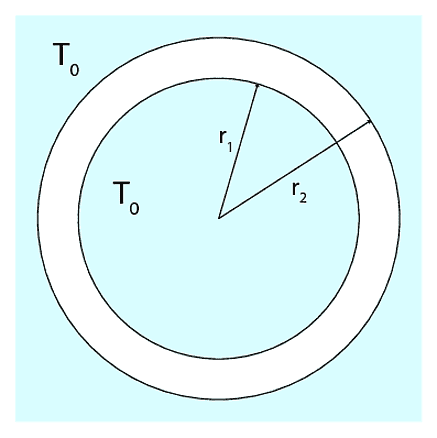
I have to solve time dependent diffusion equation ##D\nabla^2 T(r,t)=\frac{\partial T}{\partial t}## (##D## is diffusion constant and ##T(r,t)## is temperature function) for a spherical shell of radii ##r_1## and ##r_2## in a where inner and outer temperatures are constant at ##T_0## as shown in the picture, with initial condition ##T(r_1<r<r_2,t=0)=T_1##. Since problem is spherically symmetrical function ##T## is not dependent on asimutal and polar angle.
By separating the variables (##T(r,t)=R(r)\tau (t)##) we obtain two equations:
$$\nabla^2 R(r) + k^2 R(r) = 0$$
$$\frac{\partial \tau(t)}{\partial t}\frac{1}{\tau(t)} = - k^2 D$$
For time dependent part we get ##\tau(t)=C e^{-k^2DT}## and for the radial part a linear combination of spherical bessel functions of first (##j_0##) and second type (##n_0##) (only 0-th order because of symmetry) $$R(r) = \sum\limits_n [A_n j_0(k_n r) + B_n n_0(k_n r)]$$
Complete solution can then be written as:
$$T(r,t) = \sum\limits_n [A_n j_0(k_n r) + B_n n_0(k_n r)]e^{-k^2_n DT} + T_0,$$
with initial condition $$T(r_1<r<r_2,t=0)=T_1,$$
and boundary conditions $$ T(r=r_1,t)=T(r=r_2,t)=T_0$$
I don't know how to get coefficients ##A_n##, ##B_n## and ##k_n##. I tried getting ##k_n## from zeroes of spherical bessel function ##j_0## but since the center of sphere is hollow I must not set ##B_n## to zero as I would in the case of a full sphere.
I can't seem to get any further than this and would appreciate any suggestion. Thanks for the help.
Homework Statement
I have to solve time dependent diffusion equation ##D\nabla^2 T(r,t)=\frac{\partial T}{\partial t}## (##D## is diffusion constant and ##T(r,t)## is temperature function) for a spherical shell of radii ##r_1## and ##r_2## in a where inner and outer temperatures are constant at ##T_0## as shown in the picture, with initial condition ##T(r_1<r<r_2,t=0)=T_1##. Since problem is spherically symmetrical function ##T## is not dependent on asimutal and polar angle.
Homework Equations
By separating the variables (##T(r,t)=R(r)\tau (t)##) we obtain two equations:
$$\nabla^2 R(r) + k^2 R(r) = 0$$
$$\frac{\partial \tau(t)}{\partial t}\frac{1}{\tau(t)} = - k^2 D$$
For time dependent part we get ##\tau(t)=C e^{-k^2DT}## and for the radial part a linear combination of spherical bessel functions of first (##j_0##) and second type (##n_0##) (only 0-th order because of symmetry) $$R(r) = \sum\limits_n [A_n j_0(k_n r) + B_n n_0(k_n r)]$$
Complete solution can then be written as:
$$T(r,t) = \sum\limits_n [A_n j_0(k_n r) + B_n n_0(k_n r)]e^{-k^2_n DT} + T_0,$$
with initial condition $$T(r_1<r<r_2,t=0)=T_1,$$
and boundary conditions $$ T(r=r_1,t)=T(r=r_2,t)=T_0$$
The Attempt at a Solution
I don't know how to get coefficients ##A_n##, ##B_n## and ##k_n##. I tried getting ##k_n## from zeroes of spherical bessel function ##j_0## but since the center of sphere is hollow I must not set ##B_n## to zero as I would in the case of a full sphere.
I can't seem to get any further than this and would appreciate any suggestion. Thanks for the help.