Help interpreting symbols of basic electric circuit

Click For Summary
SUMMARY

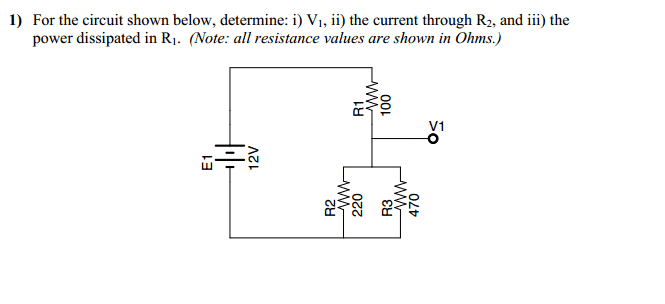
This discussion clarifies the interpretation of voltage in electric circuits, specifically regarding the notation of V1 in relation to resistors. It establishes that V1 represents the voltage from a labeled node to ground, which corresponds to the voltage across resistors R2 and R3. The conversation emphasizes that voltage is relative, and it is standard practice to use the bottom horizontal wire as ground. Participants agree that a clear assumption about the reference point, such as the battery's negative terminal, is essential for accurate voltage measurement.

PREREQUISITES
  • Basic understanding of electric circuit components, including resistors and voltage.
  • Familiarity with circuit notation and terminology.
  • Knowledge of voltage reference points in electrical engineering.
  • Experience with interpreting circuit diagrams.
NEXT STEPS
  • Study the concept of voltage reference points in electric circuits.
  • Learn how to analyze voltage across resistors using Ohm's Law.
  • Explore circuit simulation tools like LTspice for practical voltage analysis.
  • Review common circuit notation and symbols used in electrical engineering.
USEFUL FOR

This discussion is beneficial for electrical engineering students, educators, and anyone involved in circuit design or analysis who seeks to deepen their understanding of voltage interpretation in electric circuits.

string
Messages
1
Reaction score
0
Is asking for the voltage of a point in a wire (before/after a resister) the same as asking for the voltage across that resister? I understand voltage is relative..

Here is the circuit:
rI5t47k.png


I can't wrap my head around what V1 represents. Other questions in this assignment specifically ask for the voltage across some element of the circuit. I just don't know how to interpret the notation of V1 as it is drawn in this circuit as I've never encountered it before.

Any perspective on this would be appreciated.
 
Physics news on Phys.org
string said:
Is asking for the voltage of a point in a wire (before/after a resister) the same as asking for the voltage across that resister? I understand voltage is relative..
Yes (at least I THINK that's what you are asking)
I can't wrap my head around what V1 represents. Other questions in this assignment specifically ask for the voltage across some element of the circuit. I just don't know how to interpret the notation of V1 as it is drawn in this circuit as I've never encountered it before.

It is standard to take the bottom horizontal wire in a circuit as ground, so V1 just means the voltage from the labeled node to ground, which is the voltage across R2 and R3
 
It's a badly worded question.

Voltages are indeed relative so to answer the question you will need to make an assumption. A reasonable assumption would be to choose 0V, Ground or battery -ve as the reference as Phinds suggests. Your answer should state that

"V1 is ?V w.r.t the battery -ve terminal"

In this case it's straightforward but in future watch out for exam questions that have the battery with the -ve terminal at the top.
 
The book claims the answer is that all the magnitudes are the same because "the gravitational force on the penguin is the same". I'm having trouble understanding this. I thought the buoyant force was equal to the weight of the fluid displaced. Weight depends on mass which depends on density. Therefore, due to the differing densities the buoyant force will be different in each case? Is this incorrect?

Similar threads

  • · Replies 8 ·
Replies
8
Views
2K
  • · Replies 6 ·
Replies
6
Views
1K
Replies
4
Views
2K
Replies
1
Views
3K
  • · Replies 7 ·
Replies
7
Views
2K
  • · Replies 9 ·
Replies
9
Views
2K
  • · Replies 32 ·
2
Replies
32
Views
3K
Replies
2
Views
1K
  • · Replies 4 ·
Replies
4
Views
1K
  • · Replies 4 ·
Replies
4
Views
4K