Help me finding the current in here please (Circuit analysis)

Click For Summary

Discussion Overview

The discussion revolves around a circuit analysis problem involving the determination of current values in a circuit under specific conditions (R=0 and R=infinite). Participants are exploring the implications of these conditions on the circuit's behavior and the relationships between various currents.

Discussion Character

  • Technical explanation, Debate/contested, Mathematical reasoning

Main Points Raised

  • One participant expresses confusion about the values of currents Iy and I5 being zero when R=0, questioning the validity of their findings.
  • Another participant points out an error in the fourth KCL equation, suggesting that I2 should equal I4 based on the markings in the circuit.
  • A different participant advises eliminating the 15 ohm resistor in series with the current source, stating that it does not affect the circuit's behavior under the given conditions.
  • This participant also claims that if R=0, then Vx must be zero, leading to conclusions about the currents I2, I4, I3, and I5, suggesting that fewer equations may be needed to solve the problem.

Areas of Agreement / Disagreement

There is no clear consensus among participants; some express differing views on the correct application of circuit laws and the implications of the given conditions on the circuit analysis.

Contextual Notes

Participants have not resolved the implications of their assumptions, and there are unresolved mathematical steps related to the circuit analysis.

FelipeMedLev
Messages
2
Reaction score
0
Moved from a technical forum, no template.
Hi! I've been struggling with this.
Original exercise here: Find the value of Iy when R=0. And the value of Vx when R is infinite.
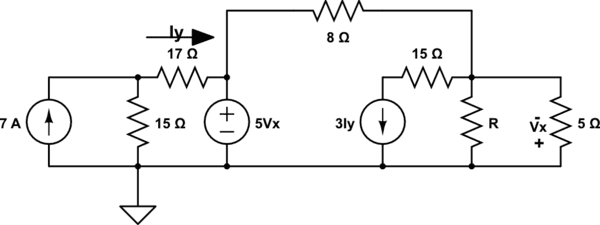
Cfoqb.png

For the first part of the question I did this since R=0:
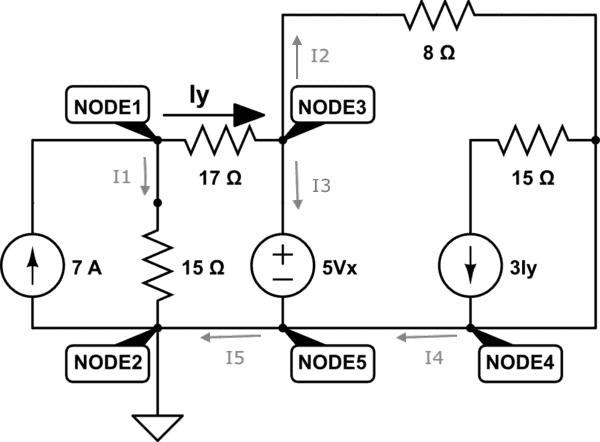
htge1.png

I've tried to solve this circuit and I get that Iy and I5 are 0 A, and this can't be possible since Iy is a current source. What am I doing wrong?

The second KVL equation englobes the whole circuit. (Solved the system using Mathematica)
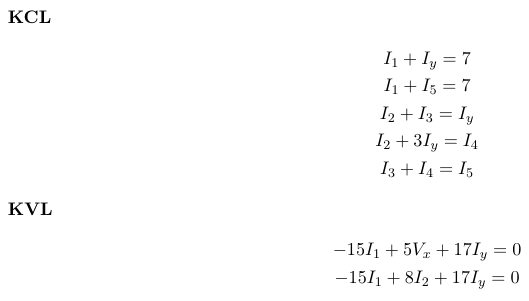
Fl6qG.png

2z0ST.png


Thanks in advance!
 

Attachments

  • Cfoqb.png
    Cfoqb.png
    6.1 KB · Views: 836
  • htge1.png
    htge1.png
    11.8 KB · Views: 706
  • Fl6qG.png
    Fl6qG.png
    3.6 KB · Views: 511
  • 2z0ST.png
    2z0ST.png
    4 KB · Views: 462
Physics news on Phys.org
Your 4th KCL equation is incorrect.
Seeing how you've marked I2 and I4, the equation should be I2=I4.
 
  • Like
Likes   Reactions: berkeman
Thanks!
 
Last edited:
You should eliminate the 15 ohm resistor in series with the 3Iy current source; resistors in series with ideal current sources have no effect on the rest of the circuit. The only reason to keep it would be if you were required to find the voltage across it, which you are not.

If R=0 there are some things you can determine without solving any equations. If R=0, then Vx=0 and also the 5Vx source equals zero. This means that the voltage across the 8 ohm resistor is zero, and therefore the current I2=0, which means that I4=0 and I3=Iy and I3=I5. You can modify your equations to take these facts into account. You won't need so many equations either.
 

Similar threads

  • · Replies 7 ·
Replies
7
Views
2K
Replies
15
Views
3K
Replies
2
Views
2K
  • · Replies 1 ·
Replies
1
Views
2K
  • · Replies 4 ·
Replies
4
Views
2K
  • · Replies 5 ·
Replies
5
Views
2K
  • · Replies 6 ·
Replies
6
Views
3K
  • · Replies 5 ·
Replies
5
Views
2K
  • · Replies 5 ·
Replies
5
Views
3K
  • · Replies 8 ·
Replies
8
Views
2K
