Help understanding Angular V as it applies to Kepler's 2nd law

  • Context: Graduate 
  • Thread starter Thread starter masteriti
  • Start date Start date
  • Tags Tags
    2nd law Angular Law
Click For Summary

Discussion Overview

The discussion revolves around understanding the application of angular velocity in the context of Kepler's 2nd law, particularly in relation to the area swept out by a radius vector in orbital mechanics. Participants explore the mathematical expressions and geometric interpretations involved in this concept.

Discussion Character

  • Technical explanation
  • Conceptual clarification
  • Mathematical reasoning

Main Points Raised

  • One participant references Robert Braeunig's blog and discusses the area swept out by a radius vector, questioning the expression for the height of the triangle in the context of angular speed.
  • Another participant suggests that for small angles, the approximation ##\tan\Delta\theta \approx \Delta\theta## is applicable, indicating that the author is simplifying the explanation for those without calculus knowledge.
  • A different participant acknowledges confusion regarding the triangle's area formula and realizes that the distance covered along a circumference relates to the height of the triangle, which is approximated by the small angle.
  • Another contribution mentions a common approach to express the area swept out as ##dA=\frac{1}{2}r^2(\theta)d\theta##, suggesting integration to find the area between two angles.

Areas of Agreement / Disagreement

Participants express varying levels of understanding and confusion regarding the geometric interpretation and mathematical formulation. There is no consensus on a single clear explanation, and multiple viewpoints on the interpretation of the formulas are presented.

Contextual Notes

Some participants note the limitations of their understanding, particularly regarding the transition from angular speed to the geometric representation of area, and the use of approximations for small angles.

masteriti
Messages
2
Reaction score
0
Robert Braeunig has an great blog on rocket science here: http://www.braeunig.us/space/index.htm, and I've been trying to follow the math his piece on Orbital Mechanics.

I'm having trouble in particular following his description on Kepler's 2nd law, here's how he puts it:
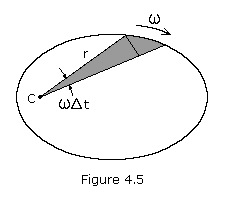
fig4-05.gif


Figure 4.5 shows a particle revolving around C along some arbitrary path. The area swept out by the radius vector in a short time interval t is shown shaded. This area, neglecting the small triangular region at the end, is one-half the base times the height or approximately r(rt)/2. This expression becomes more exact as t approaches zero, i.e. the small triangle goes to zero more rapidly than the large one. The rate at which area is being swept out instantaneously is therefore

[tex] \lim_{t\rightarrow 0}{\Big[ \frac{r(rωΔt)}{2} \Big]} = \frac {ωr^2}{2}[/tex]

I understand the area of the triangle is given by (base x height)/2. I understand r is the triangle base in this case, but how does the opposite side equal rt or rωΔt?

The way I'm reading this is that Angular speed is just change in angle given a change in time ω = Δθ / Δt, so as I understand it, ωΔt just leaves the angle Δθ. So shouldn't the height then be r tan(Δθ)? What am I missing?
 
Physics news on Phys.org
I understand the area of the triangle is given by (base x height)/2. I understand r is the triangle base in this case, but how does the opposite side equal rt or rωΔt?

The way I'm reading this is that Angular speed is just change in angle given a change in time ω = Δθ / Δt, so as I understand it, ωΔt just leaves the angle Δθ. So shouldn't the height then be r tan(Δθ)? What am I missing?
For small time periods, ##\tan\Delta\theta \approx \Delta\theta## ... it's an approximation.

The author is giving a description for people who don't have calculus yet.
 
I got hung up by the formula for a triangle in the figure and forgot that the distance covered on a circumference is s = rθ, so it would make sense for it to approximate the height of a very small triangle. Thank you for the reply!
 
Its a common approach - what they really wanted was ##dA=\frac{1}{2}r^2(\theta)d\theta## and you can integrate to get the area swept by motion between two angles.

However, it can take a bit of getting used to.
 

Similar threads

  • · Replies 6 ·
Replies
6
Views
3K
  • · Replies 8 ·
Replies
8
Views
2K
Replies
1
Views
3K
  • · Replies 4 ·
Replies
4
Views
2K
  • · Replies 3 ·
Replies
3
Views
11K
  • · Replies 9 ·
Replies
9
Views
3K
Replies
1
Views
1K
  • · Replies 2 ·
Replies
2
Views
2K
  • · Replies 4 ·
Replies
4
Views
12K
  • · Replies 8 ·
Replies
8
Views
3K