Hi, I with a ferrite rod antenna please

  • Thread starter Thread starter michael1978
  • Start date Start date
  • Tags Tags
    Antenna Hi Rod
Click For Summary
SUMMARY

The forum discussion centers on constructing a ferrite rod antenna for an AM radio, specifically for a TRF regenerative receiver. The user initially faced issues with the antenna's dimensions, mistakenly stating a diameter of 90mm instead of 9.2mm, and struggled with circuit assembly. After guidance from other users, the individual successfully built the antenna and sought assistance with an LM386 audio amplifier, which was not functioning correctly. The conversation highlights the importance of proper component selection and circuit design in radio projects.

PREREQUISITES
  • Understanding of AM radio principles and TRF regenerative receivers
  • Familiarity with ferrite rod antennas and their construction
  • Basic knowledge of electronic components, including LM386 amplifiers
  • Experience with circuit schematics and voltage measurement techniques
NEXT STEPS
  • Research the specifications and applications of the LM386 audio amplifier
  • Learn about the design and tuning of ferrite rod antennas
  • Study the differences between operational amplifiers and audio amplifiers
  • Explore troubleshooting techniques for audio circuits in radio projects
USEFUL FOR

Electronics enthusiasts, amateur radio operators, and hobbyists interested in building and troubleshooting AM radio receivers and antennas.

michael1978
Messages
434
Reaction score
19
hello to everybody,
can some help to make a ferrit rod antenna and to explain me thnx

is for am radio, trf regenerative

i have a ferrit rod 90mm diameter, and i have 0.5mm wire magnetic.

this is the schematic , i make also the am receiver, but i don't know the ferrit rod(is problem i try to make but the radio don't work)(simpele i don't know how to make a ferrit rod antenna), i follow the steps but i try he does nt work

thnx
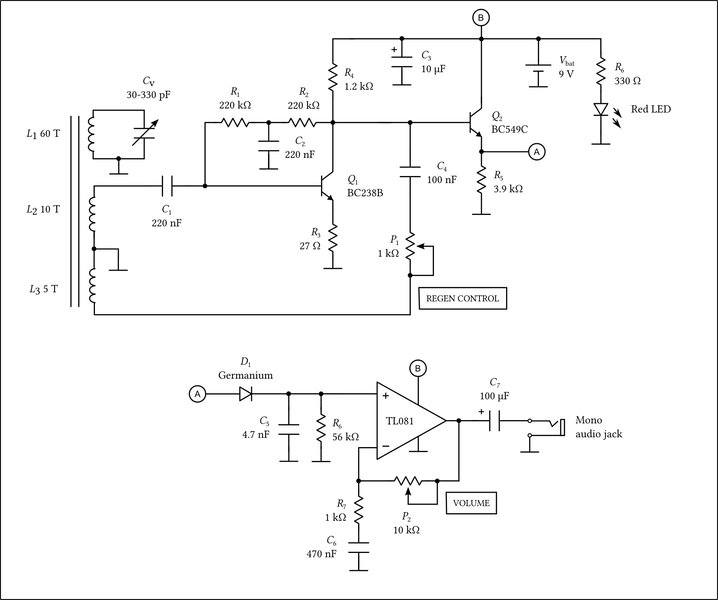
REGEN 3.jpg
 

Attachments

  • REGEN 3.jpg
    REGEN 3.jpg
    27.5 KB · Views: 2,169
Engineering news on Phys.org
Perhaps English is not your first language. However, our rules say

SMS messaging shorthand ("text-message-speak"), such as using "u" for "you", "please" for "please", or "wanna" for "want to" is not acceptable.
 
michael1978 said:
i follow the steps but i try he does nt work
Can you post the steps? Did this come as part of an AM Radio Kit? Or are you trying to do this mostly from scratch without a pre-made blank Printed Circuit Board (PCB)?

What test equipment do you have available? Do you have a Digital Voltmeter (DVM)? Do you have an Oscilloscope? Do you have a Signal Generator? Do you have any other test equipment?

And do you have anybody there where you live who has done this before? If you have any HAM radio operators near where you live, they can be a great resource for helping you to learn these kinds of circuits.

Is the AM radio band around 1MHz where you live?
 
Averagesupernova said:
I doubt the rod is supposed to 90 mm diameter. 9 sounds closer.
Good point, or maybe he means 90mm long. But you're right, that's certainly not the diameter!
 
anorlunda said:
Perhaps English is not your first language. However, our rules say
but i try my best...;-(
 
berkeman said:
Can you post the steps? Did this come as part of an AM Radio Kit? Or are you trying to do this mostly from scratch without a pre-made blank Printed Circuit Board (PCB)?

What test equipment do you have available? Do you have a Digital Voltmeter (DVM)? Do you have an Oscilloscope? Do you have a Signal Generator? Do you have any other test equipment?

And do you have anybody there where you live who has done this before? If you have any HAM radio operators near where you live, they can be a great resource for helping you to learn these kinds of circuits.

Is the AM radio band around 1MHz where you live?
this is the site where i make in breedeboard, is not my idea, but i want to learn, so i try also one am i hear one radio with noise, and i destroy, because ferrit rod problem, i don't go so much outside i work a little with my child a little with electronics. this the site where complete tell https://imgur.com/a/JpwJs, i have a normal standard multimete and one smath oscillscope, because i try when i put diode he demulate, i so in oscillscope, i know ferrite rod antenna i make bad i think
 
Averagesupernova said:
I doubt the rod is supposed to 90 mm diameter. 9 sounds closer. This looks like the type of antenna that was used in the old radio shack kits. My bet is if you scored one of them it would work. https://www.google.com/search?client=ms-android-verizon&ei=GsnLWrjkD-OLjwTMx5PgCw&q=radio+shack+150+in+1+electronic+project+kit&oq=tadio+shavck+kits&gs_l=mobile-gws-serp.1.0.0i71l5.0.0..3952...0...0.0....mobile-gws-wiz-serp.eQ9otP4Mhm4=
i buy it long time one 300 experiments complets kit, but i finish is almost nothing to teach, but i take from internet this circuit and the other, i don't use that anymore
 
michael1978 said:
this is the site where i make in breedeboard, is not my idea, but i want to learn, so i try also one am i hear one radio with noise, and i destroy, because ferrit rod problem, i don't go so much outside i work a little with my child a little with electronics. this the site where complete tell https://imgur.com/a/JpwJs, i have a normal standard multimete and one smath oscillscope, because i try when i put diode he demulate, i so in oscillscope, i know ferrite rod antenna i make bad i think
Fun project, especially to do it with your child. :smile:

So does your circuit look pretty much like the one in the link you posted? Where did you get the ferrite rod for the antenna? Can you verify its dimensions, and maybe post a picture of it and your circuit that you built based on the website?

Can you use your multimeter to measure the voltages at each point in the circuit and label a printout of the circuit diagram? That will help us to verify that it is build correctly. Can you also post a picture of the variable capacitor that you are using? Thanks.
 
  • Like
Likes   Reactions: michael1978
  • #10
berkeman said:
Fun project, especially to do it with your child. :smile:

So does your circuit look pretty much like the one in the link you posted? Where did you get the ferrite rod for the antenna? Can you verify its dimensions, and maybe post a picture of it and your circuit that you built based on the website?

Can you use your multimeter to measure the voltages at each point in the circuit and label a printout of the circuit diagram? That will help us to verify that it is build correctly. Can you also post a picture of the variable capacitor that you are using? Thanks.

yes i can show you my circuit, but the antenna i destroy so i have only ferrit rod and is 9m and for long i don't know i will put my tomorow.
 
  • #11
michael1978 said:
yes i can show you my circuit, but the antenna i destroy so i have only ferrit rod and is 9m and for long i don't know i will put my tomorow.
So you are saying that you have a ferrite rod that is 90millimeters in diameter and 9 meters long? What the heck did you get that giant thing out of?
 
  • #12
berkeman said:
So you are saying that you have a ferrite rod that is 90millimeters in diameter and 9 meters long? What the heck did you get that giant thing out of?
sorry i make 0 zero morei is 9 of 9.2 mm round, and yesterday in the night was 1 clock night, and now is 7 clock morning, but today i goona send you my circuit and ferrit rod with wire, which i put out all the wire... and for the rest, have a nice day.
 
  • #13
berkeman said:
Fun project, especially to do it with your child. :smile:

So does your circuit look pretty much like the one in the link you posted? Where did you get the ferrite rod for the antenna? Can you verify its dimensions, and maybe post a picture of it and your circuit that you built based on the website?

Can you use your multimeter to measure the voltages at each point in the circuit and label a printout of the circuit diagram? That will help us to verify that it is build correctly. Can you also post a picture of the variable capacitor that you are using? Thanks.
here is my photo, i did not take a proper photo sorry, but is enough to see
IMG_20180410_073222.jpg
 

Attachments

  • IMG_20180410_073222.jpg
    IMG_20180410_073222.jpg
    61.9 KB · Views: 873
  • #14
berkeman said:
Fun project, especially to do it with your child. :smile:

So does your circuit look pretty much like the one in the link you posted? Where did you get the ferrite rod for the antenna? Can you verify its dimensions, and maybe post a picture of it and your circuit that you built based on the website?

Can you use your multimeter to measure the voltages at each point in the circuit and label a printout of the circuit diagram? That will help us to verify that it is build correctly. Can you also post a picture of the variable capacitor that you are using? Thanks.
hi man i solved ferrit rod antenna, somebody told me how to make it, so i make it, but, you say is very easy, can you help me with amplifier is not working i get no signals...do you know how to fix it, i use lm386
 
  • #15
michael1978 said:
can you help me with amplifier is not working i get no signals...do you know how to fix it, i use lm386
Glad your antenna is okay now (how can you tell it is okay now?).

To help you fix your circuit, please use your meter to measure the voltages at the connection points in the circuit and write those voltages on the schematic so you can post a picture of that. Put the negative wire of your meter on "ground", and measure the voltages at the other connection points in the circuit. Thanks. :smile:
 
  • #16
berkeman said:
Glad your antenna is okay now (how can you tell it is okay now?).

To help you fix your circuit, please use your meter to measure the voltages at the connection points in the circuit and write those voltages on the schematic so you can post a picture of that. Put the negative wire of your meter on "ground", and measure the voltages at the other connection points in the circuit. Thanks. :smile:
I will do it
 
  • Like
Likes   Reactions: berkeman
  • #17
berkeman said:
Glad your antenna is okay now (how can you tell it is okay now?).

To help you fix your circuit, please use your meter to measure the voltages at the connection points in the circuit and write those voltages on the schematic so you can post a picture of that. Put the negative wire of your meter on "ground", and measure the voltages at the other connection points in the circuit. Thanks. :smile:
I measure transistor 1 and 2 = 1.77V
lm386
pin1 = 2,96V
pin 2 = 1.88
pin 3 = 4.20
pin 4 = 4.60
pin 5= 2.60
pin 6 = 0.84
pin 7 = 0
pin 8 = 2.84
BATTERY SUPPLY 5V AND SOMETHING

i don't know what to measure else?
 
  • #18
michael1978 said:
I measure transistor 1 and 2 = 1.77V
lm386
pin1 = 2,96V
pin 2 = 1.88
pin 3 = 4.20
pin 4 = 4.60
pin 5= 2.60
pin 6 = 0.84
pin 7 = 0
pin 8 = 2.84
BATTERY SUPPLY 5V AND SOMETHING

i don't know what to measure else?
The schematic shows a TL081 opamp, not a LM386 audio amp. Can you show us exactly your schematic, with pin numbers on the parts?

Also, the original schematic uses a 9V battery. How come your battery is only about 5V?

And the original schematic with the TL081 opamp appears to have a problem with biasing the inputs to the opamp -- the TL081 is not designed to run with its inputs near ground when it is operated on a single supply (like 9V). An opamp like an LM324 is a better choice for single-supply operation.

Also, can you show us what you are using now for the variable capacitor that is used to help tune the antenna?
 
  • #19
berkeman said:
The schematic shows a TL081 opamp, not a LM386 audio amp. Can you show us exactly your schematic, with pin numbers on the parts?

Also, the original schematic uses a 9V battery. How come your battery is only about 5V?

And the original schematic with the TL081 opamp appears to have a problem with biasing the inputs to the opamp -- the TL081 is not designed to run with its inputs near ground when it is operated on a single supply (like 9V). An opamp like an LM324 is a better choice for single-supply operation.

Also, can you show us what you are using now for the variable capacitor that is used to help tune the antenna?

man, this not normal the battery very fast up, because i buy just for test, he stays onlys 5v, 4V up, so in that site they say you can use lm386, that i had in my home, after variable i make one 500 to 600 pico farad, i found in the internet how to make variable capacitor,

now i put new battery from 9V, i hear noise like motor brbrbrbrbr fast and slow when i make with regen pot, but i have to put in my ear to hold it, because is only little bit volume in my 8ohm speaker,,
of maybe capacitor from china which i connected to 8ohm speakerwhat do you think what is not working, is working ferrit rod antenna
what do you think is not normal?
those are the pins number of lm386 SO lm386 have 8 pins
 
  • #21
Once you get the op-amp issue straightened out, you may be able to use another AM receiver to generate a carrier. You would do this by tuning into the local oscillator of your second receiver. By using several receivers you should be able to hear the beat between the two local oscillators (the difference in frequency between the two). But cross that bridge when you get there. Listen to @berkeman concerning the 386. He knows what he is saying.
 
  • Like
Likes   Reactions: berkeman
  • #23
michael1978 said:
do you have any idea how to make easy to change that opamp with lm386,
For a start, I would get rid of the TL086 circuit shown and use the LM386 circuit instead. Take your point "A", keep the diode and capacitor out of it, and change the resistor to the potentiometer shown on the LM386 circuit. So point "A" feeds the LM386 input through the diode and cap and potentiometer. That should get you started.
 
  • #24
berkeman said:
For a start, I would get rid of the TL086 circuit shown and use the LM386 circuit instead. Take your point "A", keep the diode and capacitor out of it, and change the resistor to the potentiometer shown on the LM386 circuit. So point "A" feeds the LM386 input through the diode and cap and potentiometer. That should get you started.
i make it, now what to do? so draw black line of pot where i connected
REG 2.jpg
REG 2.jpg
 

Attachments

  • REG 2.jpg
    REG 2.jpg
    85.8 KB · Views: 785
Last edited:
  • #25
berkeman said:
For a start, I would get rid of the TL086 circuit shown and use the LM386 circuit instead. Take your point "A", keep the diode and capacitor out of it, and change the resistor to the potentiometer shown on the LM386 circuit. So point "A" feeds the LM386 input through the diode and cap and potentiometer. That should get you started.
HELLO, i change yesterday like i show you, but today i make separate the lm386, i hear nothing, what is this in gods name?
 
  • #26
Do you know what the voltages around various parts of the circuit are and do you know what they are supposed to be?
 
  • #27
Averagesupernova said:
Do you know what the voltages around various parts of the circuit are and do you know what they are supposed to be?
somebodu told to solder lm386, now i am going to solder and after to connect
 
  • #28
michael1978 said:
somebodu told to solder lm386, now i am going to solder and after to connect
Solder it to what?
 
  • #29
berkeman said:
Solder it to what?
to pcb
 
  • #30
What PCB? I must have missed something...
 

Similar threads

  • · Replies 2 ·
Replies
2
Views
961
  • · Replies 14 ·
Replies
14
Views
3K
  • · Replies 10 ·
Replies
10
Views
2K
  • · Replies 11 ·
Replies
11
Views
2K
  • · Replies 3 ·
Replies
3
Views
2K
  • · Replies 37 ·
2
Replies
37
Views
4K
  • · Replies 20 ·
Replies
20
Views
4K
  • · Replies 11 ·
Replies
11
Views
1K
Replies
1
Views
2K
Replies
7
Views
4K