High current battery switching without putting the load through the sw

Click For Summary

Discussion Overview

The discussion revolves around the challenge of switching between multiple lithium polymer batteries (7.4v, 11.1v, and 14.8v) for a project requiring high current draw (up to 150a for milliseconds, then 30a continuous). Participants explore alternatives to rotary switches for managing high currents without allowing higher voltage batteries to discharge into lower voltage ones.

Discussion Character

  • Exploratory, Technical explanation, Debate/contested

Main Points Raised

  • The original poster (OP) seeks advice on using a rotary switch to manage power from three different voltage batteries but realizes the risk of higher voltage batteries discharging into lower ones.
  • Some participants question the compatibility of the batteries and the necessity of switching between them, suggesting that the higher voltage battery would attempt to charge the lower voltage ones, leading to potential failures.
  • One participant suggests using IGBTs instead of a rotary switch, noting that IGBTs can prevent current from flowing back into the lower voltage batteries if selected correctly.
  • The OP clarifies the intention to switch between power sources to feed into a common output, but does not elaborate on the overall goal of the project.

Areas of Agreement / Disagreement

Participants express differing views on the feasibility and safety of switching between the batteries. There is no consensus on the best approach or the underlying purpose of the battery switching.

Contextual Notes

There are uncertainties regarding the compatibility of the batteries and the implications of using different switching methods. The discussion lacks detailed specifications on the components and their ratings, which may affect the proposed solutions.

Who May Find This Useful

Individuals interested in battery management systems, high current applications, or those exploring alternatives to traditional switching methods in electrical circuits.

Zardichar
Messages
2
Reaction score
0
Hey guys, I am new to the forum and came to here to ask for help on a project that I am trying to construct.

I have 3 lithium polymer batteries, one 7.4v, 11.1v, and 14.8v. The current draw will be around 150a for an extremely short period of time (a couple milliseconds) and then will settle to around 30a continuous.

I want to use a 1 pole, 4 position (1 for off) rotary switch, but none of them can sustain very high currents. So that is where I need your help.

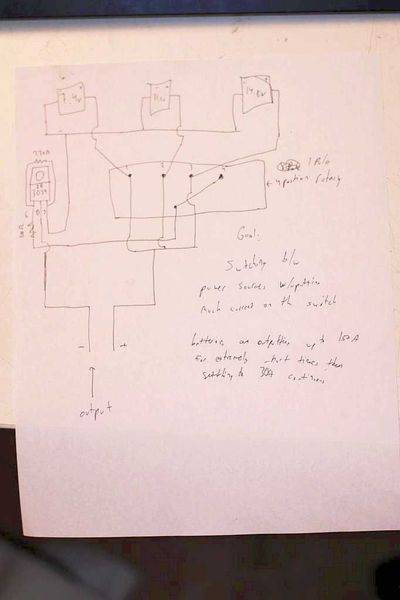
I made the following circuit for it: (sorry for low quality)
attachment.php?attachmentid=8800&stc=1&d=1372128272.jpg


but I quickly realized that when the switch is turned to any of the positions, then the higher voltage battery would just dump current into the other two, so that would be very, very bad.

I was advised to use SSR's, but then, after looking up the prices on them, decided that it wouldn't really be feasible due to my low budget ($75) Maybe there is a way to imitate the function of an SSR with just MOSFETs? I don't need it to function with AC nor do I need complete isolation so that is why I am trying to favor MOSFETs.

Please correct anything that is wrong in this post and please help me with this project.

All comments are welcome and I thank you guys in advance!
 
Last edited:
Engineering news on Phys.org
While it seems you want to use the 4P Switch to turn on the whole circuit, but why you need to switch the controll from battery to battery power but not the power legs? - I have no idea what or why you are tying to connect these three batteries - they really are not compatible.

As you describe the Higher voltage battery will dominate, but I would not say "dump current" - it will try to charge the lower voltage batteries and you will have multiple serious failures.

So what are you trying to accomplish?
 
Thank you for your response. I just read my OP again and did realize that I didn't state the purpose.

I want to be able to switch between these power sources by turning the 4P switch. They will all be feeding into the same output.

Thanks
 
If you use IGBT in each leg - they do not have body diode property, if selected without the Anti-Parallel integrated diode - so they will block each battery from feeding each other. A conservative estimate of 1.4V Vf x 30A ... 50 W of losses - may be more than you are looking for.

So I do now know what but I do not know why you want to switch the different batteries - to get different voltages, or some other purpose, to run them all down as far as possible?
 

Similar threads

  • · Replies 14 ·
Replies
14
Views
4K
Replies
6
Views
2K
  • · Replies 8 ·
Replies
8
Views
4K
  • · Replies 7 ·
Replies
7
Views
2K
  • · Replies 2 ·
Replies
2
Views
2K
Replies
9
Views
4K
  • · Replies 10 ·
Replies
10
Views
7K
  • · Replies 34 ·
2
Replies
34
Views
5K
Replies
19
Views
6K
  • · Replies 4 ·
Replies
4
Views
3K