How current flows through battery nickel plate -- Diagram shown

Click For Summary

Discussion Overview

The discussion revolves around the welding of nickel plates to 18650 battery cells, focusing on the implications of plate width and thickness for current flow and heat generation. Participants explore the effects of these factors on performance and the challenges associated with soldering to nickel.

Discussion Character

  • Technical explanation
  • Debate/contested
  • Experimental/applied

Main Points Raised

  • One participant questions whether making the nickel plate wider than the battery's positive area would aid current flow or render part of the plate ineffective.
  • Another suggests that the extra width of the tab may reduce resistance, but its necessity depends on the specific application.
  • A participant raises concerns about the positioning of the wires and whether it would cause uneven heating of the nickel plate.
  • Some argue that current will spread out across the nickel plate, implying that extra width is not wasted.
  • There are differing opinions on the ease of soldering to nickel, with one participant claiming it is straightforward while another recounts difficulties experienced with solder adhesion.
  • Discussion includes the potential use of alternative materials, such as brass shim stock, for better soldering results.

Areas of Agreement / Disagreement

Participants express differing views on the effectiveness of wider nickel plates and the challenges of soldering to nickel. There is no consensus on the best approach to welding or soldering, and the discussion remains unresolved regarding the optimal design for current flow and heat management.

Contextual Notes

Participants mention various assumptions about current distribution and the physical properties of materials involved, but these assumptions are not universally accepted or verified within the discussion.

Who May Find This Useful

This discussion may be of interest to individuals involved in battery assembly, electrical engineering, or those exploring soldering techniques for nickel and related materials.

iDred
Messages
3
Reaction score
1
I'm going to weld nickel plates/tabs to 18650 cells. Each two batteries will be welded together with a nickel plate. In the center of the nickel plate will be a copper wire to take the 20 amp current flowing from the two cells at 10 amps per cell.

Since I have .2 mm thick nickel plates, to get the correct size I would need to make it 10 mm wide to handle the 10 amps. This would make the cross sectional area of the nickel plate large enough to handle 10 amps.

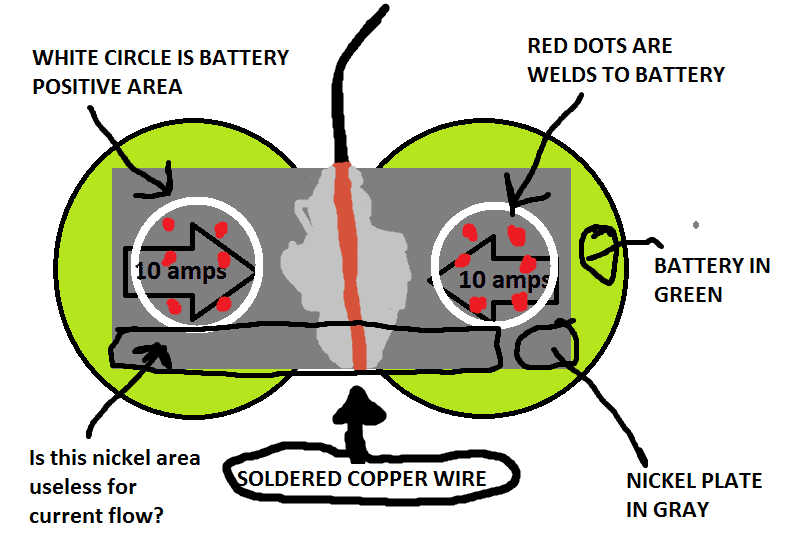
My question is that because I can only weld the plates to the battery positive side which has a small positive ciruclar area. Does making the plates wider than this positive area help the current flow?

Assume the diameter of this positive area is 7mm, Will making the plate 10mm wide make some of the plate useless?

Will I need to make the plate thicker and keep the plate width equal to the positive battery side area?

What I don't know is how electric will flow? Will it be a straight line from the red dots to the wire, will it spread out through the whole nickel plate?

Below is a picture to help show what I am talking about. You can see the red dot welds are centered in the wide nickel plate. The white circle is the copper top of the batter and the only place I can weld to.
two%20cells%202a_zpsjppxjf99.png
 
  • Like
Likes   Reactions: Merlin3189
Engineering news on Phys.org
It will help if you can explain better what this projects is about.
Welding 18650 of anything is a pretty big task.
I don't think it will matter a lot about whether some parts of the nickel superstructure are not useful as current conductors,
Your description sounds like you will need a very good heat sinks, and extra nickel will certainly be useful for that purpose.
 
18650 is a cell size. I assume that is what the OP is referring to not a quantity.

The extra width of the tab will reduce the resistance however whether this is necessary depends on your application.

Be sure both cells are charged to the same voltage before welding or you will get a nasty surprise.

BoB
 
If this makes it easier to understand. In the picture below you have the wire on the left delivering 10 amps. The wire on the right taking the 10 amps.

The nickel plate between the two wires has the exact mass (cross sectional area) to handle 10 amps without heating up if the 10 amps were evenly spread through it.

My question is because of the way the wires are positioned, will this heat the nickel plate because the wire is soldered on the left is in the center and not run along the length of the nickel plate.

Will this cause the nickel plate to heat up? Am I wasting nickel plate because of the way I soldered the wires? Or is it possible the electric will spread out and utilize the whole nickel plate?

What I don't understand is how the electric will flow from the two wires.

Thank you for any help anyone can give me.
soldered%20wire%201_zpsq4jvyn8g.png
 
The current will spread out, so extra width is not wasted. I think it would be better to, for example, use foil of double thickness (0.4mm) than of double width (20mm), were you to make a comparison, because the current density at the weld points will be better with less heating.

Whether there are issues associated with spot welding to the case of 18650 cells I don't know. Do manufacturers data sheets say anything about this? You've ruled out using the "soft pack" lipolys with their tabs ready for soldering?
whatever the right term is.

Some lipolys sold for RC applications come with phenomenal discharge capabilities, if it's important to your need.
 
i think it is difficult to solder to nickel
i had to take some Radio Shack NiCads into work and silver plate their tabs before solder would stick

http://www.plateworld.com/editorial26.htm


Soldering to Electroless Nickel


It is generally thought that it is not possible to solder to electroless nickel (EN) plated deposits unless a strong acid flux is used. The fluxes can be harmful to other components in an assembly, particularly if it is an electronic device. So, soldering is often avoided where electroless nickel could provide many advantages.

He goes onto say sulfamic acid might make a useable flux.
Of course i had only plain rosin flux and it was hopeless until i plated the metal tabs.
Could you use brass shim stock instead? It'll solder really well.

good luck !

old jim
 
Jim, actually soldering to nickel is very extremely easy using regular radio shack 60/40 solder. I have already done that to put together a battery pack without having a welder. I had to solder all the nickel tabs to the battery.
This is what I bought specifically for welding, but it solders to it like tinned wire.
  • 50 pieces pure Ni200/Ni201 nickel (99.6% plus)
 
iDred said:
This is what I bought specifically for welding, but it solders to it like tinned wire.
  • 50 pieces pure Ni200/Ni201 nickel (99.6% plus)

Sounds like handy stuff to have around.
Where'd you buy it ?

Makes me wonder what were those Radio Shack Nicad tabs made of ?
 
jim hardy said:
i think it is difficult to solder to nickel
i had to take some Radio Shack NiCads into work and silver plate their tabs before solder would stick to
The cells were provisioned with solder tabs that solder wouldn't stick to? What use is that! :oldeek:

Perhaps they were manufactured to be weld tabs, to weld into an assembly.
 
  • #10
i learn something every day at PF.
http://www.specialmetals.com/assets/documents/alloys/nickel-duranickel/nickel-200-201.pdf
upload_2016-1-6_5-48-54.png
and
http://www.kester.com/kester-content/uploads/2013/06/questions-about-solderability.pdf
upload_2016-1-6_6-0-21.png
NascentOxygen said:
The cells were provisioned with solder tabs that solder wouldn't stick to? What use is that! :oldeek:
None.
Symptom of a dying organization, they do increasingly dumb stuff.

old jim
 
Last edited by a moderator:

Similar threads

  • · Replies 14 ·
Replies
14
Views
3K
Replies
7
Views
1K
  • · Replies 44 ·
2
Replies
44
Views
5K
  • · Replies 1 ·
Replies
1
Views
2K
  • · Replies 1 ·
Replies
1
Views
4K
  • · Replies 16 ·
Replies
16
Views
3K
  • · Replies 28 ·
Replies
28
Views
46K
  • · Replies 4 ·
Replies
4
Views
3K
  • · Replies 1 ·
Replies
1
Views
2K
  • · Replies 6 ·
Replies
6
Views
5K