How Accurate is Propositional Logic in Explaining Multiple Integrals?

Click For Summary
SUMMARY

The discussion centers on the use of propositional logic to interpret concepts from "CALCULUS VOL II" by Tom M. Apostol, specifically regarding the definition of step functions. The original poster expresses difficulty in understanding the book and attempts to clarify it through logical language, which some participants find less comprehensible than Apostol's explanations. Key points include the importance of visual aids and textual descriptions in mathematical understanding, as well as the potential pitfalls of relying solely on logical notation. The conversation highlights the balance between clarity and precision in mathematical communication.

PREREQUISITES
  • Understanding of propositional logic and its notation
  • Familiarity with step functions and their definitions in calculus
  • Basic knowledge of mathematical proofs and their significance
  • Experience with reading advanced mathematics texts, particularly calculus
NEXT STEPS
  • Study the definition and properties of step functions in detail
  • Explore the role of visual aids in mathematical comprehension
  • Learn about the use of logical notation in mathematical proofs
  • Investigate common challenges faced when interpreting advanced mathematical texts
USEFUL FOR

Mathematics students, educators, and anyone involved in teaching or learning advanced calculus concepts, particularly those struggling with the clarity of mathematical definitions and proofs.

oliverkahn
Messages
27
Reaction score
2
TL;DR
Can anyone point out the mistakes or incorrect logical steps (if any) in the attached PDF file.
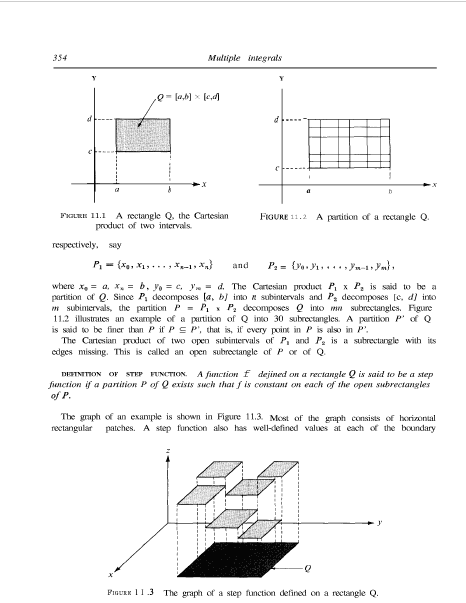
The following 3 pages are extract from the book: "CALCULUS VOL II" by Tom M. Apostol
1.PNG

2.PNG

3.PNG


My interpretation of these 3 pages is worked out in the attached PDF file. Entirely done in propositional logic language.

Can anyone point out the mistakes or incorrect logical steps (if any) in the attached PDF file.
 

Attachments

  • Wow
Likes   Reactions: PeroK
Physics news on Phys.org
oliverkahn said:
Entirely done in propositional logic language.
Why would you want to do this? It's almost as if you had taken something that is fairly straightforward, and encrypted it.
 
Mark44 said:
Why would you want to do this? It's almost as if you had taken something that is fairly straightforward, and encrypted it.
I need to do this because I am having difficulties in quickly comprehending that book. The encrypted one is much more easier for me to make sense of what the book is saying. Also the book has skipped several trivial proofs.
 
oliverkahn said:
need to do this because I am having difficulties in quickly comprehending that book.
And I'm having extreme difficulties in understanding what you have done. Apostol's book, like many advanced mathematics books, is not intended for quick comprehension. However, it includes text descriptions of what it's describing, as well as images, neither of which is present in your work.

Rather than coming up with something that is nearly incomprehensible, I think it would be better to ask questions about the parts of Apostol's explanation that you don't understand.
oliverkahn said:
Also the book has skipped several trivial proofs.
If the proofs are indeed trivial, it shouldn't be a problem that they have been skipped. Calculus textbooks often do this sort of thing.
 
Last edited:
Mark44 said:
And I'm having extreme difficulties in understanding what you have done. Apostol's book, like many advanced mathematics books, is not intended for quick comprehension. However, it includes text descriptions of what it's describing, as well as images, neither of which is present in your work.

In the first page of my work, I guess everything MAY be comprehensible except the last biconditional...

In the book, it is written as:

4.PNG

This is equivalent to the following statement:

DEFINITION OF STEP FUNCTION: A function ##f## defined on a rectangle ##Q## is said to be a step function if(f) a partition ##P## of ##Q## exists such that on each of the open subrectangles of ##P##, ##f## is constant. A step function also has well defined value at each points of the partition boundary.

This statement can also be written in logic language as:

##f: Q \longrightarrow \mathbb{R} = \text{step function}##

##\Leftrightarrow##

##\exists\ P \ni##

##\forall\ Q_{ij}, \left( f: Q_{ij} \longrightarrow \mathbb{R} \right)= \text{a constant AND } f:\text{partition boundary} \longrightarrow \mathbb{R}##

Hope this may be comprehensible. (or not?). If yes, everything in the first page of my work may be easy to understand.

I have not used English text in my work because through logic codes, it is much easier for me to visualize what the symbols are trying to tell us rather than English text filled with grammers. This is my personal opinion. Others may be having different opinions.
 
Last edited:
oliverkahn said:
This is equivalent to the following statement:

DEFINITION OF STEP FUNCTION: A function ##f## defined on a rectangle ##Q## is said to be a step function if(f) a partition ##P## of ##Q## exists such that on each of the open subrectangles of ##P##, ##f## is constant. A step function also has well defined value at each points of the partition boundary.
In fact, your version is nearly identical to the one in Apostol.
oliverkahn said:
This statement can also be written in logic language as:

##f: Q \longrightarrow \mathbb{R} = \text{step function}##

##\Leftrightarrow##

##\exists\ P \ni##

##\forall\ Q_{ij}, \left( f: Q_{ij} \longrightarrow \mathbb{R} \right)= \text{a constant AND } f:\text{partition boundary} \longrightarrow \mathbb{R}##

Hope this may be comprehensible. (or not?). If yes, everything in the first page of my work may be easy to understand.
Yes, I understand this, but IMO it is not as good as Apostol's definition, because Apostol explains the definition in words, and includes drawings of what the partition might look like.
oliverkahn said:
I have not used English text in my work because through logic codes, it is much easier for me to visualize what the symbols are trying to tell us rather than English text filled with grammers. This is my personal opinion. Others may be having different opinions.
It is much easier for most people to visualize something if there is a drawing. If it works for you, then fine, but most native speakers of English (which I assume from your IP address) would have a better grasp with a description in English plus a drawing or two.

What you're doing seems to me to be something like describing the Mona Lisa painting via a Fortran program. Admittedly this is a rough analogy, but is something that came to mind.
 
Notice that since f is already defined on the whole rectangle, it is certainly also defined on the boundaries of the partition.

I do almost have some sympathy for some of your concerns about logical language, in particular the desire to precede a statement about some quantity with a quantifier specifying that quantity. I.e. it is indeed more precise and correct to say " for each sub rectangle Q, f is constant on Q", than to say "f is constant on Q, for each sub rectangle Q". Of course this is not quite what was said, and what was said is already pretty precise for normal English.

I myself used to have such overly strict obsessions with logical language. I am also sympathetic with those concerned about the value of rendering something understandable into something less so.
 
  • Informative
Likes   Reactions: oliverkahn
mathwonk said:
Notice that since f is already defined on the whole rectangle, it is certainly also defined on the boundaries of the partition.

I do almost have some sympathy for some of your concerns about logical language, in particular the desire to precede a statement about some quantity with a quantifier specifying that quantity. I.e. it is indeed more precise and correct to say " for each sub rectangle Q, f is constant on Q", than to say "f is constant on Q, for each sub rectangle Q". Of course this is not quite what was said, and what was said is already pretty precise for normal English.

I myself used to have such overly strict obsessions with logical language. I am also sympathetic with those concerned about the value of rendering something understandable into something less so.
What do you mean by "rendering something understandable into something less so"
 
perhaps i should have said, that they consider less so, since i was only channeling some of the responses you have received. However, although i have not read your version, i recall people thinking my own propositional logic statements were less clear than the same thing said in normal English.
 

Similar threads

  • · Replies 22 ·
Replies
22
Views
2K
  • Sticky
  • · Replies 0 ·
Replies
0
Views
4K
Replies
2
Views
729
  • · Replies 7 ·
Replies
7
Views
8K
  • · Replies 3 ·
Replies
3
Views
2K
Replies
3
Views
1K
  • · Replies 4 ·
Replies
4
Views
2K
  • · Replies 2 ·
Replies
2
Views
2K
  • · Replies 14 ·
Replies
14
Views
3K
  • · Replies 9 ·
Replies
9
Views
3K