How can I solve double integrals with tricky limits and substitutions?

Click For Summary

Homework Help Overview

The discussion revolves around solving double integrals with challenging limits and substitutions, specifically focusing on integrals involving square roots and trigonometric functions.

Discussion Character

  • Exploratory, Assumption checking, Problem interpretation

Approaches and Questions Raised

  • The original poster attempts to solve double integrals by changing limits and using substitutions but encounters difficulties, particularly with the expressions under the square root and the sine function. Some participants suggest interchanging limits to facilitate integration and question the correctness of the integral's setup.

Discussion Status

Participants are actively exploring different approaches to the problem, with some guidance offered regarding limit interchange and the need for clarity in the integral's formulation. There is recognition of potential misprints in the problem statements, and the discussion remains open-ended without a definitive resolution.

Contextual Notes

There are indications of confusion regarding the limits of integration and the setup of the integrals, with a suggestion that a graphical representation may aid in understanding the problem better.

ApeXaviour
Messages
34
Reaction score
0
I was fine with these in class, tutorials etc. It's only since I found this in a past paper that I've had a problem with them.
[tex]\[ \int_0^1\! \int_{\sqrt{y}}^1 9\sqrt{1-x^3}\,dxdy.\] [/tex]

Nomatter what I substitute in under the sqrt sign I just can't get out the integral for x :(
I tried changing the limits so they run from x^2 to 1 for y and 0 to 1 for x..


I'm having similar trouble with this one...
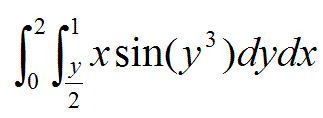
4.GIF


The Sin(y^3) here is what's getting me. Also tried changing the limits and substitution. No luck.. just ends up a big unsolvable mess for me

Thanks
Declan
 

Attachments

  • 4.GIF
    4.GIF
    2.6 KB · Views: 572
Last edited:
Physics news on Phys.org
For the first one, if you interchange the limits, y will run from 0 to x^2, which will let you do the x integral by substitution. The second integral doesn't make sense as wriiten, but the same approach as for the first one will work if you meant for the inner integral to run from x/2 to 1.
 
Hmm.. you're right. I didnt even notice that about the second one. Re-checked the past exam papers and that's exactly how it's written though. Must be a missprint.

I obviously don't have the hang of changing these limits, thanks for your help I'll try wrap my head around that now..
 
If you're having trouble finding new limits, a sketch of the graph will certainly help!
 

Similar threads

Replies
2
Views
2K
  • · Replies 1 ·
Replies
1
Views
2K
  • · Replies 27 ·
Replies
27
Views
3K
Replies
10
Views
2K
  • · Replies 3 ·
Replies
3
Views
2K
Replies
4
Views
3K
  • · Replies 10 ·
Replies
10
Views
2K
  • · Replies 17 ·
Replies
17
Views
4K
  • · Replies 9 ·
Replies
9
Views
2K
  • · Replies 2 ·
Replies
2
Views
2K