How do I Calculate Normal and Applied Forces on a Branch Wheeled System?

Click For Summary

Discussion Overview

The discussion revolves around calculating the normal and applied forces on a branch wheeled system, particularly focusing on the forces acting on wheels positioned on branches along a circular path. Participants explore various approaches to solving the problem, including theoretical frameworks and practical considerations.

Discussion Character

  • Exploratory
  • Technical explanation
  • Debate/contested
  • Mathematical reasoning

Main Points Raised

  • One participant questions the ability to sum the forces to zero given the horizontal and vertical components, suggesting that additional information or forces may be necessary.
  • Another participant proposes that adding more wheels could help balance the forces, although they express uncertainty about how to calculate the load distribution among the wheels.
  • A different viewpoint suggests that knowing the mass of the system is essential for calculating the normal forces accurately.
  • One participant recommends using a Lagrangian approach, incorporating potential and kinetic energy to derive constraint forces, although specifics are not fully detailed.
  • Another participant requests more specific guidance, emphasizing the need for a solution based on ratios and sine angles.

Areas of Agreement / Disagreement

Participants express differing views on the necessary conditions and information required to solve the problem, indicating that multiple competing perspectives remain without consensus on a definitive approach.

Contextual Notes

Some limitations include the lack of information regarding the mass of the system and how the load is shared among multiple wheels, which may complicate the calculations and lead to statically indeterminate scenarios.

losbellos
Messages
63
Reaction score
0
Dear Physics lover friends,

theproblem.gif


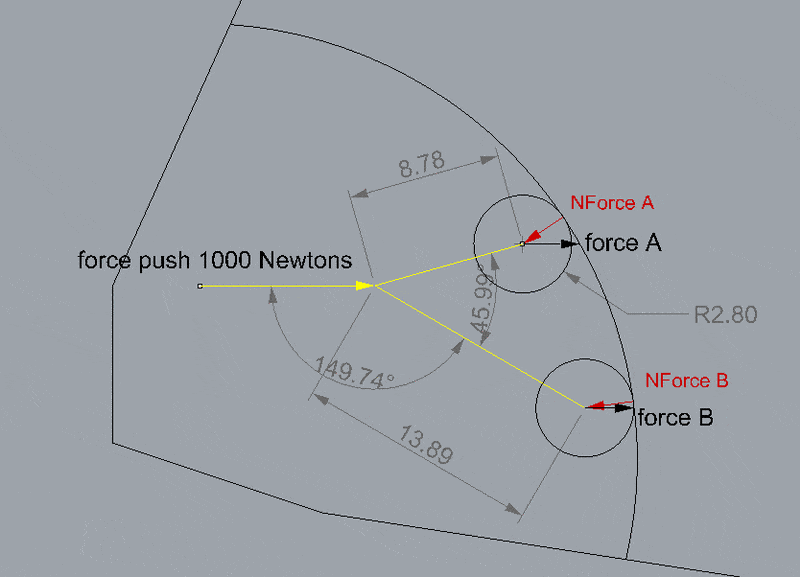
I am in the middle of something and I would like to ask a question on how to solve this branch wheeled problem.
The yellow lines are the branches, they have one wheels on them and the wheels are on a circular path.
I would like to know how much the normal force A and B and how much are the force A and force B.

Could you lease elaborate?
Thank you,
 
Physics news on Phys.org
Inspecting the drawing suggests that the three forces (1000N, NForceA and NForceB) can't sum to zero. For example the 1000N force is horizontal and both the NForces have downward vertical components. So either there is another force missing or the assembly must be accelerating. I might be wrong but I don't think you can solve it without more info.
 
  • Like
Likes   Reactions: russ_watters
Hej, that might be that the system accels, but I believe that it is possible to zero it out, maybe by putting more wheels.
Actually on the end If I make sure the calculus is right I will try to convert it to a system that it will generate zeroed systems.

If I have only one arm that's easy I believe because the normal angle and the north angle can tell the normal components length (how much force it actually holds) and then the remaining force could generate some torque from the big circle's centerpoint (from the midponint not because there is no angle there)

So have you got any suggestions?
 
The problem is I think you need to need to know it's mass in order to calculate the normal forces you asked about.

If you add more wheels I think you have a problem calculating how the load is shared between them. I think it depends on how the frame flexes. eg It becomes statically indeterminate.
 
Last edited:
I would set up a Lagrangian. Use 1000 times the horizontal position of the branch for your potential. Use an angular coordinate or two for the position of the wheels. Your KE is a function only of the derivative of the angular position. Then put in constraints for the arms and wall. Solve the Lagrangian and get your constraint forces.
 
please can you be more specific? I mean please only answer if you know the answer.
This system must be able to solve by ratios and sin angles.

Thanks anyways!

[[Moderator's note: Per this request, the level of the thread has been changed from "A" to "B", and several off-topic posts discussing the appropriate level have been removed]]
 
Last edited by a moderator:

Similar threads

  • · Replies 22 ·
Replies
22
Views
5K
  • · Replies 11 ·
Replies
11
Views
2K
  • · Replies 35 ·
2
Replies
35
Views
5K
  • · Replies 116 ·
4
Replies
116
Views
13K
  • · Replies 16 ·
Replies
16
Views
3K
  • · Replies 11 ·
Replies
11
Views
2K
  • · Replies 49 ·
2
Replies
49
Views
5K
  • · Replies 3 ·
Replies
3
Views
2K
  • · Replies 11 ·
Replies
11
Views
8K
  • · Replies 8 ·
Replies
8
Views
6K