How do I design a PI controller with unity DC gain?

Click For Summary

Discussion Overview

The discussion revolves around designing a PI controller with unity DC gain, as part of a homework problem. Participants explore the implications of the unity gain condition and how it relates to the transfer function of the system.

Discussion Character

  • Homework-related
  • Technical explanation
  • Debate/contested

Main Points Raised

  • One participant begins by stating the form of the PI controller as D(s) = (Kp + Ki/S) and expresses confusion about achieving unity DC gain.
  • Another participant explains that the condition for unity DC gain can be expressed as G(0)/(1 + Kp*G(0)) = 1, but emphasizes the need to substitute the plant's transfer function G(s) into this equation.
  • A later reply questions how the equation (G(0)/(1 + Kp*G(0)) = 1) is derived from the condition of a PI controller with unity DC gain, indicating a lack of clarity in the provided solution.
  • One participant suggests that the textbook may be asking for approximations that are not clearly explained, and raises the question of where the controller is placed in the feedback loop.
  • Another participant confirms that the controller is likely placed between the error signal E(s) and the plant G(s), based on the problem's indication of 'unity feedback'.

Areas of Agreement / Disagreement

Participants express uncertainty about the derivation of the equation related to unity DC gain and the placement of the controller in the feedback loop. There is no consensus on how to proceed with the problem or the assumptions made in the textbook solution.

Contextual Notes

Participants note that the problem may involve assumptions or approximations that are not fully detailed in the textbook, leading to confusion about the correct approach to the design of the PI controller.

glorimda
Messages
3
Reaction score
0
I'm doing my homework, and encountered a problem.
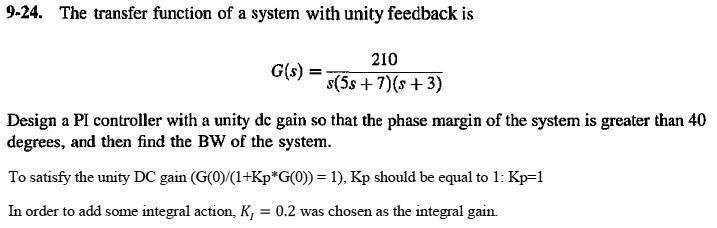
1.jpg


The problem is the one as attached. It includes a part of solution that I don't understand.

I've known that when designing the PI controller, we start from D(s) = (Kp + Ki/S)

The condition of the PI controller is, firstly, unity DC gain.

So the way I started is setting D(0) = 1, but couldn't proceed anymore because there is 1/s

in D(s), also it is obviously different from the solution.

The second way was setting whole transfer function of the system Gcl(0) = 1,

but couldn't find the right solution.

According to solution, it approaches Kp and Ki separately.

And it uses (G(0)/(1+Kp*G(0))=1), but I can't understand this.

Could somebody help me out??
 
Last edited:
Engineering news on Phys.org
The secret is in the fact that there is a pole @ s=0 in the plant. When you apply the feedback controller, You'll have H(s) = \frac{G_c(s)G(s)}{1 + G_c(s)G(s)} where G_c(s) is the controller.

You start with the criterion they gave you \frac{G(0)}{1 + K_pG(0)} = 1. In order to use this, you first have to plug in G(s). Notice, that of course, if we then set s=0, that the expression blows up, so instead we have to do the Laplace domain equivalent of L'Hopital's rule, which is multiplying the expression by a fancy form of one, or \frac{s}{s}. Assigning {\hat{G}}(s) = \frac{210}{(5s+7)(s+3)}, then you'll have \frac{{\hat{G}}(s)}{s + K_p{\hat{G}}(s)}. Notice now that if you plug in 0, the expression simplifies to \frac{21}{K_p21} which, set equal to one, produces the result that K_p=1.

Unfortunately, I remember less about the phase margin controller design. Maybe I'll brush up and get back to you (I love reviewing. I seriously might.). But I will say this... The design centers around starting with the bode plot for G(s). Since the new plant will be Gc(s)G(s), the phases will add, and you have to cancel out the unwanted phase in the plant with the controller. It's also standard to add in 5 degrees of safety within the design procedure since it's known that this procedure involves some, perhaps strong, approximation. This is vague and I'm sorry I don't have more details. But I hope this helps get you started...
 
Last edited:
Thanks for reply.
In fact, I'm still unclear about the part (G(0)/(1+Kp*G(0))=1) which is from the solution.
In the problem, they just gave me the condition that 'PI controller with a unity dc gain'
and in the solution, the equation '(G(0)/(1+Kp*G(0))=1)' just came up. The equation is not from the problem, but from solution. What I wondered was how to induce
'PI controller with a unity dc gain' ----> (G(0)/(1+Kp*G(0))=1)
The rest of the part you explained, I got it, but not this part.
I hope that you understood my question. ^^!
 
Ohhhhhh I see what you're saying. Honestly I don't know. It seems like the textbook is asking you to take more approximations than necessary, and not giving you some of the information. It depends. Where is the controller assumed to be placed in the loop? Between the E(s) signal and the G(s) plant or in the Feedback Loop on Y(s)? The way the problem is posed makes it look like it's in the feedback loop on Y(s). That may yield something.
 
I guess the controller is supposed to be placed between E(s) and plant G(s), because in the problem I attached, it says 'unity feedback' which means H(s) = 1.

All I got is identical to the one I attached.

I'm many times bothered due to lack of explanation and sources regarding exercises in

the textbook. >.<
 

Similar threads

Replies
2
Views
2K
  • · Replies 3 ·
Replies
3
Views
5K
  • · Replies 3 ·
Replies
3
Views
7K
  • · Replies 6 ·
Replies
6
Views
3K
  • · Replies 17 ·
Replies
17
Views
8K
Replies
8
Views
2K
Replies
22
Views
4K
Replies
3
Views
1K
Replies
12
Views
2K
  • · Replies 4 ·
Replies
4
Views
5K