How do I find the refractive index in sugar solutions?

Click For Summary

Homework Help Overview

The discussion revolves around determining the refractive index of sugar solutions using a prism and laser pointer. The original poster describes an experiment where they encountered issues with measuring the angle of deviation instead of the minimum angle of deviation, leading to confusion about the validity of their results and the necessity of redoing the experiment.

Discussion Character

  • Exploratory, Assumption checking, Problem interpretation

Approaches and Questions Raised

  • Participants discuss the implications of measuring the angle of deviation and whether the original poster can still use the refractive index formula. Alternative methods, such as measuring apparent and real depth, are suggested, though uncertainties about execution remain. Questions about specific angles and measurements related to the prism setup are also raised.

Discussion Status

The discussion is ongoing, with participants exploring various methods to approach the problem. Some guidance has been offered regarding reconstructing the light path and applying Snell's law, but there is no clear consensus on the best course of action. The original poster expresses confusion about the complexity of the algebra involved.

Contextual Notes

Participants note the time constraints faced by the original poster and the potential need to adjust the experimental aim if redoing the experiment is not feasible. The apex angle of the prism is mentioned as a known value, which may influence the calculations discussed.

Jane Smith
Messages
12
Reaction score
1
Thread moved from the technical forums, so no Homework Template is shown
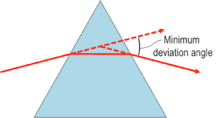
For class I conducted a experiment where I made sugar solutions, poured them into a glass prism container and used a laser pointer to find the refractive index. However, while typing in my results I realized I found the angle of deviation instead of the minimum angle of deviation since I didn't adjust the prism so that the refracted light inside the prism was parallel to the side of the prism.
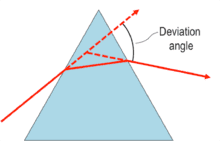
220px-Deflection_of_light_ray_passing_through_prism.png
220px-Minimum_deflection_of_light_ray_passing_through_prism.png

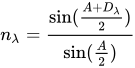
Does that mean I can not use the formula
1a4ee7cc8377d03e0e50298e6cae5debc6a747b3
to find the refractive index? Do I have to redo my experiment? I am at a time constraint so I would even be open to having another aim for my investigation instead of redoing the experiment. I am very confused and my teacher hasn't been much help.
 

Attachments

  • 220px-Deflection_of_light_ray_passing_through_prism.png
    220px-Deflection_of_light_ray_passing_through_prism.png
    3.2 KB · Views: 1,092
  • 220px-Minimum_deflection_of_light_ray_passing_through_prism.png
    220px-Minimum_deflection_of_light_ray_passing_through_prism.png
    2.8 KB · Views: 1,090
Physics news on Phys.org
That formula cannot be used unless the prism is in minimum deviation position.

There is one more way, though I am not sure how to do the experiment. There is a formula: ##n = \frac{\text{Apparent depth}}{\text{Real depth}}## The idea is to put a coin in a beaker, pour the solution over the coin upto a certain height (the real depth). Now, measure the apparent depth of the coin, and use the above formula.

I am not sure how to measure the apparent depth. I have heard that it can be done using microscopes, but I'm not sure.
 
Jane Smith said:
For class I conducted a experiment where I made sugar solutions, poured them into a glass prism container and used a laser pointer to find the refractive index. However, while typing in my results I realized I found the angle of deviation instead of the minimum angle of deviation since I didn't adjust the prism so that the refracted light inside the prism was parallel to the side of the prism.
View attachment 233369View attachment 233370
Does that mean I can not use the formula
1a4ee7cc8377d03e0e50298e6cae5debc6a747b3
to find the refractive index? Do I have to redo my experiment? I am at a time constraint so I would even be open to having another aim for my investigation instead of redoing the experiment. I am very confused and my teacher hasn't been much help.

Do you know angle B?
upload_2018-11-4_5-26-21.png
 

Attachments

  • upload_2018-11-4_5-26-21.png
    upload_2018-11-4_5-26-21.png
    3.8 KB · Views: 1,038
Jane Smith said:
I do know angle B, how does this help me?
Depending upon what angles you did measure, you should be able to reconstruct the light path through the prism in terms of the unknown index of refraction. The algebra may not be trivial.

Can you provide details about the prism and what data you collected? A diagram would be good.
 
gneill said:
Depending upon what angles you did measure, you should be able to reconstruct the light path through the prism in terms of the unknown index of refraction. The algebra may not be trivial.

Can you provide details about the prism and what data you collected? A diagram would be good.
upload_2018-11-5_22-50-36.png
upload_2018-11-5_22-51-39.png

This is how I set up my experiment. Instead of making sure the laser inside the prism was parallel with the the side of the prism, I just made sure to keep the prism in the same position during the entire experiment. I marked the points b and d as I put the laser through the solutions.
 

Attachments

  • upload_2018-11-5_22-50-36.png
    upload_2018-11-5_22-50-36.png
    4.4 KB · Views: 673
  • upload_2018-11-5_22-51-39.png
    upload_2018-11-5_22-51-39.png
    5 KB · Views: 713
Do you have measurements for the distances bc, de, and ce?
 
gneill said:
Depending upon what angles you did measure, you should be able to reconstruct the light path through the prism in terms of the unknown index of refraction. The algebra may not be trivial.

Can you provide details about the prism and what data you collected? A diagram would be good.
Yes, you should be able to solve this by breaking it down into two refraction problems with unknown angles inside the prism. You will need to know the angle between the two prism surfaces to find the angle of incidence on the 2nd surface. However, the math will be messy. You may need to do a numerical solution.
 
gneill said:
Do you have measurements for the distances bc, de, and ce?
Yes, I do
 
  • #10
DaveE said:
Yes, you should be able to solve this by breaking it down into two refraction problems with unknown angles inside the prism. You will need to know the angle between the two prism surfaces to find the angle of incidence on the 2nd surface. However, the math will be messy. You may need to do a numerical solution.
I am sorry but I don't understand. That might be too advanced for me.
 
  • #11
Do you have the apex angle of the prism?
 
  • #12
Draw a picture and name every angle of refraction at the two interfaces. Then apply Snell's law to get two formulas relating these angles to the refractive indicies. You can also make an equation that relates the internal angles and the angle of the prism surfaces. You will know 3 of the 5 angles (prism, entry, and exit) and the index of refraction in air. But, you don't know the internal angles, so you will need to work with the equations to eliminate them.
 
  • #13
gneill said:
Do you have the apex angle of the prism?
The apex angle is 60 degrees.
 
  • #14
Tri-Refract Part.jpg

So, 3 equations, 3 unknowns...
 

Attachments

  • Tri-Refract Part.jpg
    Tri-Refract Part.jpg
    26 KB · Views: 575

Similar threads

  • · Replies 1 ·
Replies
1
Views
2K
  • · Replies 5 ·
Replies
5
Views
2K
  • · Replies 3 ·
Replies
3
Views
4K
Replies
3
Views
2K
  • · Replies 1 ·
Replies
1
Views
3K
  • · Replies 4 ·
Replies
4
Views
903
  • · Replies 11 ·
Replies
11
Views
3K
  • · Replies 3 ·
Replies
3
Views
2K
  • · Replies 8 ·
Replies
8
Views
5K
Replies
4
Views
2K