How Do Velocity and Pressure Relate in Linear Sound Wave Equations?

Click For Summary
SUMMARY

The discussion centers on the relationship between velocity and pressure in linear sound wave equations, specifically referencing Euler's equation. The equations presented include the second-order time derivatives of velocity and pressure, highlighting the continuity equation's role in mass conservation. The continuity equation, expressed as $$\partial_t \rho + \vec{\nabla} (\rho \vec{v})=0$$, confirms the interdependence of density, velocity, and pressure. The conclusion drawn is that velocity and pressure are indeed related through the principles outlined in Euler's equation.

PREREQUISITES
  • Understanding of linear sound wave equations
  • Familiarity with Euler's equation in fluid dynamics
  • Knowledge of the continuity equation in non-relativistic physics
  • Basic concepts of vector calculus
NEXT STEPS
  • Study the derivation and applications of Euler's equation in fluid dynamics
  • Explore the implications of the continuity equation on fluid flow
  • Learn about the mathematical treatment of linear sound waves
  • Investigate the relationship between pressure, density, and velocity in compressible flows
USEFUL FOR

Students and professionals in physics, particularly those focusing on fluid dynamics, acoustics, and applied mathematics, will benefit from this discussion.

unscientific
Messages
1,728
Reaction score
13
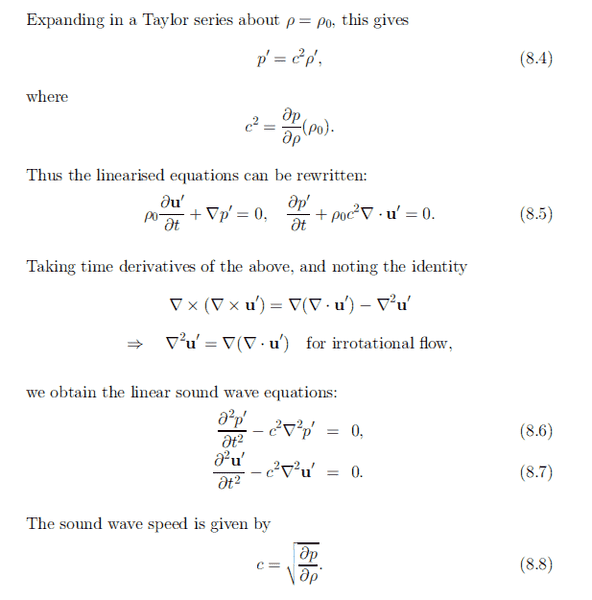
Taken from my lecturer's notes, how did they make the jump from 8.5 to 8.6 and 8.7?
sound1.png


Even after differentiating (8.5) with time I get

\rho_0 \frac{\partial^2 \vec u'}{\partial t^2} + \nabla \frac{\partial p '}{\partial t} = 0
\frac{\partial^2 p'}{\partial t^2} + \rho_0 c^2 \nabla \cdot \frac{\partial \vec u'}{\partial t} = 0

Is there a relation between ##\vec u## and ##p## I am missing?
 
Physics news on Phys.org
Note that
$$\vec{\nabla} \cdot \partial_t \vec{u}=\partial_t \vec{\nabla} \cdot \vec{u}.$$
 
vanhees71 said:
Note that
$$\vec{\nabla} \cdot \partial_t \vec{u}=\partial_t \vec{\nabla} \cdot \vec{u}.$$

Is ##\nabla \cdot \vec u ## somehow related to pressure?
 
It's somewhat related to density. Using the continuity equation, which expresses mass conservation (valid in non-relativistic physics from very basic principles)
$$\partial_t \rho + \vec{\nabla} (\rho \vec{v})=0.$$
 
vanhees71 said:
It's somewhat related to density. Using the continuity equation, which expresses mass conservation (valid in non-relativistic physics from very basic principles)
$$\partial_t \rho + \vec{\nabla} (\rho \vec{v})=0.$$

\frac{\partial m}{\partial t} = - \int \rho \vec v \cdot d\vec S
\int \frac{\partial \rho}{\partial t} dV = -\int \rho \nabla \cdot \vec v dV

This implies that ##\frac{\partial \rho}{\partial t} + \nabla \cdot (\rho \vec v) = 0 ##.
 
Well yes that equation is satisfied by default, as it is the continuity equation.

You can relate the velocity and pressure through Euler's equation.
 
  • Like
Likes   Reactions: unscientific

Similar threads

  • · Replies 4 ·
Replies
4
Views
2K
  • · Replies 3 ·
Replies
3
Views
2K
  • · Replies 1 ·
Replies
1
Views
2K
  • · Replies 4 ·
Replies
4
Views
2K
  • · Replies 5 ·
Replies
5
Views
665
  • · Replies 32 ·
2
Replies
32
Views
3K
  • · Replies 12 ·
Replies
12
Views
3K
  • · Replies 7 ·
Replies
7
Views
2K
  • · Replies 0 ·
Replies
0
Views
2K
  • · Replies 4 ·
Replies
4
Views
4K