How Do You Calculate Average Power in an AC Circuit with Phasors?

Click For Summary

Discussion Overview

The discussion revolves around calculating average power in an AC circuit using phasors, focusing on the conversion of voltage and current from time-domain sinusoidal functions to phasor representation, and the subsequent calculation of average power using these phasors. The context includes technical reasoning and mathematical formulation.

Discussion Character

  • Technical explanation
  • Mathematical reasoning

Main Points Raised

  • One participant presents the problem of calculating average power with given voltage and current functions expressed in sinusoidal form.
  • Another participant emphasizes the need to convert peak values to RMS values for phasor representation.
  • A formula for average power is suggested, which includes the power factor derived from the angle difference between voltage and current phasors.
  • There is a discussion about the conversion factor from peak to RMS values, with a participant noting the factor of 0.707 for sinusoidal functions.
  • Participants confirm the calculation of the angle difference, with one suggesting it is 30 degrees based on the provided phase angles.
  • Clarification is provided that the cosine function's value remains the same regardless of the sign of the angle difference.

Areas of Agreement / Disagreement

Participants generally agree on the need to convert to RMS values and the method of calculating average power, but the discussion does not resolve the specifics of the calculations or confirm the final average power value.

Contextual Notes

The discussion does not fully address the assumptions regarding the phase angles or the implications of using peak versus RMS values in the context of average power calculations.

ineedmunchies
Messages
42
Reaction score
0
Ok I've been given a problem that I've got stuck on, I was wondering if anyone here could help.

Q:
v(t) = 100 sin(200t+20^)
i(t) = 10 sin(200t-10^)
Express voltage and current as phasors, and calculate the average power being supplied. (I've used ^ to denote degrees)

The phasors part is pretty simple I think, the voltage is a line 100 in magnitude and 20 degrees positive of the x axis, and the current is of 10 magnitude and 10 degrees negative of the x axis.
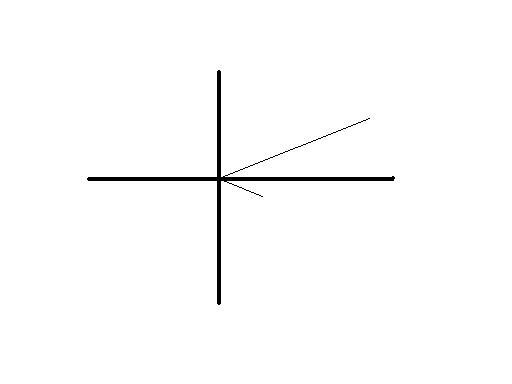
phasor.jpg


Its the power bit that I don't get, should I break these down into complex form and multiply them that way?
 
Engineering news on Phys.org
The phasors part is pretty simple I think, the voltage is a line 100 in magnitude and 20 degrees positive of the x axis, and the current is of 10 magnitude and 10 degrees negative of the x axis.

Be careful here. v(t) and i(t) are given in peak values. Phasors are represented in RMS or effective values.

To find ave. power, you need to find the power factor. Which is the cos(theta), where theta is the angle difference between the i(t) and v(t).

Pave = (Vm*Im)/2 * cos(theta)
Where Vm and I am are the peak values of v(t) and i(t), respectively.
 
Oh I forgot about them being in rms, that means they should be .707 times the peak values, because they are sinusoidal?

And theta would be 30 degrees?
 
Oh I forgot about them being in rms, that means they should be .707 times the peak values, because they are sinusoidal?
Correct.
And theta would be 30 degrees?
Correct also.
Dont forget that cosine of a positive and negative theta gives the same result. So it won't matter which angle you subtracted from what.
 

Similar threads

Replies
3
Views
2K
  • · Replies 15 ·
Replies
15
Views
3K
  • · Replies 17 ·
Replies
17
Views
7K
  • · Replies 3 ·
Replies
3
Views
2K
  • · Replies 10 ·
Replies
10
Views
5K
  • · Replies 17 ·
Replies
17
Views
4K
Replies
13
Views
3K
  • · Replies 2 ·
Replies
2
Views
2K
Replies
13
Views
2K
  • · Replies 4 ·
Replies
4
Views
1K