AC Circuit Analysis: Solving Example with Confusing Concepts

Click For Summary

Discussion Overview

The discussion revolves around concepts in AC circuit analysis, specifically addressing confusion regarding phasor values of voltage, the use of italicized versus non-italicized symbols for voltage and current, and the calculation of average power. Participants explore theoretical aspects and practical implications of these concepts.

Discussion Character

  • Exploratory
  • Technical explanation
  • Conceptual clarification
  • Debate/contested

Main Points Raised

  • One participant questions the origin of the phasor value of voltage being -π/2, seeking clarification on its derivation.
  • Another participant explains that a phase shift of -π/2 corresponds to a sine function being expressed as a cosine function with a phase shift.
  • Concerns are raised about the use of italicized versus non-italicized symbols for voltage and current in the context of average power calculations, with some participants suggesting that this inconsistency may indicate a mistake in the textbook.
  • Participants express confusion over the application of real versus complex values in the example solutions provided in the textbook.
  • A later reply acknowledges the confusion and suggests that the example solution is inconsistent in its notation.
  • A participant shares their background as a mechanical engineering student, highlighting the challenges of learning AC circuit analysis without prior knowledge of electricity.

Areas of Agreement / Disagreement

Participants express confusion and seek clarification on several points, indicating that there is no consensus on the issues raised, particularly regarding the notation and the derivation of phasor values.

Contextual Notes

Participants note inconsistencies in the textbook regarding the use of symbols and the presentation of concepts, which may affect understanding. There is also a mention of a lack of prior knowledge among some participants, which influences their grasp of the material.

Who May Find This Useful

This discussion may be useful for students studying electrical engineering or related fields, particularly those new to AC circuit analysis and seeking clarification on foundational concepts.

bardia sepehrnia
Messages
28
Reaction score
4
TL;DR
Difficulty understanding some concepts; RMS of voltage and current with phasor.
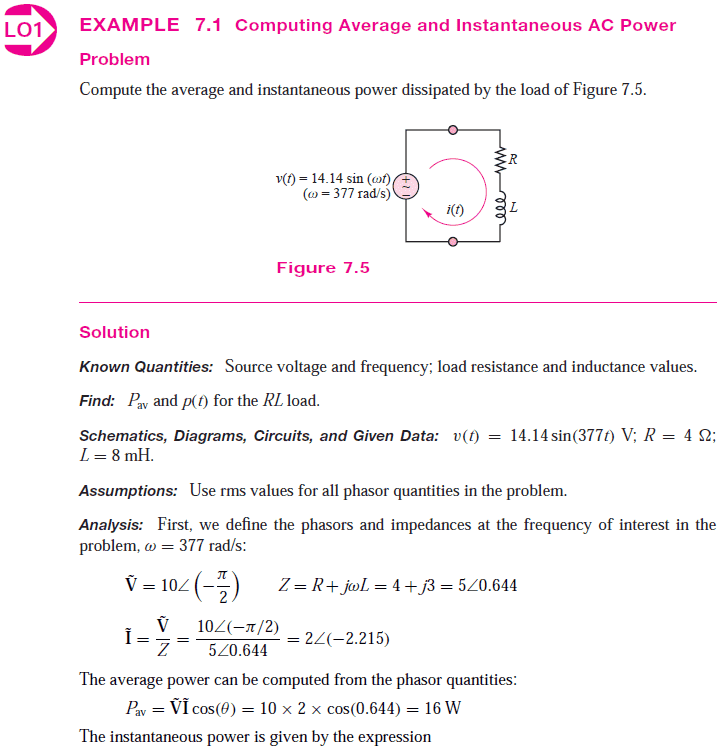
I'm reading this chapter in Electrical Engineering book regarding AC circuit analysis where there is a solved example which I've attached, but there are some concepts that are confusing me.
First, why and how do we know that the phasor value of voltage is: -pi/2
Note: I do understand that 14.14/√2 ≈ 10 but I don't get where -π/2 comes from?
1612277409541.png

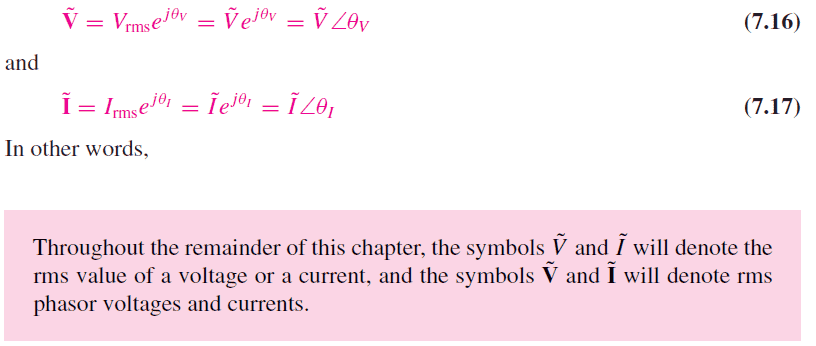
Second, earlier in the book and before the solved example the following formulas are stated:
1612277382210.png
1612277691856.png

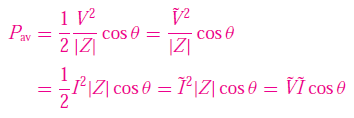
So why in calculation of average power, the italic V and I are not used. Is that a mistake on the book? Shouldn't average power only be real number and not complex? Also in the solved example only real values of I and V is used, yet the V and I are not italic.
 
Engineering news on Phys.org
##\angle\frac{\pi}{2}## is a phase shift of 90 degrees. That is equivalent to multiplying by j as in ##(R+j\omega L)##
 
Hi,
bardia sepehrnia said:
First, why and how do we know that the phasor value of voltage is: -pi/2
That's easy: ##\ \sin(\omega t) = \cos (\omega t - {\pi\over 2})##
bardia sepehrnia said:
  1. So why in calculation of average power, the italic V and I are not used. Is that a mistake on the book?
  2. Shouldn't average power only be real number and not complex?
  3. Also in the solved example only real values of I and V is used, yet the V and I are not italic.
I agree it's confusing. They make a mess of it in example solution 7.1..
  1. Yes. in example solution 7.1 it is clear that ##\tilde{\bf\text{V}}=10## and ##\tilde{\bf\text{I}}=2## and 7.16 & 17 wants ##\tilde V## and ##\tilde I##
  2. Yes. And it is; do you see it otherwise ?
  3. Isn't this the same question as 1. ?
You pasted a ##P_{\text{av}}= ... ## picture after the 'Throughout...' where they are more consistent .
 
  • Like
Likes   Reactions: bardia sepehrnia
Thank you very much! It sounds very simple after you explained it but I just started on this topic and I'm a mechanical engineering student. Our uni started teaching us AC circuit analysis before any prior knowledge on electricity. I had to self study everything just to understand what the teacher says. First lesson he started solving equations with impedance and that was the first time I heard that term!
 
  • Like
Likes   Reactions: dlgoff and BvU

Similar threads

  • · Replies 3 ·
Replies
3
Views
2K
  • · Replies 5 ·
Replies
5
Views
2K
  • · Replies 3 ·
Replies
3
Views
2K
  • · Replies 6 ·
Replies
6
Views
2K
  • · Replies 14 ·
Replies
14
Views
9K
  • · Replies 6 ·
Replies
6
Views
3K
  • · Replies 3 ·
Replies
3
Views
3K
  • · Replies 56 ·
2
Replies
56
Views
6K
  • · Replies 2 ·
Replies
2
Views
2K
Replies
20
Views
4K