How Do You Connect Vcc+ and Vcc- in a TL072 OpAmp Circuit?

Click For Summary
SUMMARY

The discussion focuses on connecting the Vcc+ and Vcc- pins in a TL072 operational amplifier circuit, specifically for a Sallen-Key high-pass filter design. Users are advised to connect Vcc+ to the positive terminal of a power supply and Vcc- to ground, or alternatively use two batteries with one connected to each pin. The output voltage of the amplifier is determined by the input signal and the gain, but it is crucial to ensure that the input signal remains within the common-mode range to avoid distortion. The TL074 op-amps have a limited input common-mode range, necessitating a design that keeps inputs at least 4V away from the supply rails.

PREREQUISITES
  • Understanding of operational amplifier configurations, specifically the TL072 and TL074 models.
  • Basic knowledge of Sallen-Key filter design principles.
  • Familiarity with power supply connections and voltage divider circuits.
  • Awareness of common-mode input voltage limitations in op-amps.
NEXT STEPS
  • Research the datasheet for the TL072 and TL074 op-amps for detailed specifications.
  • Learn about designing Sallen-Key filters and their applications in audio processing.
  • Explore CMOS op-amps that allow closer input and output to the supply rails.
  • Investigate methods for ensuring signal integrity in op-amp circuits, including coupling techniques.
USEFUL FOR

Electronics engineers, audio signal processing designers, and hobbyists working with operational amplifiers and filter circuits.

rusty009
Messages
68
Reaction score
0
Ok, sorry for this basic question, I am currently designing a sallen-key high pass filter using a TL072 opAmp, with the schematic shown below,
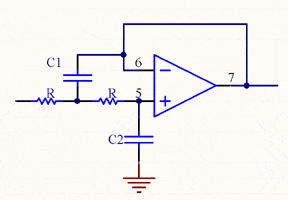
SallenKeyLP.gif


This circuit is connected to a piezo trasnducer whose signal I wnat to amplify. I was wondering, what do I connect to the Vcc+ and Vcc- pins of the op amp ? Should I connect a battery to each pin or is one of them (Vcc-) the ground ? I am aware this is a very basic question but I was just wondering. Also, say I put 18 volts into the amplifier, will this turn my amplified signal into 18 volts ? Thanks.
 
Engineering news on Phys.org
The simplest arrangement is to have two batteries with one battery's positive and the other battery's negative going to the opamp and the other battery connections going to ground.

You can also use one battery and put a voltage divider across it to get a ground point.
Like this:
[PLAIN]http://dl.dropbox.com/u/4222062/LM324.PNG

However, this does take extra current from the battery for the voltage divider.

And it means the input signal must vary around the half-battery-voltage point (not around ground) or be capacity coupled into the opamp.

The output of the opamp is limited by the supply voltages, but it will be equal to the size of the input signal (usually measured in peak to peak volts), multiplied by the gain of the amplifier.

If this comes to more than the supply voltage, then the signal output will get distorted.
 
Last edited by a moderator:
And keep in mind that the TL074 style opamps do not let their inputs get very close to the rails. For +/-15V power supplies, the input common-mode range is only +/-11V. So you have to keep your inputs at least 4V away from the rails, which often limits your design...

http://www.datasheetcatalog.org/datasheet/texasinstruments/tl074.pdf

You can look at more modern (and more expensive...) CMOS opamps -- some let you get the inputs and output very close to the rails.
 

Similar threads

  • · Replies 10 ·
Replies
10
Views
2K
  • · Replies 15 ·
Replies
15
Views
5K
  • · Replies 21 ·
Replies
21
Views
3K
  • · Replies 3 ·
Replies
3
Views
2K
Replies
6
Views
2K
  • · Replies 4 ·
Replies
4
Views
3K
  • · Replies 28 ·
Replies
28
Views
6K
  • · Replies 6 ·
Replies
6
Views
3K
  • · Replies 22 ·
Replies
22
Views
7K
  • · Replies 1 ·
Replies
1
Views
3K