How Do You Derive the Initial Vertical Velocity Equation?

Click For Summary

Homework Help Overview

The discussion revolves around deriving the initial vertical velocity equation, particularly in the context of vertical motion under constant acceleration, such as that experienced near the Earth's surface. Participants are exploring the relationships between various equations of motion and the assumptions involved in estimating maximum initial velocities, specifically related to a tennis ball.

Discussion Character

  • Exploratory, Assumption checking, Conceptual clarification

Approaches and Questions Raised

  • Participants are questioning the validity of the equation's transformation and discussing the assumptions necessary for estimating maximum initial velocity. Some are considering the implications of using trigonometric functions in this context, while others are reflecting on the physical limitations of the scenario.

Discussion Status

The discussion is ongoing, with various interpretations being explored regarding the maximum initial velocity of a tennis ball. Some participants have provided insights into the challenges of estimating this velocity, while others are seeking clarification on the original question and its complexity.

Contextual Notes

There is a noted lack of defined symbols in the original equation, which complicates the discussion. Participants are also grappling with the nature of the question being classified as hard, emphasizing the need for realistic assumptions in their estimations.

Aquaticus
Messages
22
Reaction score
0
Hi can anyone help me with this formula:
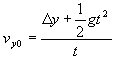
vertical_displacement_equation_initial_velocity.png


How do I end up with this equation, thanks in advance!
 
Physics news on Phys.org
Aquaticus said:
Hi can anyone help me with this formula: View attachment 38940

How do I end up with this equation, thanks in advance!

It looks like a re-arrangement of one of the 5 standard equations of motion under constant acceleration - which is what you get during vertical motion near the Earths surface [constant acceleration that is]

EDIT: Though given the symbols used, it looks like there is an error in the transformation - but without the symbols being defined you can't be certain.
 
Can I use it to determine the maximum initial velocity?
 
Aquaticus said:
Can I use it to determine the maximum initial velocity?

How would you propose to do that?
 
I don't know, I'm really stuck on that maximum initial velocity part
 
Aquaticus said:
I don't know, I'm really stuck on that maximum initial velocity part

maximum initial velocity was not part of your original post. What actual question are you trying to solve?
 
The question I want to solve is:

Estimate the maximum "initial velocity" that you can achieve with a regular tennis ball.

It is classified as a hard question which got me thinking...

I think that assumptions are a key role here, at the same time I have seen many other equations on how to solve for the initial velocity - but not the maximum.
 
Aquaticus said:
The question I want to solve is:

Estimate the maximum "initial velocity" that you can achieve with a regular tennis ball.

It is classified as a hard question which got me thinking...

I think that assumptions are a key role here, at the same time I have seen many other equations on how to solve for the initial velocity - but not the maximum.

I answered that question in another thread - look around.
 
Is it really that simple? Doesn't it have to do with some trigonometric functions?
 
  • #10
Aquaticus said:
Is it really that simple? Doesn't it have to do with some trigonometric functions?

It is that simple - made so by the words "estimate" and "you".
 
  • #11
What do you mean by "you"?

(Does your answer involve the maximum initial velocity?)
 
  • #12
Aquaticus said:
What do you mean by "you"?

(Does your answer involve the maximum initial velocity?)

The original question was

Estimate the "maximum velocity" you can throw a standard Tennis Ball.
 
  • #13
Why do you think this question s classified as hard? Might it be that one should make assumptions? Or what do you think?
 
  • #14
Aquaticus said:
Why do you think this question s classified as hard? Might it be that one should make assumptions? Or what do you think?

It is hard because you are not just plugging numbers into a formula. You have to realistically estimate what you yourself can do.
Since you are throwing a tennis ball, the ball is quite irrelevant as your arm if far heavier than the ball.
It would be interesting to turn up to call in an upper body cast, and offer the answer 0.1 m/s.

Another classic example is to hang masses of 100g, 200g, 300g, etc on the end of a spring, and note that it extends say 5cm, 10cm then 15 cm.
The question is then posed: what if we hang 250kg on the spring.
Some people suggest 125 m, which follows the nature of the spring, but ignores the fact that the spring is probably made of only 1 metre of wire, coiled up, so is unlikely to become 125 m long.
 
  • #15
What is the vertical motion formulae?
 

Similar threads

  • · Replies 11 ·
Replies
11
Views
4K
Replies
10
Views
1K
Replies
11
Views
2K
Replies
8
Views
2K
  • · Replies 6 ·
Replies
6
Views
1K
Replies
3
Views
2K
  • · Replies 9 ·
Replies
9
Views
2K
  • · Replies 8 ·
Replies
8
Views
2K
  • · Replies 3 ·
Replies
3
Views
919
  • · Replies 3 ·
Replies
3
Views
1K