How Does an Additive Constant Impact Potential Energy Calculations?

  • Context: Undergrad 
  • Thread starter Thread starter shanepitts
  • Start date Start date
  • Tags Tags
    Constant
Click For Summary

Discussion Overview

The discussion centers around the concept of an additive constant in potential energy calculations, particularly in the context of gravitational potential energy. Participants explore how the choice of reference point affects potential energy values and the implications of adding a constant to the equations used in these calculations.

Discussion Character

  • Exploratory
  • Technical explanation
  • Conceptual clarification

Main Points Raised

  • Some participants explain that the value of potential energy is dependent on the chosen reference point, with one formula using infinity as a reference and another using the Earth's surface.
  • It is noted that without an additive term, the potential energy at the Earth's surface would be negative, and adding a constant allows for a zero potential energy at that reference point.
  • Participants discuss the nature of an additive constant, likening it to constants added in indefinite integrals, and emphasize that the zero of potential can be defined arbitrarily.
  • One participant acknowledges the clarity gained from the discussion, indicating that the explanation helped them understand the topic better.

Areas of Agreement / Disagreement

Participants generally agree on the role of the additive constant in redefining potential energy reference points, but there are nuances in how this concept is articulated, with some variations in emphasis and detail.

Contextual Notes

Some statements include conditional language regarding the universality of potential differences, indicating that while the discussion is focused on specific cases, broader implications may not be fully resolved.
shanepitts
Messages
84
Reaction score
1
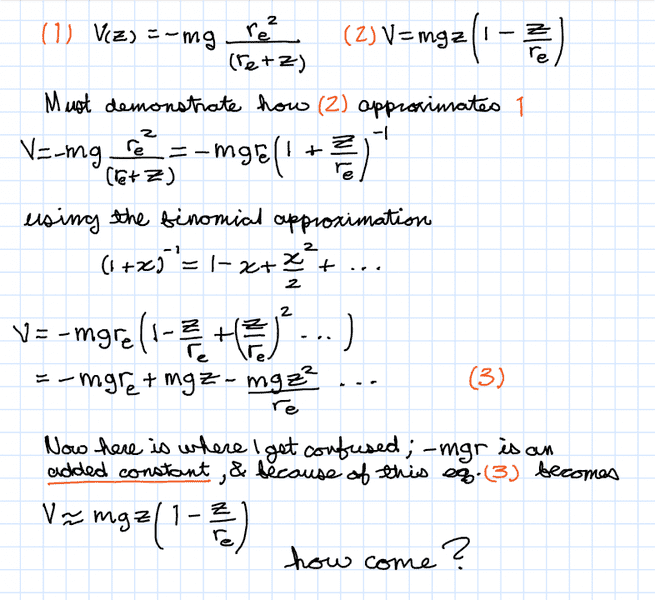
Pictured below was a problem shown in class with solution. I didn't have time to ask the professor a question about the last step involving an additive constant.

V is potential energy, re=Earth radius and z is distance from Earth's surface.

Screenshot_2015-08-05-11-37-00-1.png


What is an additive constant, and how does it allow the last transformation?
 
Physics news on Phys.org
You know (I hope) that the value of the potential energy depends on the reference point.
In the first formula, the reference point is at infinite. That means the energy becomes closer and closer to zero as z increases to infinite.

The other formula, U=mgz uses the surface of the Earth as reference.
So you need to change your formula to take this into account. Without the additive term, the energy at z=0 will be -mgR.
By adding +mgR you make the energy zero at z=0.
 
  • Like
Likes   Reactions: shanepitts
An additive constant is a constant that you add on. A very typical example is when you do an indefinite integral.

##\int x dx = \frac{x^2}{2} + c ##

Here ##c## is an additive constant.

The zero of a potential can be defined where you like. This is because you only ever see differences in potential from one place to another. (Well... I guess strictly speaking that is not universally true. But for purposes of your homework assignment it is.) That means you can add any constant onto the potential and get an equally valid potential. All it does is redefine where the zero is. By using the form that your assignment has it has defined the zero of ##V(z)## to be at ##z=0## which seems a natural place to define it.
 
  • Like
Likes   Reactions: shanepitts
nasu said:
You know (I hope) that the value of the potential energy depends on the reference point.
In the first formula, the reference point is at infinite. That means the energy becomes closer and closer to zero as z increases to infinite.

The other formula, U=mgz uses the surface of the Earth as reference.
So you need to change your formula to take this into account. Without the additive term, the energy at z=0 will be -mgR.
By adding +mgR you make the energy zero at z=0.

Thank you for your detailed answer, I fully fathom now.
 
DEvens said:
An additive constant is a constant that you add on. A very typical example is when you do an indefinite integral.

##\int x dx = \frac{x^2}{2} + c ##

Here ##c## is an additive constant.

The zero of a potential can be defined where you like. This is because you only ever see differences in potential from one place to another. (Well... I guess strictly speaking that is not universally true. But for purposes of your homework assignment it is.) That means you can add any constant onto the potential and get an equally valid potential. All it does is redefine where the zero is. By using the form that your assignment has it has defined the zero of ##V(z)## to be at ##z=0## which seems a natural place to define it.

Thanks
 

Similar threads

  • · Replies 2 ·
Replies
2
Views
2K
  • · Replies 6 ·
Replies
6
Views
2K
  • · Replies 27 ·
Replies
27
Views
12K
  • · Replies 6 ·
Replies
6
Views
2K
  • · Replies 4 ·
Replies
4
Views
3K
  • · Replies 31 ·
2
Replies
31
Views
4K
Replies
7
Views
2K
  • · Replies 5 ·
Replies
5
Views
3K
Replies
29
Views
3K
  • · Replies 3 ·
Replies
3
Views
808