How Does Switching Polarity Affect Capacitor Energy and Heat Dissipation?

  • Context: Undergrad 
  • Thread starter Thread starter varunKanpur
  • Start date Start date
  • Tags Tags
    Capacitor Energy Heat
Click For Summary

Discussion Overview

The discussion revolves around the effects of switching polarity on capacitor energy and heat dissipation in a circuit involving multiple capacitors. Participants explore the energy changes associated with the switching process, including how energy is delivered by the battery and the implications for heat generation.

Discussion Character

  • Exploratory
  • Technical explanation
  • Mathematical reasoning
  • Debate/contested

Main Points Raised

  • One participant suggests that when the switch is flipped, the change in energy of the capacitor will be released as heat energy, potentially amounting to twice the energy stored in the capacitor.
  • Another participant argues that the energy dissipated will be the sum of the energy delivered by the battery and the energy stored in the capacitors before and after the switch is flipped, noting that the energy in the capacitors remains equal despite the change in voltage direction.
  • A later reply emphasizes that the charge delivered by the battery can be determined by observing the charge on a specific capacitor before and after the switch is flipped, suggesting that the work done by the battery equals the heat generated.
  • One participant calculates the charge delivered by the battery as 2Q, based on the changes in charge before and after switching, and presents a formula involving the capacitance values.
  • Another participant clarifies that while the left capacitor is in series with the battery, some current through the capacitor will also flow through another capacitor, complicating the energy calculations.
  • There is a mention of eliminating certain options in a multiple-choice context due to inconsistency with energy units, indicating a search for a quick solution.
  • One participant concludes that the energy supplied by the battery must have gone into heat as no net energy is added to the capacitors, reinforcing the idea that the extra energy supplied is related to the change in charge.

Areas of Agreement / Disagreement

Participants express differing views on the calculations and implications of energy changes, with no consensus reached on the exact nature of the energy dissipation or the correct approach to the problem.

Contextual Notes

Participants reference specific charge calculations and the relationships between different capacitors, but there are unresolved mathematical steps and assumptions regarding the circuit configuration and energy transformations.

varunKanpur
Messages
7
Reaction score
0
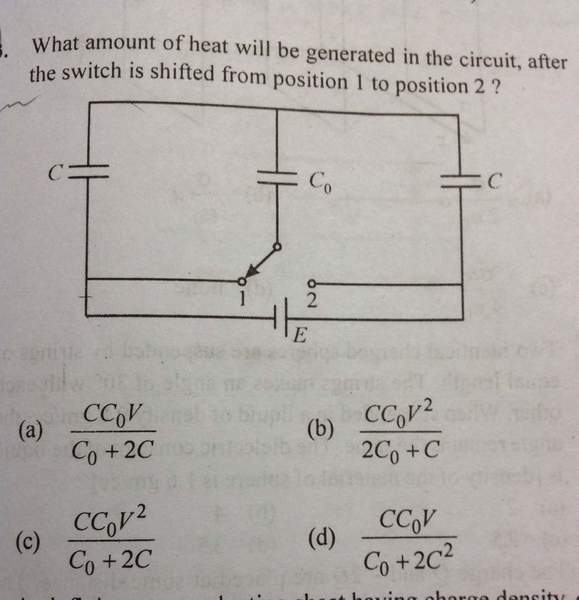
I am not able to solve this problem

image.jpg


I am thinking that Co would be charging in reverse polarity switch is shifted to 2 position, so change in energy of capacitor will be released as heat energy, i.e twice the energy of stored capacitor.
 
Physics news on Phys.org
Nice problem :).

The energy that dissipates will be equal to the energy delivered by the battery + (the energy stored in the capacitors before you flip the switch) - (the energy stored in the capacitors after you flip the switch).

The energy in the capacitors before and after you flip the switch is equal, because the end situation after the switch is flipped is just a reflection of the situation before the switch is flipped. The voltage across C0 will be in the other direction, but that won't matter for its energy.

So you only need the energy delivered by the battery which is QV, where Q is the amount of charge it delivered.

Now you can find the amount of charge that the battery delivered just by watching what happens to the charge on the left C, because when you disconnect C0 from point 1, there will be no current anywhere in the circuit, and after you connect C0 to point 2, all of the current that is going through the battery is also going through the left C.

So you just have to find the charge on the left capacitor before and after you flip the switch, and multiply it by V.
 
  • Like
Likes   Reactions: 1 person
willem2 said:
Now you can find the amount of charge that the battery delivered just by watching what happens to the charge on the left C, because when you disconnect C0 from point 1, there will be no current anywhere in the circuit, and after you connect C0 to point 2, all of the current that is going through the battery is also going through the left C.

So you just have to find the charge on the left capacitor before and after you flip the switch, and multiply it by V.

Thank for the quick reply. When I will connect Co to point 2 then a fraction of current will flow through to the left C and rest through Co.

The work done by the battery = To the heat generated.
When the switch is closed the polarity of capacitor changes.
Before Switching, Charge is -Q| |Q
But after switching, Charge would be Q| |-Q
Then the Charge delivered by the battery is 2Q.
According to my calculation, Q=CCoV/(2C Co)

Therefore the answer should be 2CCoV2/(2C Co)
 
varunKanpur said:
Thank for the quick reply. When I will connect Co to point 2 then a fraction of current will flow through to the left C and rest through Co.

The point is that when the switch makes a connection at point 2, the left C is in series with the battery, so the charge delivered by the battery is equal to the change in charge of the left C.

This is not the case for C0. You calculated the charge on before and after the flip correctly, but some of the current going through C0 will go through the rightmost C, and not the battery.

before the flip, the leftmost C has charge

\frac { V C^2} {2C + C_0}

and after it:

\frac { V C (C+C_0)} {2C + C_0}

The difference is the answer you need.

This is half your answer, and that's because half of the charge needed to decharge C0 and charge it in the opposite direction, will be delivered by the righthand C and not by the battery.
 
  • Like
Likes   Reactions: 1 person
varunKanpur said:
I am not able to solve this problem
It's indeed a good question! http://physicsforums.bernhardtmediall.netdna-cdn.com/images/icons/icon6.gif

With this being a multi-choice question, I'd be seeking a reasonably quick (or insightful) method of deciding on an answer.

Examining the options, we can immediately eliminate 2 simply because they don't have units consistent with energy. This then leaves a 50% chance of guessing the correct option. :wink:
 
Last edited by a moderator:
willem2 said:
The point is that when the switch makes a connection at point 2, the left C is in series with the battery, so the charge delivered by the battery is equal to the change in charge of the left C.

This is not the case for C0. You calculated the charge on before and after the flip correctly, but some of the current going through C0 will go through the rightmost C, and not the battery.

before the flip, the leftmost C has charge

\frac { V C^2} {2C + C_0}

and after it:

\frac { V C (C+C_0)} {2C + C_0}

The difference is the answer you need.
http://physicsforums.bernhardtmediall.netdna-cdn.com/images/icons/icon14.gif That looks right. The difference is a measure of the quantity of charge that has been supplied by the battery to effect the changes brought about by the switching. No nett energy has been added to the bank of capacitors, so the energy supplied by the battery must have all gone into heat as the losses.

The extra energy supplied by the battery = V.ΔQ
where ΔQ is that difference in charge determined above.

Well done!
 
Last edited by a moderator:

Similar threads

Replies
152
Views
8K
  • · Replies 11 ·
Replies
11
Views
2K
  • · Replies 2 ·
Replies
2
Views
2K
  • · Replies 3 ·
Replies
3
Views
3K
  • · Replies 7 ·
Replies
7
Views
2K
  • · Replies 4 ·
Replies
4
Views
7K
  • · Replies 1 ·
Replies
1
Views
2K
  • · Replies 1 ·
Replies
1
Views
2K
  • · Replies 44 ·
2
Replies
44
Views
6K
  • · Replies 3 ·
Replies
3
Views
2K