aletheia
- 49
- 13
- TL;DR
- Colder mass has more density and sinks while hotter mass has less density therefore it raises, but where exactly do the convection cycle begins?
I’m having trouble understanding how exactly non-equilibrium heat-transfer initiates convection, whether or not phase change is involved.
Consider the following experiments.
First: heating soy oil in a glass kettle on a regular gas stove; 4 probes — at the bottom, midway, near the surface inside the oil, and in the air above the oil (as in the image below); turn the fire on and follow the changes in temperature.
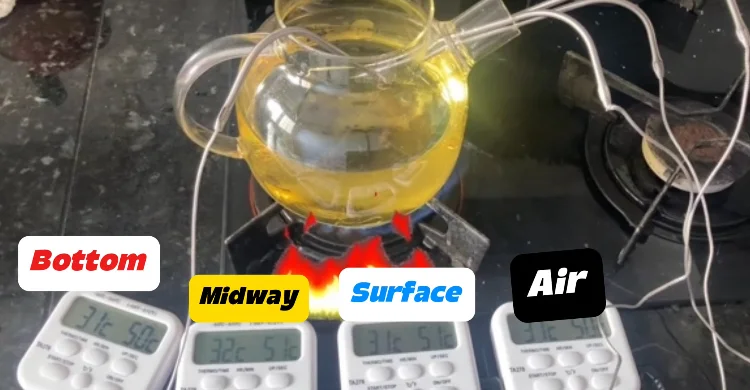
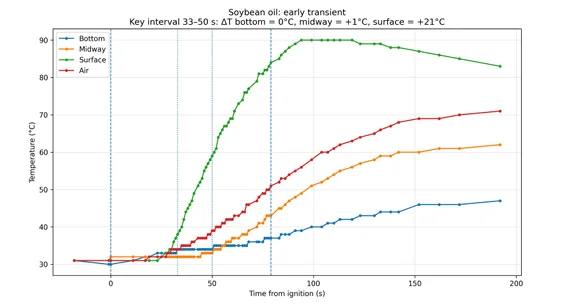
I was expecting that the bottom would lead — i.e., the temperature at the bottom, specially during active heating, would be hotter than the temperature at the surface.
I plotted the dynamics on a chart:
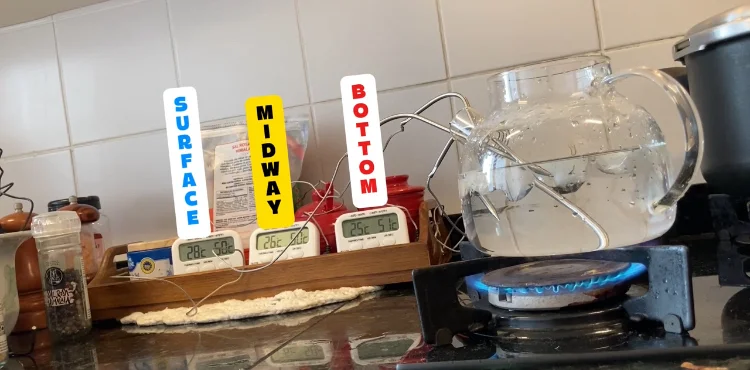
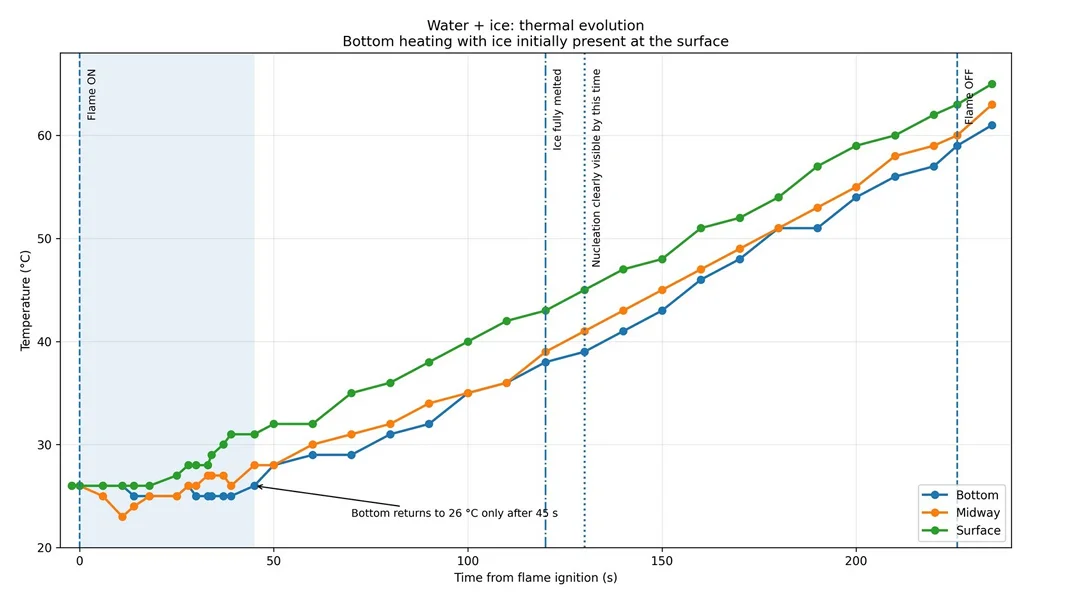
Second: same stove-kettle setup, 3 probes (bottom, midway, and surface, as in the image below), ice on the surface and fire on simultaneously; here again my naive expectative was that the button, directly receiving the heat from the fire would be hotter than the surface, especially while having ice still floating on the surface.
The data is on the chart below:
I have obviously repeated the experiments with different containers, different types of probes, etc., and the results were qualitatively similar.
Could someone explain how this dynamic happens?
The videos of the experiments are at the links below:
Soy oil
Water & Ice
Consider the following experiments.
First: heating soy oil in a glass kettle on a regular gas stove; 4 probes — at the bottom, midway, near the surface inside the oil, and in the air above the oil (as in the image below); turn the fire on and follow the changes in temperature.
I was expecting that the bottom would lead — i.e., the temperature at the bottom, specially during active heating, would be hotter than the temperature at the surface.
I plotted the dynamics on a chart:
Second: same stove-kettle setup, 3 probes (bottom, midway, and surface, as in the image below), ice on the surface and fire on simultaneously; here again my naive expectative was that the button, directly receiving the heat from the fire would be hotter than the surface, especially while having ice still floating on the surface.
The data is on the chart below:
I have obviously repeated the experiments with different containers, different types of probes, etc., and the results were qualitatively similar.
Could someone explain how this dynamic happens?
The videos of the experiments are at the links below:
Soy oil
Water & Ice

 (as in the image below) is placed on a leveled stainless steel at the furthest (about 15cm) point from the region where the flame
  hits the pan from below.