How should I Approach this Circuit Calculation?

Click For Summary
SUMMARY

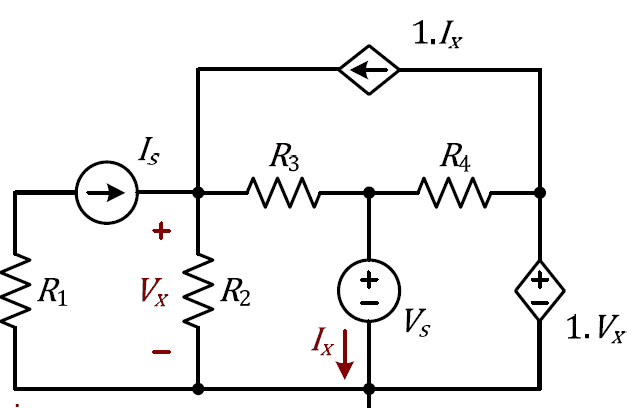
The discussion focuses on calculating power in a circuit with resistors R1, R2, R3, and R4, each with specified resistances, and a voltage source VS of 25V. The user is applying the node method to determine the current Ix and the voltage Vx, but encounters difficulties in identifying the resistance associated with Ix. Participants emphasize the importance of analyzing node potentials and suggest that there may be simpler methods to find the power produced by the dependent current source without fully solving for Vx and Ix.

PREREQUISITES
  • Understanding of circuit analysis techniques, specifically the node method.
  • Familiarity with Ohm's Law (V=IR) and power calculations (P=VI).
  • Knowledge of ideal voltage and current sources and their characteristics.
  • Ability to interpret circuit diagrams and node potentials.
NEXT STEPS
  • Research the node voltage method in circuit analysis.
  • Learn about dependent sources and their impact on circuit behavior.
  • Study techniques for simplifying circuit analysis, such as inspection methods.
  • Explore power calculations in resistive circuits and the implications of different configurations.
USEFUL FOR

Electrical engineering students, circuit designers, and anyone involved in circuit analysis and power calculations.

REEEEEEEE
Messages
10
Reaction score
0
Homework Statement:: R1 = 2kOHms; R2 = 2kOHms; R3 = 3kOHms;
R4 = 3kOHms; VS = 25V; IS = 10mA
[5,5] a) Determine the power
provided by the source dependent on
current using method
of the nodes
[3.0] b) What is the value of electrical power
dissipated in all resistors in the circuit?
Relevant Equations:: V=IR
P=VI
Captura de ecrã 2021-11-30 173328.png


I am currently applying nodemethod but I got to the Ix part and I don't know what is the R of Ix now how to find it.
Can you give me some sugestions please?
 
Physics news on Phys.org
REEEEEEEE said:
... I got to the Ix part and I don't know what is the R of Ix now how to find it.
Can you give me some sugestions please?
An ideal voltage source maintains voltage, independent of current. Rv = dv/di = 0.
An ideal current source maintains current, independent of voltage. Ri = dv/di = ∞.
 
REEEEEEEE said:
[5,5] a) Determine the power
provided by the source dependent on
current using method
of the nodes
Just to be clear, you are looking for the power produced by the indicated current source?
1638298978000.png
 
gneill said:
Just to be clear, you are looking for the power produced by the indicated current source?
View attachment 293358
I am looking or the current Ix and the afte geting it and vx I will look for the power
 
REEEEEEEE said:
I am looking or the current Ix and the afte geting it and vx I will look for the power
If the object is to find the power produced by that dependent current source, then there may be an easier way to find it than analyzing the whole circuit to find ##V_x## and ##I_x##.

By inspection of the circuit, what must be the potential difference across that current source? Hint: look at the node potentials where it connects.
 
Well, you've got a circuit with a lot of known components and some variables. Show us what you HAVE done. We don't give help without seeing that you have put in some effort.
 
phinds said:
Well, you've got a circuit with a lot of known components and some variables. Show us what you HAVE done. We don't give help without seeing that you have put in some effort.
I am sorry.
Here's my work
unnamed (1).jpg
 
Too bad it's not really legible
 

Similar threads

  • · Replies 1 ·
Replies
1
Views
2K
Replies
5
Views
4K
  • · Replies 15 ·
Replies
15
Views
2K
  • · Replies 5 ·
Replies
5
Views
2K
  • · Replies 3 ·
Replies
3
Views
2K
  • · Replies 34 ·
2
Replies
34
Views
6K
Replies
1
Views
2K
  • · Replies 1 ·
Replies
1
Views
1K
  • · Replies 8 ·
Replies
8
Views
2K
  • · Replies 6 ·
Replies
6
Views
2K