How the reluctance in a magnetic circuit depends on flux?

Click For Summary

Discussion Overview

The discussion revolves around the relationship between reluctance in a magnetic circuit and magnetic flux. Participants explore how reluctance is defined and whether it changes with varying flux levels, considering different materials and their properties.

Discussion Character

  • Technical explanation
  • Conceptual clarification
  • Debate/contested

Main Points Raised

  • Some participants reiterate that reluctance is defined as length divided by the product of permeability and area of cross-section, questioning how this relates to changes in flux.
  • One participant suggests that the change in reluctance with flux is dependent on the medium through which the flux is passing, indicating that different materials may exhibit different behaviors.
  • Another participant notes that length and cross-section are generally not dependent on flux, except potentially in cases of magnetorestriction in iron.
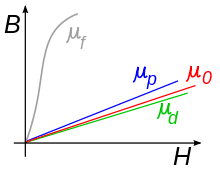
  • It is mentioned that permeability is a constant for free space, while for most other materials, it remains nearly constant, with exceptions for ferromagnetic materials that follow a BH saturation curve.

Areas of Agreement / Disagreement

Participants express differing views on the relationship between reluctance and flux, with no consensus reached on how reluctance changes with varying flux levels. The discussion remains unresolved regarding the specific conditions under which reluctance may vary.

Contextual Notes

Participants highlight the importance of material properties, such as permeability, in understanding reluctance, but the discussion does not resolve the implications of these properties on reluctance under varying flux conditions.

Aswin Sasikumar 1729
Messages
19
Reaction score
0
Since reluctance is equal to length decided by product of permeability and area of cross section,how does reluctance change with flux?
 

Attachments

  • 1475379596388-1670082523.jpg
    1475379596388-1670082523.jpg
    51.9 KB · Views: 550
Engineering news on Phys.org
Aswin Sasikumar 1729 said:
Since reluctance is equal to length decided by product of permeability and area of cross section,how does reluctance change with flux?
Length divided by product of permeability and area of cross section
 
Aswin Sasikumar 1729 said:
Sorry for the inconvenience

It's okay, you're pretty new here.

Aswin Sasikumar 1729 said:
Length divided by product of permeability and area of cross section

You already know the answer.
Length and cross section are not dependent on flux (excepting maybe magnetorestriction in iron)

that leaves permeability
which for free space is a constant
and
as that Wiki article explains for most other materials is very near the same constant
the big exception being ferromagnetic materials
which have the classic BH saturation curve.
220px-Permeability_by_Zureks.svg.png

Simplified comparison of permeabilities for: ferromagnets (µf), paramagnets (µp), free space (µ0) and diamagnets (µd)
 

Similar threads

  • · Replies 6 ·
Replies
6
Views
1K
  • · Replies 4 ·
Replies
4
Views
2K
  • · Replies 17 ·
Replies
17
Views
2K
Replies
8
Views
2K
  • · Replies 9 ·
Replies
9
Views
3K
Replies
22
Views
2K
  • · Replies 3 ·
Replies
3
Views
3K
  • · Replies 5 ·
Replies
5
Views
5K
  • · Replies 6 ·
Replies
6
Views
2K
  • · Replies 8 ·
Replies
8
Views
2K