karsnen
- 1
- 0
Hello,
SCENARIO :
I am a game developer and I am playing around with rigidbodies. I have a piece of wall which might get impact by an external force. The wall has in turn several other broken pieces (hidden for the moment) put up together to resemble this huge wall. Upon impact I switch one whole piece of wall for the individual pieces and would like to simulate that the wall is broken and subsequently forces are applied to the individual pieces. Thus creating a realistic visual appeal.
PICTURE ORIENTATION :
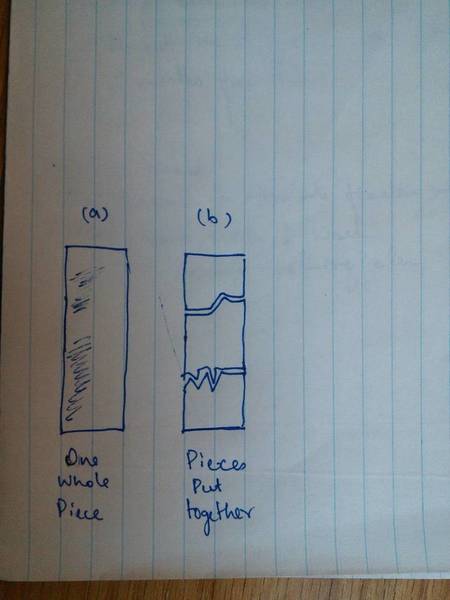
In the picture, the (a) is a whole piece which would get impact and then upon impact it would switch to (b) which in turn have to be applied the respective forces.
RESOURCES :
Now I have information from the force on impact and also the information from rigidbody of the whole piece at any point of time, till the switch.
REQUIREMENT :
What I am not sure is how should apply forces to the individual pieces to create the sort of realistic simulation? How should I approach it?
I hope I was clear with my scenario, resources I have and my requirement. If I am not clear at any point, please I would like to detail it.
Thank you for your time and highly appreciate it.
Karsnen.
INFORMATION I HAVE :
The External Force :
The Whole Piece of Rigidbodiy:
SCENARIO :
I am a game developer and I am playing around with rigidbodies. I have a piece of wall which might get impact by an external force. The wall has in turn several other broken pieces (hidden for the moment) put up together to resemble this huge wall. Upon impact I switch one whole piece of wall for the individual pieces and would like to simulate that the wall is broken and subsequently forces are applied to the individual pieces. Thus creating a realistic visual appeal.
PICTURE ORIENTATION :
In the picture, the (a) is a whole piece which would get impact and then upon impact it would switch to (b) which in turn have to be applied the respective forces.
RESOURCES :
Now I have information from the force on impact and also the information from rigidbody of the whole piece at any point of time, till the switch.
REQUIREMENT :
What I am not sure is how should apply forces to the individual pieces to create the sort of realistic simulation? How should I approach it?
I hope I was clear with my scenario, resources I have and my requirement. If I am not clear at any point, please I would like to detail it.
Thank you for your time and highly appreciate it.
Karsnen.
INFORMATION I HAVE :
The External Force :
- Source of the force
- Position of the source of the force
The Whole Piece of Rigidbodiy:
- mass
- velocity
- angular Drag
- angular Velocity
- center Of Mass
- inertia Tensor
- inertia Tensor Rotation
- position - The position of the rigidbody.
- rotation