How to apply Thevenin and Norton Model

  • Context: Undergrad 
  • Thread starter Thread starter SummerTime244
  • Start date Start date
  • Tags Tags
    Apply Model Thevenin
Click For Summary
SUMMARY

This discussion focuses on applying Thevenin and Norton models to analyze electrical circuits. Participants emphasize the importance of understanding basic circuit principles, such as equivalent circuits and the treatment of voltage sources when calculating Thevenin equivalent resistance. The conversation highlights the need for clarity in circuit diagrams and encourages beginners to reinforce their foundational knowledge before tackling more complex problems. Specific references to circuit analysis techniques, including Kirchoff's laws and the Kennelly and Millman theorems, are made to guide users in their approach.

PREREQUISITES
  • Understanding of Thevenin and Norton equivalents
  • Familiarity with Kirchoff's laws
  • Basic circuit analysis techniques
  • Ability to interpret circuit diagrams
NEXT STEPS
  • Study Thevenin's theorem in detail
  • Learn about Norton’s theorem and its applications
  • Explore circuit simplification techniques using Kirchoff's laws
  • Practice redrawing complex circuits for easier analysis
USEFUL FOR

Electrical engineering students, circuit designers, and anyone looking to deepen their understanding of circuit analysis techniques, particularly in applying Thevenin and Norton models.

SummerTime244
Messages
3
Reaction score
0
Hello guys,
I'm having some trouble reading two circuits :
Here they are :
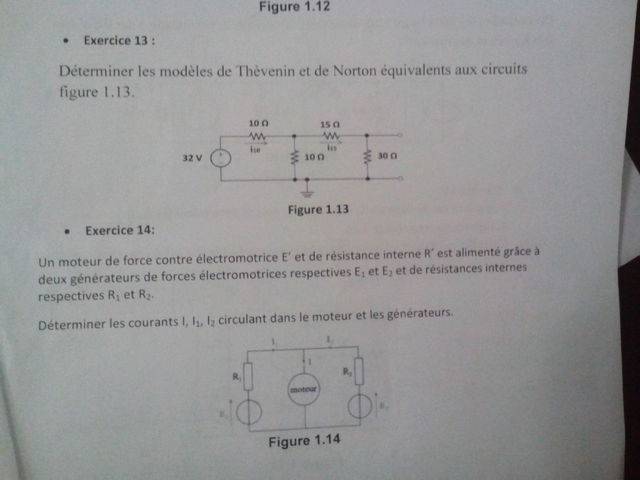
IMG_20131009_234746.jpg


In the first one I need to Determine the Thevenin then the Norton Equivalent of the circuit.

For the second one I have to find expressions of the current I1 flowing through the R1 resistor, I2 in R2 and then I which goes through the Motor.

I only need an idea, or a way to re-draw the circuit differently in order to know what theorem to use : Kennelly, Millman, or just good old Kirchoff law.

Thank you very much in advance :)
 
Physics news on Phys.org
I don't mean to sound unhelpful, but It's hard to imagine a circuit much more simple than fig 1.13 for finding the equivalent circuits. If you can't do that one, you should probably go back to studying the basics of just what the equivalent circuits are and how you get them. Certainly, the circuit does not need to be redrawn as it is already trivial.

I can't read the labels on the second figure so can't comment on that one.
 
Hello again,

I'm sorry to barge in but I'm just a beginner and I'm really trying to get a grasp on this.

Here's a draft of what I did for the first Circuit. You can click on the thumbnail to make it bigger.

I put in a better drawing for the second circuit, with a motor in the middle.

Could you please tell me if what I did is good, so far?

Thanks a lot !
 
I forgot to post the picture :
HYHgdat25t_AE7g_YBf_NCMf_Htf.jpg
 
I have no idea what you are doing but on the first one you are turning a very simple problem into something complex. Again, I urge you to go back to basics and study how it is that you are supposed to get an equivalent circuit. How are you supposed to treat a voltage source when solving for the Thevenin equivalent resistance ?
 

Similar threads

  • · Replies 9 ·
Replies
9
Views
2K
  • · Replies 7 ·
Replies
7
Views
1K
  • · Replies 1 ·
Replies
1
Views
2K
Replies
14
Views
2K
  • · Replies 10 ·
Replies
10
Views
4K
  • · Replies 10 ·
Replies
10
Views
2K
  • · Replies 2 ·
Replies
2
Views
2K
  • · Replies 42 ·
2
Replies
42
Views
6K
  • · Replies 9 ·
Replies
9
Views
6K
  • · Replies 17 ·
Replies
17
Views
3K