How to Approach Solving a Variable-Mass System with a Falling Drip?

Join the discussion
Registration is free. Start your own thread to ask a follow-up.
2 replies · 2K views · last reply
Michael_0039
Messages
59
Reaction score
7
Homework Statement
Falling drip surrounding by water vapor. For t=0, initial mass=M and Uo=0. Prove the following equation...
Relevant Equations
nil
S(t)=
Printed equation: S(t) = (1/2)g{(1/2)t^2 + (M/m)t - (M^2/m^2) ln[1 + (m/M)t]}, with fractions shown in stacked form.
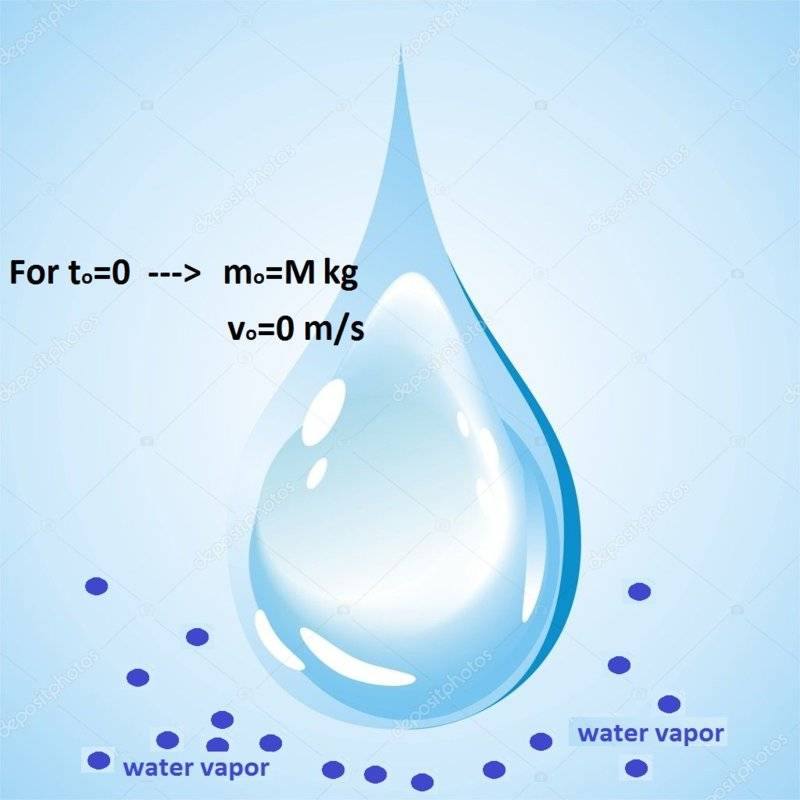
Illustration of a water droplet on a light blue background with blue dots labelled water vapor below; text reads For t0=0 ---> m0=M kg, v0=0 m/s.


Hi all!

Μy attempt to solve it:

Handwritten derivation for a variable-mass drip: momentum P = mu v, then P' = (m0 + dm)(u + du) + dm v', simplified to dP = M du + u0 dm, giving dP/dt = M du/dt + u0 dm/dt.

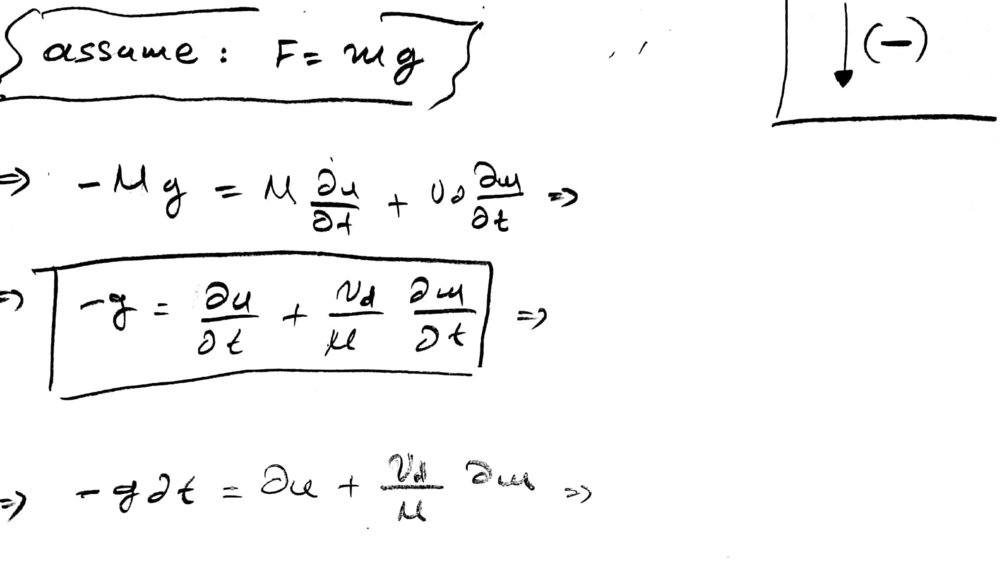
Handwritten derivation: assume F = mg, then -Mg = M du/dt + v_d dM/dt, giving -g = du/dt + (v_d/M) dM/dt, then -g dt = du + (v_d/M) dM. A small arrow labelled (-) points downward at the right.
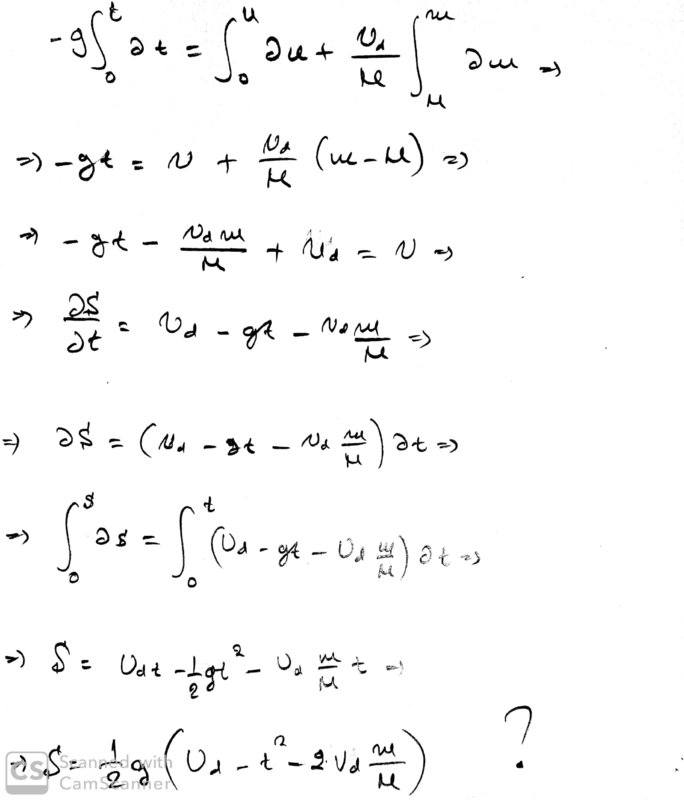
Handwritten derivation integrating a variable-mass equation from t = 0 to t, with a final expression for displacement S involving g, t, v_d and m/M, ending in a question mark.
I'm stuck here. An opinion ?

Thanks.
 
Physics news on Phys.org
Edit last line:

S=t (ud-(gt/2)-ud(m/M))


* I dont't know what happened there
 
I made a new attempt to solve it, and reading more for those kind of problems. I made some errors at the previous posts, so this is my attempt now:

Handwritten derivation for a variable-mass falling drip: condensation rate dm/dt = p gives m = M + pt, then momentum P = mv, with dP/dt = m dv/dt + v_c dm/dt and force F = dP/dt = mg assuming no air resistance.


Handwritten derivation for a variable-mass system: -mg = m du/dt + v_c dm/dt, integrated to give v_f = -gt - v_c ln|m_0/m|, followed by ds/dt = -gt - v_c ln|m_0/m|. Legend: v_f final velocity, m_0 initial mass.
I'm on the right track ?

Thanks.


Note:

This is the description:
Printed textbook problem 7.81: water vapor condenses on a raindrop at rate m mass units per unit time, drop starts at rest with mass M, show distance fallen in time t is given by a formula with logarithm, neglecting air resistance.


From: Fundamental University Fhysics Volume 1 (Mechanics), Marcelo Alonso & Edwart J. Finn
 
Last edited: