How to Determine the Upward Acceleration of M in the Pulley System?

Click For Summary

Homework Help Overview

The discussion revolves around determining the upward acceleration of mass M in a pulley system. Participants are analyzing the equations and steps involved in the solution process, focusing on the relationships between forces and accelerations in the system.

Discussion Character

  • Exploratory, Assumption checking, Problem interpretation

Approaches and Questions Raised

  • Participants express confusion regarding specific steps in the solution, particularly the term "1+7x2" and the presence of "49m" in the denominator. There are discussions about the multiplication of terms and the implications for the equations used.

Discussion Status

There is ongoing clarification regarding the equations and the relationships between different accelerations. Some participants are questioning the equality of accelerations and how terms are manipulated in the equations. Guidance has been offered in the form of alternative interpretations of the equations, but no consensus has been reached.

Contextual Notes

Participants are working with a specific solution that includes assumptions about the pulleys and strings, and there is mention of low-quality images affecting understanding. The discussion reflects a focus on the accuracy of the mathematical representation in the context of the problem.

MARK 42
Messages
10
Reaction score
0
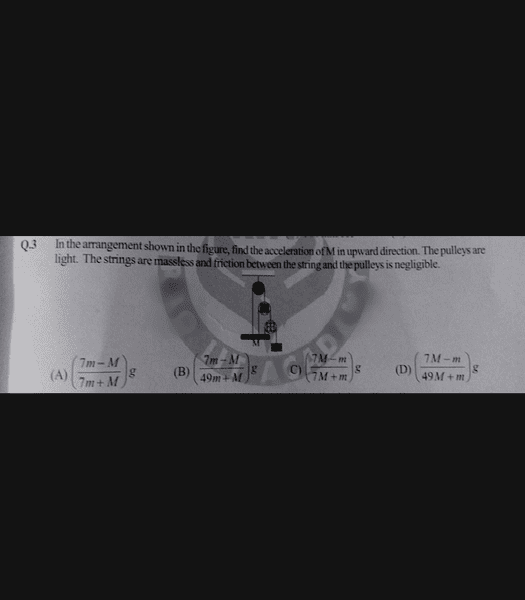
In the arrangement shown in the figure, find the acceleration of M in upward direction. The pulleys are light. The strings are mass less and friction between the string and the pulleys is negligible.
hfDg9GZ.png


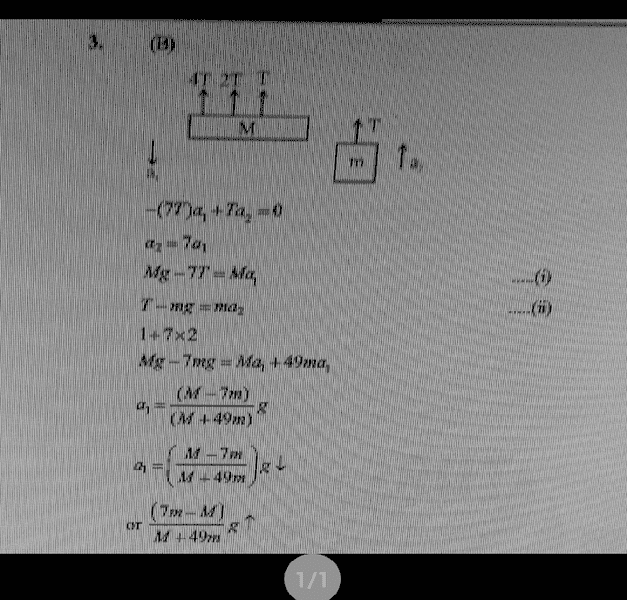
The options are given. The final answer is (B) and this was the solution:
GStiDpp.png


I don't understand the 1+7x2 step right there.
Also I fail to understand why there is 49m in the denominator of the solution instead of 7m (I'm assuming the equation is multiplied by 7. I might be wrong though.)
Can anyone explain me the solutions please? Thanks.

P.S.: Sorry about the low quality images, it was in a kind of jiffy.
 
Physics news on Phys.org
The solution makes more sense without the line "1+7*2". The line above it gets multiplied by 7 and then plugged into the equation above it.
 
I don't understand the purpose of '1+7x2' either...
 
mfb said:
The solution makes more sense without the line "1+7*2". The line above it gets multiplied by 7 and then plugged into the equation above it.

Even if equation (ii) multiplied by 7, the equation must be something like this: 7T - 7mg = 7ma2
So, on adding the two equations, 7T and -7T will get canceled out and the result will be Mg-7mg = Ma1 + 7ma1 ...(the acceleration is equal. therefore a1 = a2 .)
I don't understand where the 49ma1 comes from.
 
The accelerations are not equal.
 
mfb said:
The accelerations are not equal.
Then how come they changed ma2 to ma1 in the fourth last step?
That way, the step should be written as Mg-7mg = Ma1 + 7ma2 right?
 
MARK 42 said:
Then how come they changed ma2 to ma1 in the fourth last step?
They didn't, those are two different equations.
That way, the step should be written as Mg-7mg = Ma1 + 7ma2 right?
That is a possible way to write it.

Note the first two lines in the solution.
 
  • Like
Likes   Reactions: MARK 42
mfb said:
That is a possible way to write it.

Note the first two lines in the solution.

Oh, got it. Sorry, silly mistakes. Thanks you were really helpful.
 

Similar threads

  • · Replies 10 ·
Replies
10
Views
5K
  • · Replies 4 ·
Replies
4
Views
2K
Replies
13
Views
3K
  • · Replies 38 ·
2
Replies
38
Views
5K
  • · Replies 13 ·
Replies
13
Views
4K
  • · Replies 22 ·
Replies
22
Views
5K
  • · Replies 3 ·
Replies
3
Views
2K
  • · Replies 8 ·
Replies
8
Views
5K
  • · Replies 33 ·
2
Replies
33
Views
10K
  • · Replies 21 ·
Replies
21
Views
11K